


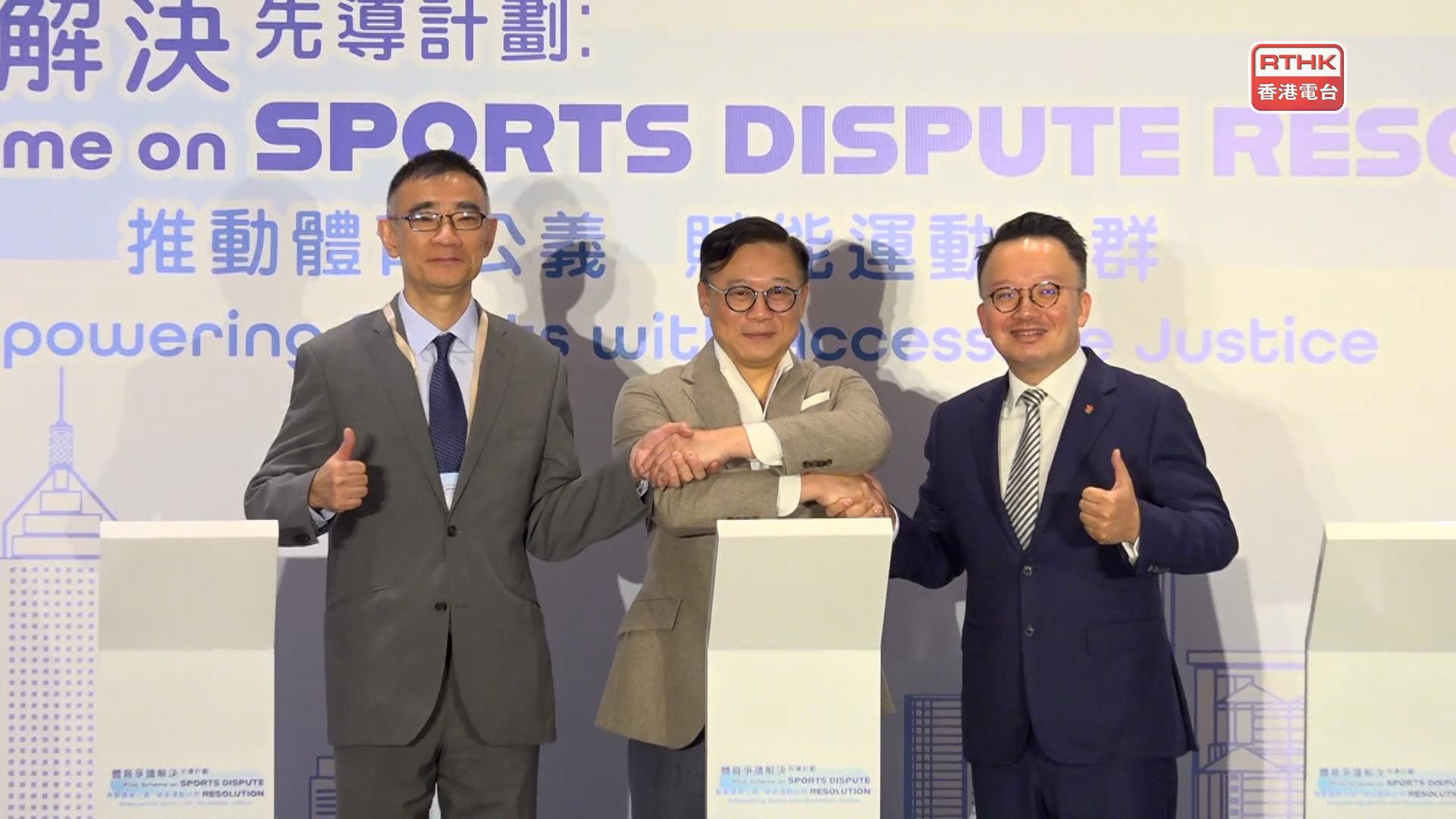
Hong Kong will start accepting sports dispute resolution cases in the first quarter of next year under the government's two-year pilot scheme.
At the scheme's launch ceremony on Thursday, Deputy Secretary for Justice Horace Cheung said dispute resolution would be a key infrastructure in sports development, saying sports organisations could benefit from the cost-effective and neutral proceedings.
Secretary for Culture, Sports and Tourism Rosanna Law said the scheme was important for the healthy and sustainable development of the local sporting industry.
"The disputes can be wide-ranging, from athlete competition eligibility, selection matters, competition ticketing and sponsorship, to broadcasting rights and organisation governance," she said.
"Disputes that involve athletes could have a major impact on their professional careers.
"It is therefore paramount for sporting development to establish a mechanism that can effectively resolve disputes and cater to the needs of the sector."
The scheme's operator is the Asian-African Legal Consultative Organization's Hong Kong Regional Arbitration Centre, whose director is the legal sector's lawmaker-elect Nick Chan.
It's tasked with coming up with specific mediation and arbitration rules and fees, as well as recruiting and appointing mediators and arbitrators.
Chan said the scheme welcomed cases that are not just local but international as well.
It is supported by government funds, with his centre taking money for basic operational costs.
However, Chan said, it wouldn't be possible over the long run for professionals to serve for free.
eBRAM International Online Dispute Resolution Centre, chaired by another legislator-elect, Thomas So, will provide technical support services for the pilot scheme.
Kenneth Fok, vice president of the Sports Federation and Olympic Committee of Hong Kong, China, said some local disputes had been taken to the Court of Arbitration for Sport in Switzerland in the past.
"To put it bluntly, the result of those cases might not be satisfactory, but the process was time-consuming and costly in terms of money," he said.
"The handling severely harmed both parties involved in the dispute, and it was not good for the development of the sport concerned."
Fok expressed the hope Hong Kong could help adjudicate disputes involving major commercial interests, much like the Lausanne-based court does for big football clubs.
Dispute resolution gets kick-start with sports pilot
2025-12-11 HKT 14:05
Share this story


