


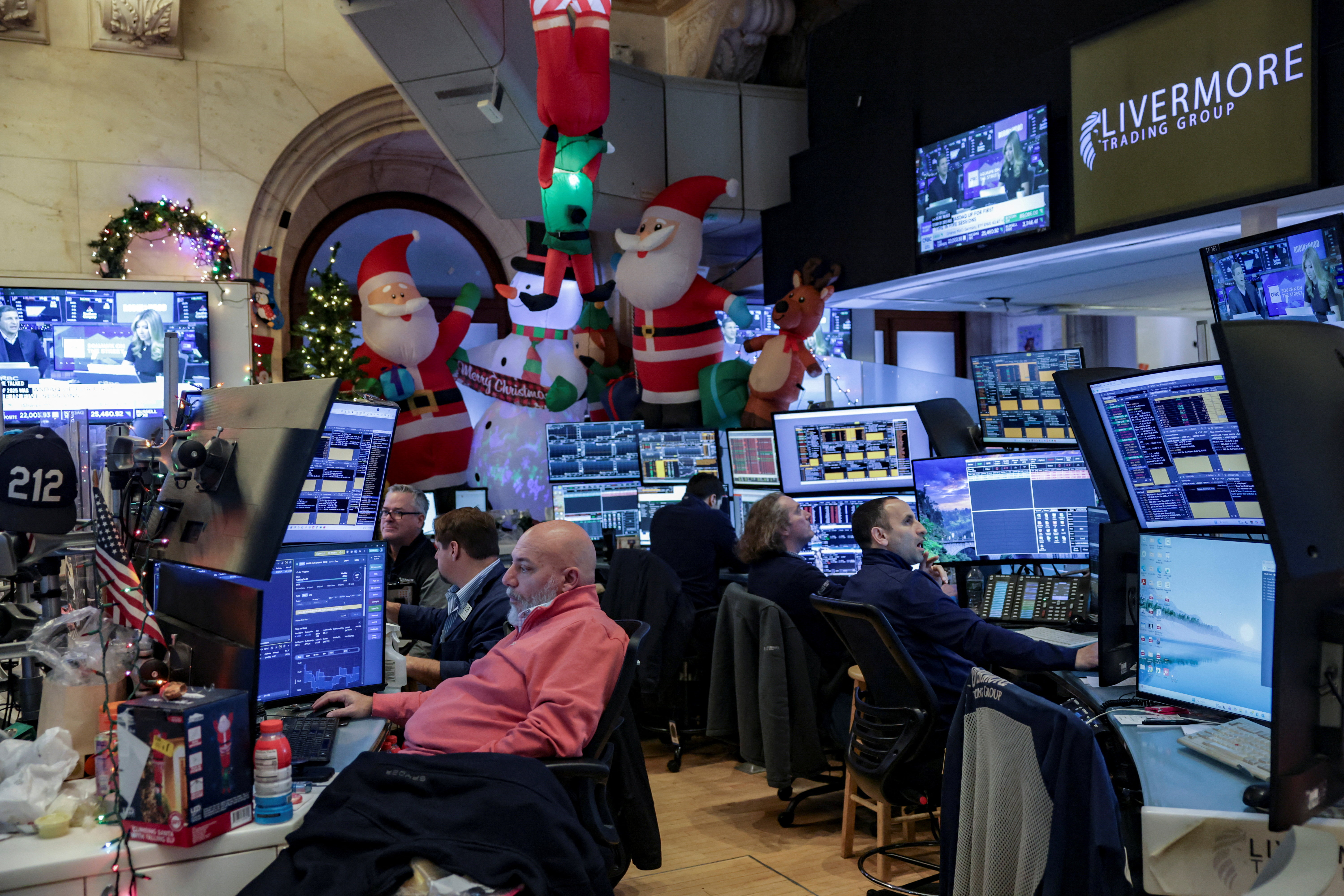
The Dow and S&P 500 indexes ended the trading week higher, starting the new year by snapping a four-day losing streak, helped by gains in chip makers Nvidia and Intel as well as Boeing.
In 2025, the Dow, the S&P 500 and the Nasdaq all notched double-digit gains, their third straight year in the green, a run last seen during 2019-2021.
Chip stocks provided a boost on Friday, with the Philadelphia SE Semiconductor index up 4 percent. Industrials and utilities also gained. Caterpillar and Boeing rose 4.5 percent and 4.9 percent, boosting the Dow.
While chip stocks rallied, several market heavyweights such as Apple and Microsoft fell to keep gains in check on the S&P 500 and Nasdaq.
The S&P 500 and the Nasdaq were also pressured by losses in consumer discretionary stocks including Amazon. Tesla also slid 2.6 percent after annual sales fell for a second year.
The Dow Jones Industrial Average rose 319 points, or 0.66 percent, to 48,382, the S&P 500 gained 12 points, or 0.19 percent, to 6,858 and the Nasdaq Composite lost six points, or 0.03 percent, to 23,235.
Joe Mazzola, head of trading & derivatives strategist at Charles Schwab, said the market was seeing a "buy the dip, sell the rip," trading mentality – where investors profit from short-term market volatility by timing entry and exit points.
"But I do think that investors might be a little bit more conscious about some of the valuations that they're paying for some of the AI plays," he said.
"At the same time when they do get the opportunity to buy in [during] a pull back, they just continue to do that. I don't see that stopping anytime so."
Smaller stocks, which have struggled in recent days, also rallied and the Russell 2000 rose 1.1 percent to snap a four-day streak of declines.
Recent selling had dashed expectations for a "Santa Claus rally" in which markets tend to get a late boost over the last five trading days of December and the first two of January, according to the Stock Trader's Almanac.
The Federal Reserve's monetary policy trajectory will set the tone for global markets in 2026, after recent economic data and expectations of a new dovish Fed chair prompted investors to price in further reductions.
"The next Fed chair is probably going to be much more dovish than Jerome Powell. So I would imagine that we actually see in the second half of this year that interest rates go down substantially," said Dennis Dick, chief market strategist at Stock Trader Network.
"And that's going to be good for all stocks, not just tech stocks."
A key highlight for January will be next week's labor market data, especially after Powell, at the central bank's December meeting, cautioned against further interest rate cuts until there was more clarity on jobs. (Reuters)
Chip plays help Dow and S&P 500 end losing streak
2026-01-03 HKT 10:37
Share this story


