


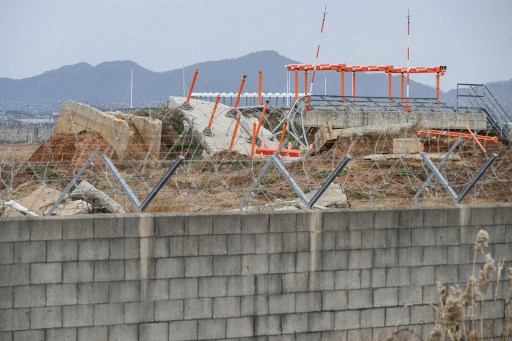
All 179 people killed when a South Korean flight crashed in December 2024 would have survived had there not been a concrete structure at the end of the runway, a simulation showed on Thursday.
Jeju Air Flight 2216 was coming in to land at Muan International Airport from Thailand when it struck a flock of birds and was forced to make a belly landing.
Bystander footage showed the pilots were able to bring the plane down before it collided with a concrete barrier, known as a localiser, at the end of the runway and burst into a fireball.
The crash killed everyone on board except for two flight attendants seated in the tail section.
The presence of the concrete structure, housing a radio antenna system and used to help planes navigate landings, sparked outrage and protests from victims' families.
International aviation safety guidelines say such navigation facilities should be made of frangible, or breakable, materials.
The government-commissioned simulation concluded that all passengers would have survived with only minor injuries, according to opposition lawmaker Kim Eun-hye, who released the findings.
"If the guidance facility at Muan Airport had been supported by a frangible structure, the aircraft would likely have breached the perimeter fence, and the resulting impact would not have been severe enough to cause serious injuries," the simulation report said.
"The impact sustained by the aircraft during its ground slide was not of a magnitude sufficient to cause serious injuries," it said.
The aircraft "would have slid for approximately 770 metres before coming to a stop" had the runway been free of obstacles, the study found.
The localisers damaged in the crash were still standing at the end of the runway when AFP visited the site in December, while what appeared to be fragments of concrete slabs lay strewn across a nearby field.
Lee Hyo-eun, whose 24-year-old daughter was killed, said the findings confirmed the families' "long-held suspicions".
"For a long time, we believed that everyone could have survived -- including my daughter -- had there not been a concrete structure at the end of the runway," she said.
"This finding only deepens our grief, knowing that those lives could have been saved." (AFP)
Jeju Air disaster could've been averted: simulation
2026-01-08 HKT 22:23
Share this story


