


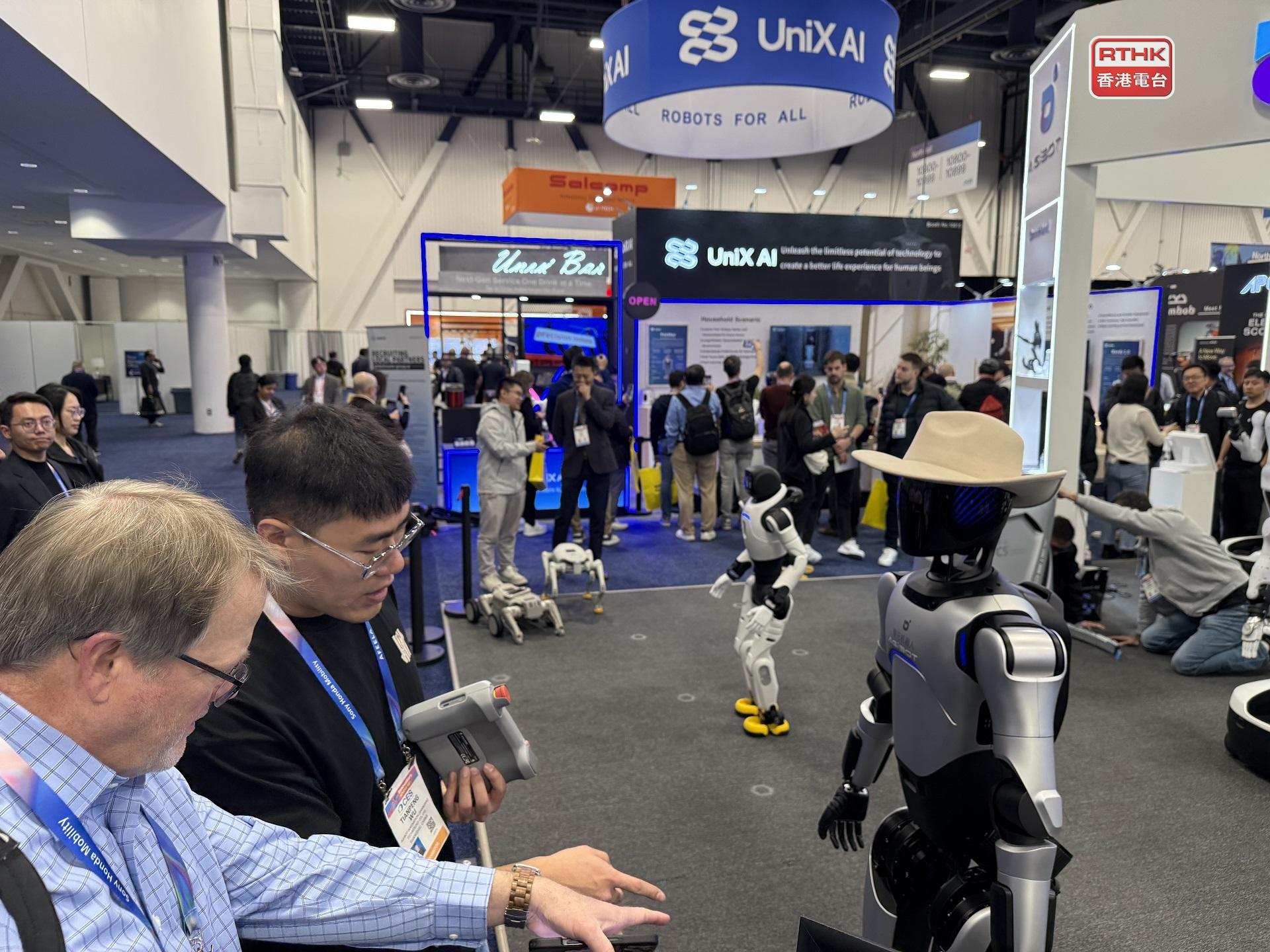


Chinese startups once again took centre stage at the annual Consumer Electronics Show in Las Vegas, showcasing a range of artificial intelligence applications while the event's organiser called for the easing of trade barriers to facilitate innovation.
Hong Kong firms also made a splash at CES, the world's largest trade fair of personal electronics which wrapped up over the weekend. Over 4,100 exhibitors from over 155 countries and regions took part this year, including some 900 from China.
The industry's biggest players also came with major announcements. Nvidia CEO Jensen Huang unveiled a new platform for autonomous driving called Alpamayo, which will help self-driving cars deal with difficult situations.
"It tells you what action it's going to take, the reason by which it came about that action, and then of course, the trajectory," he said during the company's keynote.
That of course is all due to AI, which seemed to be integrated into almost everything.
That ranged from Chinese company Roborock's vacuum that uses legs to navigate stairs, to an AI-powered fridge introduced by Changhong, a home appliance giant from Sichuan.
The company's spokeswoman told RTHK that the fridge features a drawer that keeps meat fresh for 33 days.
Walking across the show floor, it was hard not to see a Chinese company as they impressed attendees with everything from smart glasses to humanoid robots.
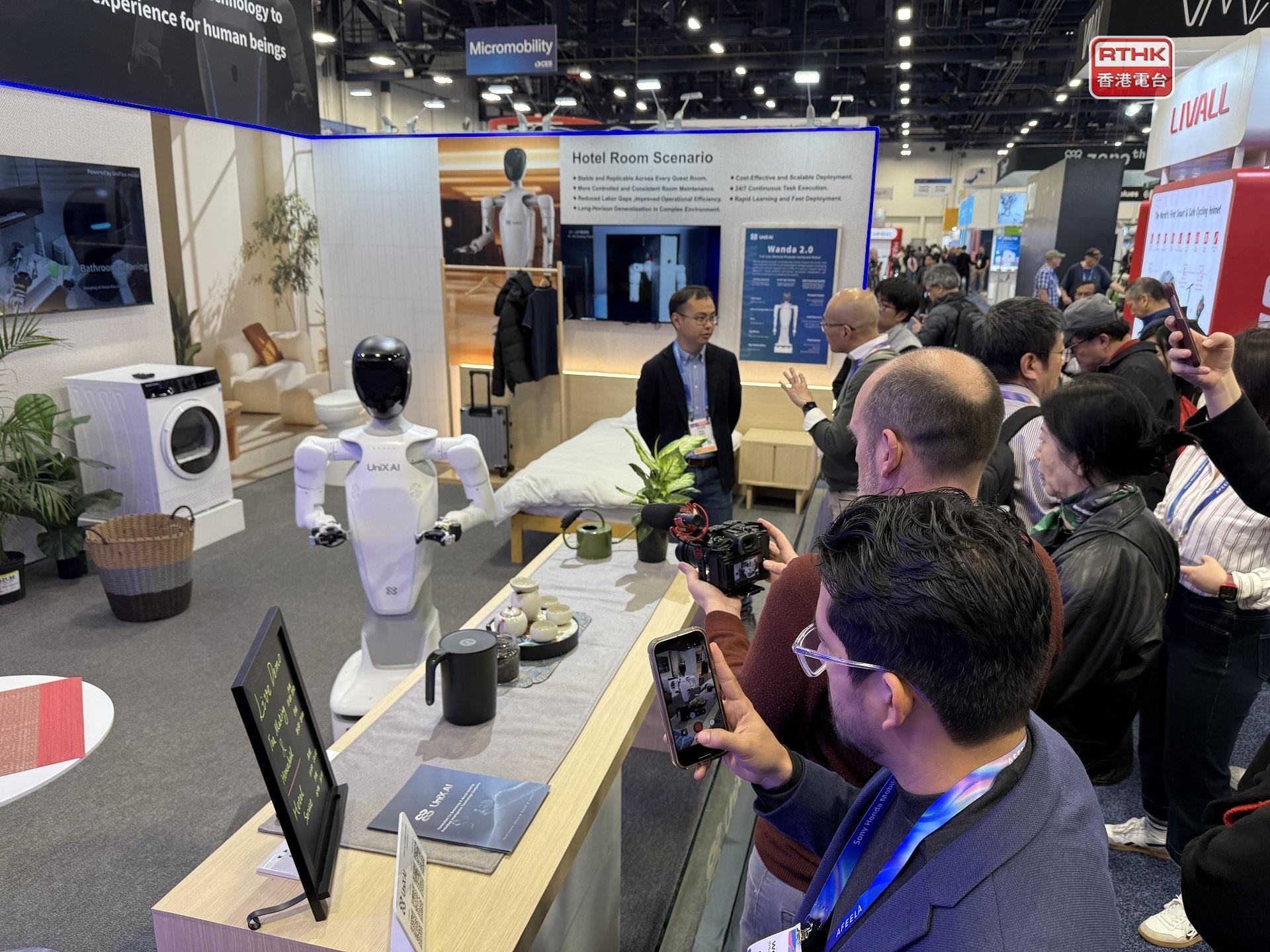
But it was UniX AI, founded in 2024 in Suzhou, that stood out. Its household robot Wanda demonstrated its ability to tackle a range of chores, from making a bed, to pulling out clothes from the washer, and even pouring tea.
CEO Fred Yang says UniX AI delivers between 100 to 150 Wanda robots every month to real world environments, primarily in China. The company is now keen to expand its business overseas.
"For now, [the robot] can already, finish like 50 [percent] to two-thirds of whatever the cleaner in the hotel can already do," he proclaimed.
"And for efficiency, that's around two-thirds of the real human being's efficiency."
Hong Kong representation was also strong. The Hong Kong Science and Technology Parks Corporation and the Hong Kong Trade Development Council led a delegation of 61 companies to the show.
Hong Kong entrepreneur Ricky Chan, co-founder of Xoxo Beverages, showcased his smart cocktail and coffee dispenser that can mix drinks with up to 15 ingredients – and serve it up in 20 seconds.
It is also equipped with AI.
"The agentic AI, what it looks like, it's like a digital human like me inside your phone and then you can do a conversation with me, and then you can tell me your flavour or your mood, and then the agent will know the man inside this machine and then tell you what's fit for you automatically," he explained.
Chan said he will follow up on conversations he has had with attendees, and hopefully secure more international clients.
"It's quite like, energetic the people. And they will give you some valuable comments on our new model because the aim for us who came to CES is to get the market feedback from all over the world."
CES Show Director John Kelley said a key purpose of the show is to facilitate global deals, adding tariffs bring only harm and no good.
"Businesses need certainty. They need clarity. And I think when you see these shifts and changes that have happened over the course of the last year or so, it just provides more uncertainty for businesses," he said.
"So we are pleased to see that President Xi Jinping and US President Donald Trump seem to have a more positive dialogue...We're hoping that tariffs and barriers to trade either lessen or become eliminated."
From appliances to robots: Chinese firms evolve at CES
2026-01-12 HKT 10:46
Share this story


RTHK's tech correspondent Mark Niu reports from Las Vegas

