


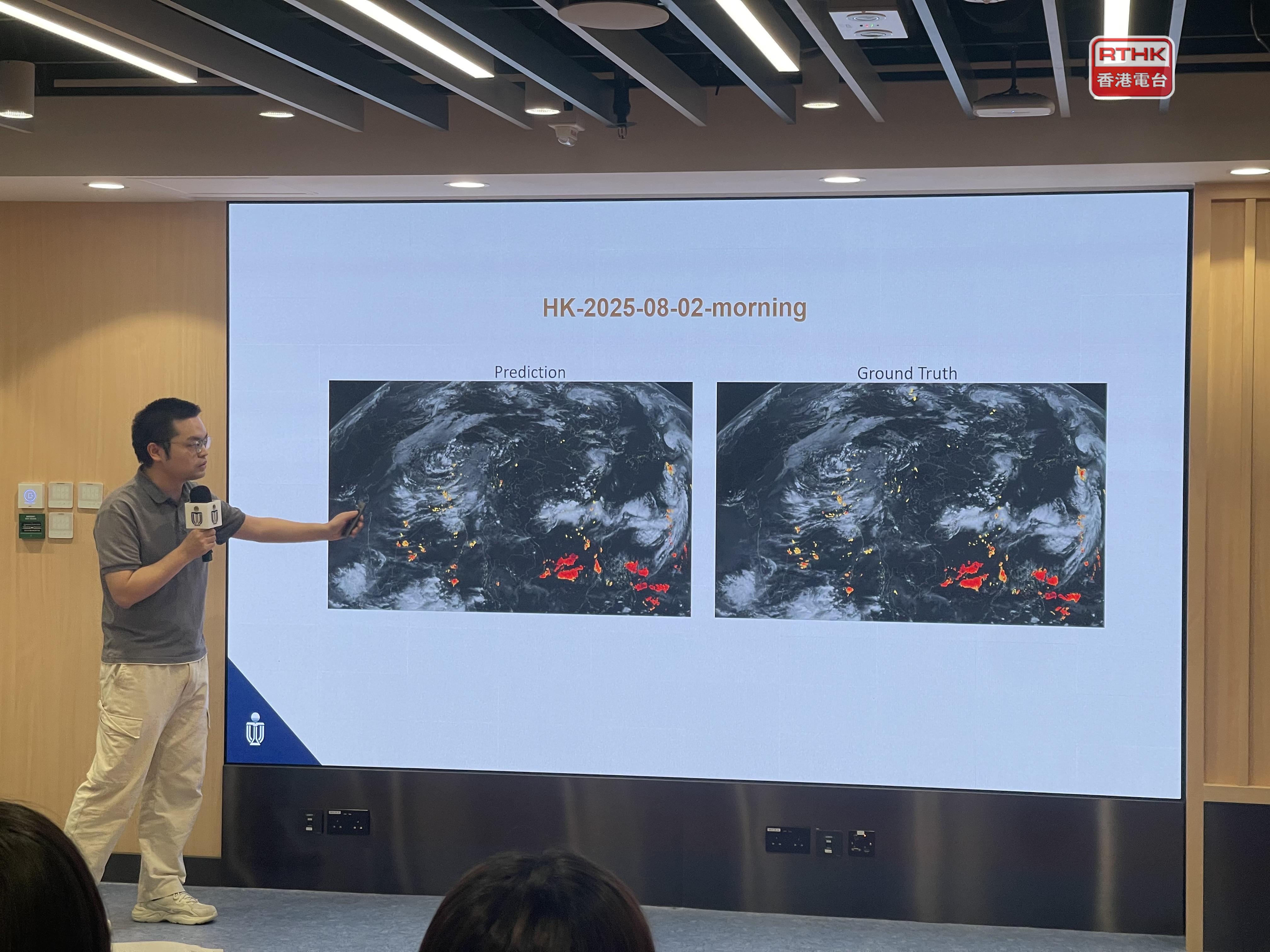
Researchers from the Hong Kong University of Science and Technology (HKUST) have developed a new AI model that improves weather forecast accuracy by more than 15 percent and can predict inclement conditions up to four hours ahead.
Using past datasets, the model generates more accurate forecasts, within two to four hours of the event happening, which gives people more time to prepare for adverse weather.
HKUST Professor Su Hui explained that existing AI forecast models do not have sufficient spatial scales for smaller cities like Hong Kong.
She added that forecasts by conventional numerical weather prediction models, which use equations based on physical laws such as fluid motion, are often limited to windows of between 20 minutes and two hours in advance, leaving little time to prepare for extreme weather conditions.
One of the study's main authors, Dai Kuai, said their new model is more accurate than conventional ones.
"Our model is quite different from foundational models, such as Pangu or GraphCast... it utilises generative techniques from computation."
Professor Hui also said there is an ongoing collaboration between her team and the Hong Kong Observatory (HKO).
"They (HKO) actually have access to this newly-built model, so they are actually implementing the scheme in their operational forecasts."
She predicts it will take a couple months before the model can be used in the public sphere.
"I hope maybe by the summer we will have something that is more concrete, and can actually show improvements in operational forecasts."
New AI model to help with weather forecasts
2026-01-28 HKT 16:18
Share this story


Dai Kuai speaks to Natasha Ho

