


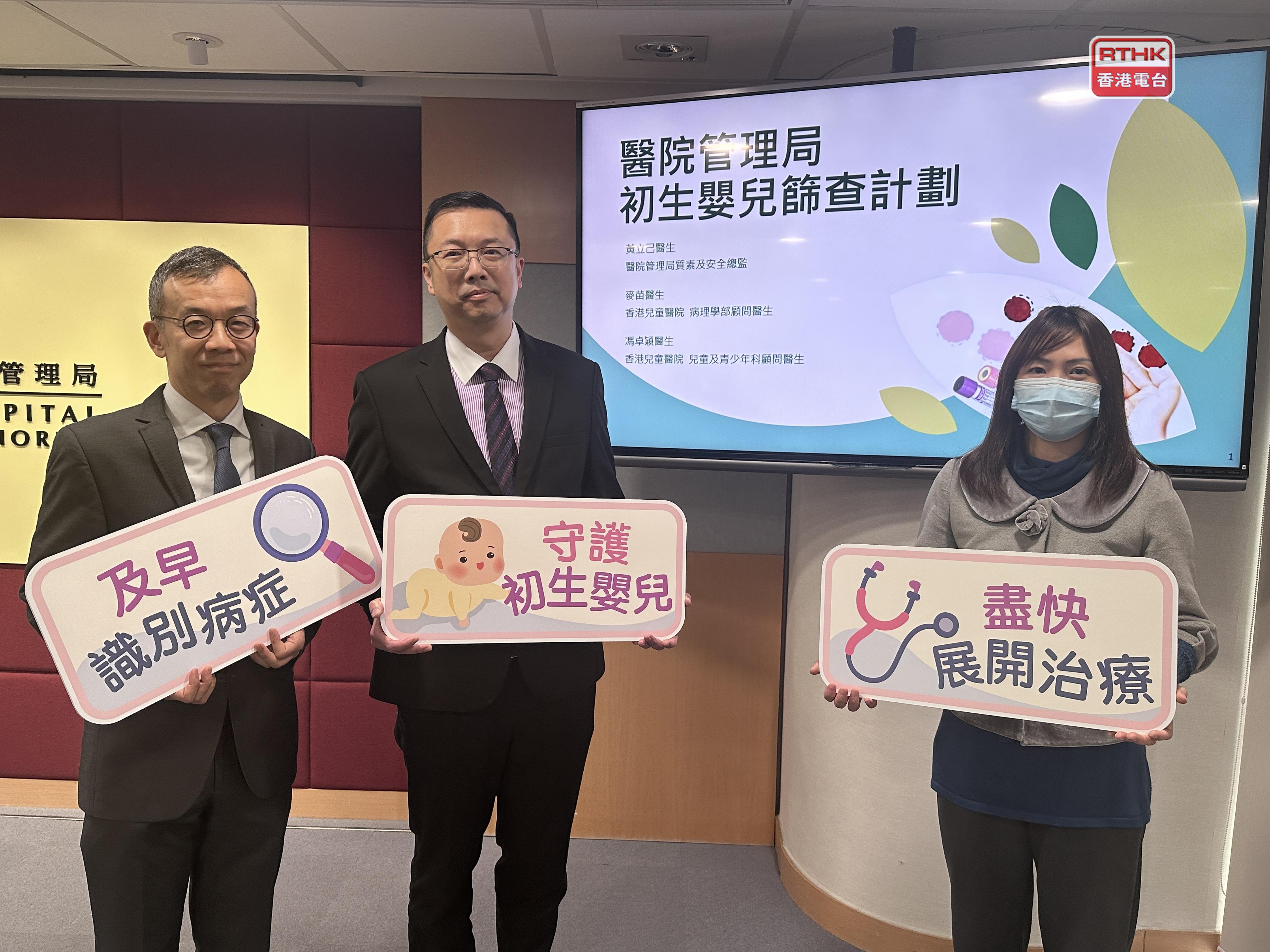
The Hospital Authority on Monday said it hopes that all private hospitals will join its newborn screening programme for rare genetic conditions.
The test takes a few drops of blood from the newborn’s heel between 24 and 72 hours after birth.
The sample is then sent to a laboratory at the Hong Kong Children’s Hospital for analysis to detect inherited metabolic disorders that may not show symptoms at first but can cause serious problems if left untreated.
The programme already covers newborns at all eight public birthing hospitals and was extended to two private ones last year.
The screening is provided free of charge by the government as long as one parent is an SAR resident.
Since 2020, more than 100,000 babies have taken the screening test and around 40 of them were found to have conditions requiring follow-up care, according to the Hospital Authority.
Dr Michael Wong, director of quality and safety at the Hospital Authority, stressed the importance of including all newborns in the programme, even if it means subsidising “richer parents” who give birth at private hospitals.
“Some parents actually think that the cost isn't worth the risk, because for an individual parent, the risk is very, very small for the baby to have such a disease. But for the whole Hong Kong, you could see that each year we will have at least a few babies who have these problems,” he said.
“Because of the serious illness or disability, they need to be cared for by our public healthcare system. So it creates an extra burden for the public healthcare system.”
A consultant at Hong Kong Children’s Hospital, Dr Fung Cheuk-wing, explained that newborns can recover well if conditions are detected early.
“From the metabolic disease point of view, we call it inherited metabolic disorder, and the commonest one is called citrin deficiency,” he said.
“And the good thing is after we pick up these patients from the newborn screening, then we can start some relatively simple treatment.
“For example, these kids cannot tolerate a high-carbohydrates diet, and that's why we need to switch to another milk formula, with lower carbohydrates but with higher fat content.
“With the switch of the formula and with regular follow-up, the outcome is really [good].”
Private hospitals should join newborn screening: HA
2026-02-02 HKT 17:57
Share this story


Dr Michael Wong speaks to Elvis Yu

