


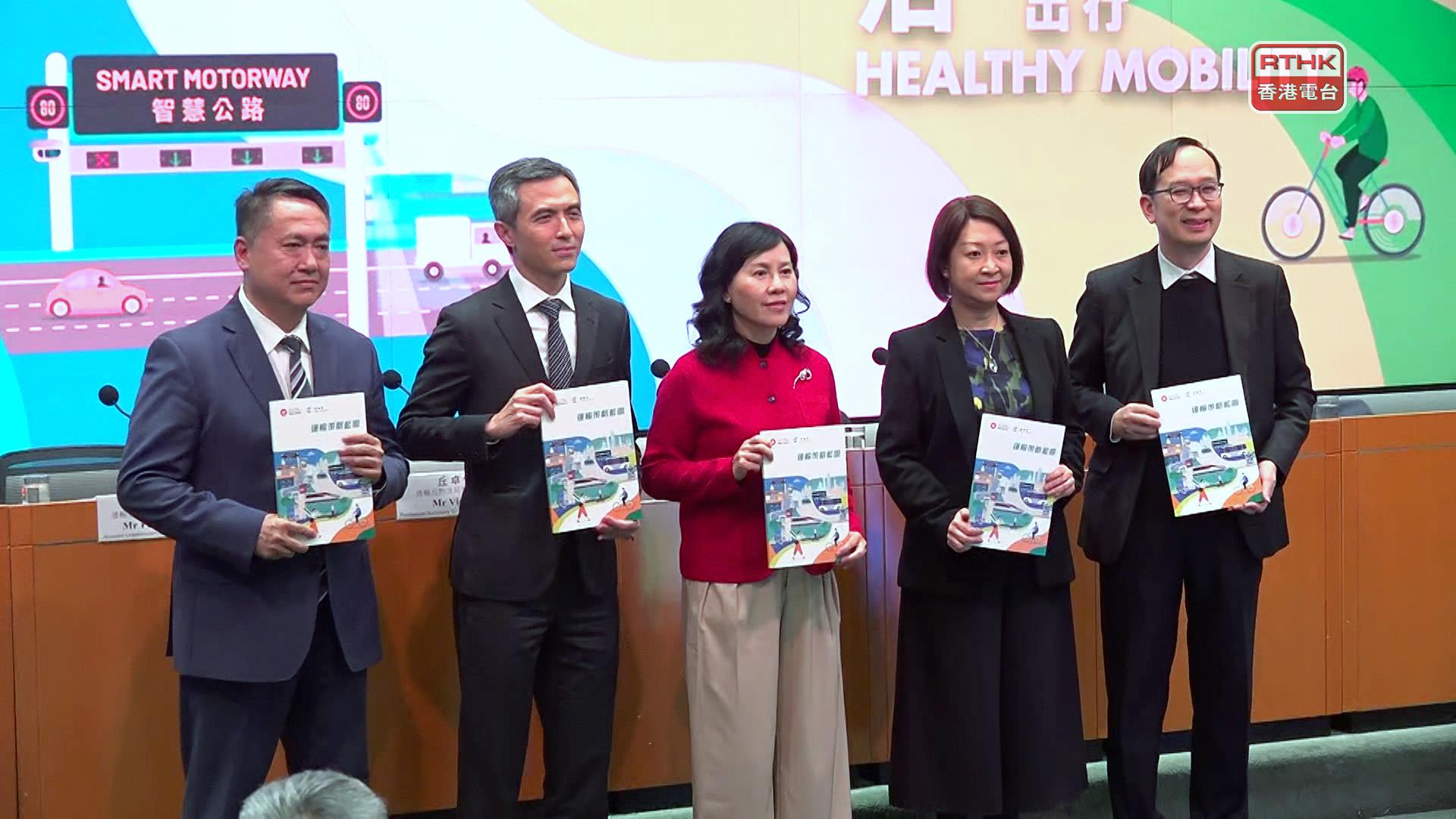
The government on Friday unveiled a new blueprint outlining Hong Kong’s transport strategy for the next two decades.
The plan is built around three main themes: “Enjoyable Journeys”, “Well-Connected City”, and “Healthy Mobility”, along with six key strategies and 25 recommendations.
As part of the blueprint, the entirety of Route 6, under the “Eight Vertical and Eight Horizontal Corridors” rail and road infrastructure layout, will be opened later this year.
There are also plans to build transport interchange hubs at strategic locations, such as Hung Shui Kiu, San Tin and Hung Hom.
On autonomous vehicles, the Commissioner for Transport will chair a working group to develop a roadmap for the broader application of the technology.
The blueprint also aims to bring forward the first batch of licensed ride-hailing platforms into operation in the fourth quarter of this year.
Transport secretary Mable Chan said authorities were working to ensure the plans were completed successfully.
“When we are ready with the whole package, we will of course consult the current term Legco. That will form a basis for us to take forward the various necessary legislative amendment exercise so that we can regulate the licensing for drivers, ride-hailing platforms, as well as vehicles,” she said.
The government is also studying ways to expand cross-harbour traffic capacity and regularise more than 20 drone projects to promote the low-altitude economy.
By the end of the year, the government aims to add over 12,000 car parking spaces to increase supply and will also launch a study on future demand and supply of car parks.
To improve the pedestrian environment, diagonal crossings at 15 suitable junctions across Hong Kong, including near Tseung Kwan O and Shek Mun stations, will be implemented from this year.
The blueprint also mentions plans to submit an amendment bill to Legco this year to introduce regulatory arrangements on the use of electric mobility devices.
The transport minister also said the government plans to expand the "Southbound Travel for Guangdong Vehicles" scheme which allows cars from Guangdong into Hong Kong.
"So far, I think it has been implemented safely, smoothly. While there were a few teething issues at the very beginning, we have actually worked very quickly to step up various measures on road safety," she said.
"Our current task will focus on the existing four cities in Guangdong Province. And so far, I think the demand and the booking figures are picking up and are steady, and we will monitor it closely in order to enable ourselves to accumulate more experience in order to scale up this scheme."
She added the government would work towards the mutual recognition of commercial vehicle licences for drivers in Hong Kong, Guangdong and Macao by next year.
HK unveils Transport Strategy Blueprint
2026-02-06 HKT 17:44
Share this story


