


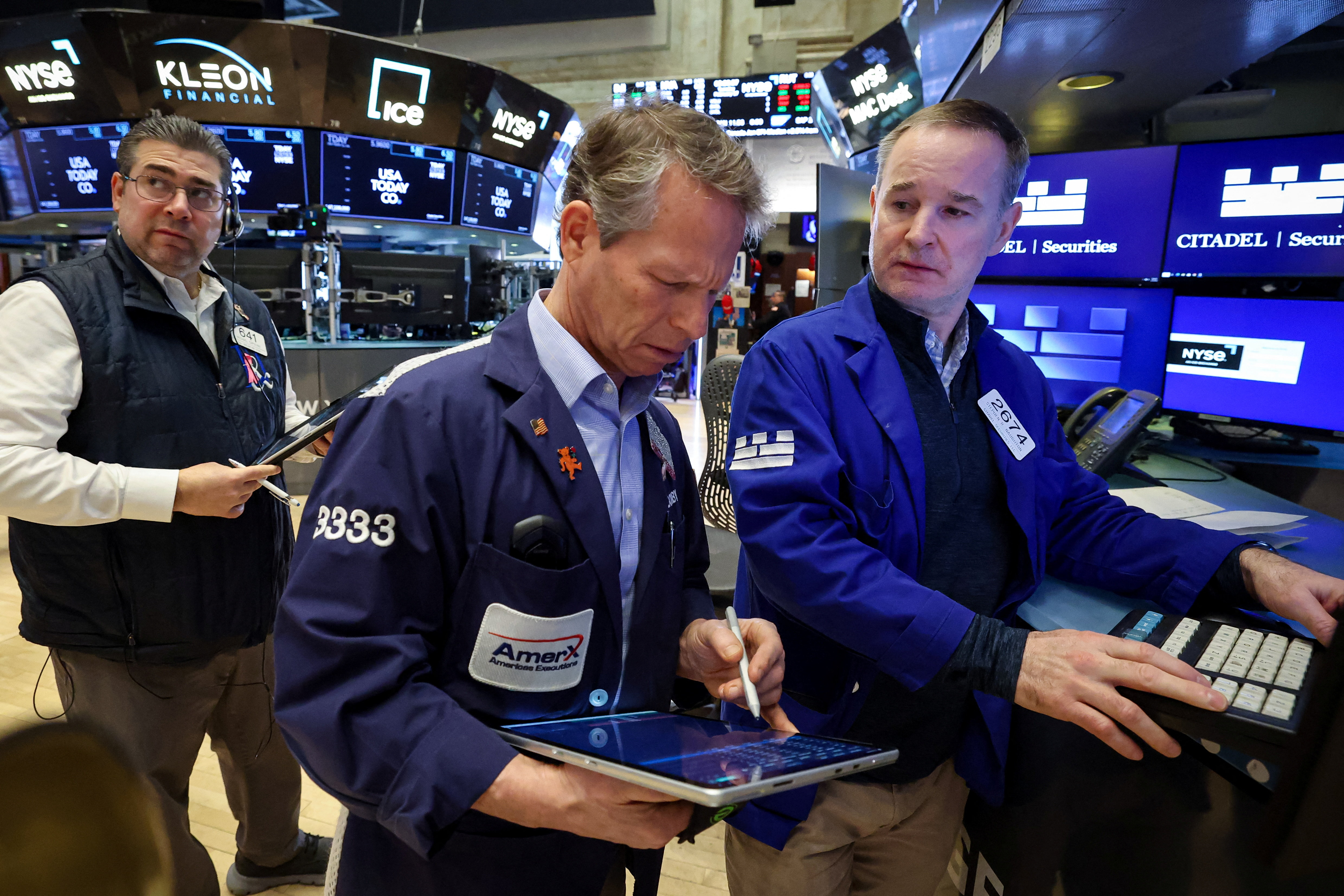
Wall Street stocks eked out nominal gains overnight as investors continued to wrestle with the pros and cons of the artificial intelligence boom, while gold slid and crude dipped as nuclear talks progressed between the United States and Iran.
In Asia, the 225-issue Nikkei Stock Average opened up 167 points, or 0.3 percent, at 56,734.
By late morning, the gains strengthened, sending the index up 648 points, or 1.15 percent, to 57,215.
The three main US stock indexes gyrated throughout the session, with the recent tech selloff prompting some bargain hunting, while the dollar gained strength and gold slipped to a one-week low.
The Dow Jones Industrial Average rose 32 points, or 0.07 percent, to 49,533, the S&P 500 rose seven points, or 0.1 percent, to 6,843 and the Nasdaq Composite rose 31 points, or 0.14 percent, to 22,578.
Worries that companies are over-investing in AI and the extent to which the nascent technology could disrupt labour markets have been contributing to investor jitters in recent weeks.
"The conversation about AI rose to the top of market concerns about two weeks ago, regarding the negative effect on employment in a broad variety of industries, and it's continuing," said Peter Tuz, president of Chase Investment Counsel in Charlottesville, Virginia.
"There's a lot of validity in that AI will result in less demand for certain types of workers. It clearly has affected the tone of the market over the last couple of weeks."
Federal Reserve governor Michael Barr said that "there might be serious short-term disruptions in the labor market" attributable to AI, even if the long-term gains to society could be quite favourable.
Turning to the subject of monetary policy, Barr said that the next interest rate cut might not occur "for some time" amid risks to the United States' inflation outlook.
San Francisco Fed president Mary Daly said the central bank must get inflation down, and that slightly restrictive monetary policy is crucial to making that happen.
The United States and Iran have reached an understanding regarding the "guiding principles" in continuing negotiations over their nuclear dispute, while a deal is not necessarily imminent, according to Abbas Araqchi, Iran's foreign minister.
"It's an optimistic starting point," Tuz added.
"It's way too early to tell, but the fact that they're talking and haven't gotten more aggressive is positive."
European stocks rallied, boosted by financials and healthcare stocks, while investors kept an eye on geopolitical developments and continued to assess the extent to which AI could reshape business models. (Reuters)
Edited by Tony Sabine
Wall St ekes out gains amid bargain hunting
2026-02-18 HKT 11:09
Share this story


