


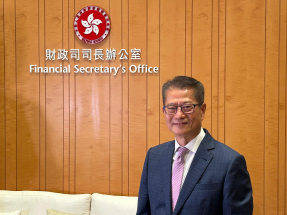
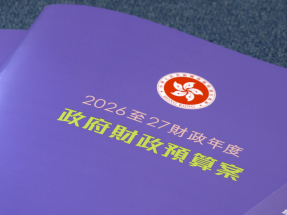
Financial Secretary Paul Chan on Wednesday said Hong Kong would raise stamp duty for residential property transactions valued at HK$100 million or more to up to 6.5 percent, in a bid to raise additional revenue.
Currently, the stamp duty stands at 4.25 percent.
For transactions between HK$100 million and HK$109.57 million, the new rate will be HK$4.25 million plus 30 percent of the amount above HK$100 million, reaching 6.5 percent for deals worth more than HK$109.57 million.
This would affect about 0.3 percent of the overall residential property transactions, but was estimated to bring in extra revenue of HK$1 billion each year.
The measure would take retrospective effect on Thursday upon passage of an amendment bill by Legco.
Chan pledged the government would make available land for the production of 98,000 private sector flats over the next five years, as authorities aim to sell nine residential plots in the coming fiscal year.
However, there will be no commercial sites up for sale in the coming year — given the high vacancy rates among non-residential properties, he added, which marked the second year that the government has suspended commercial land sales.
In his budget speech, Chan noted the upcoming new residential plots, when coupled with the MTR Corporation's property development projects, schemes from the private sector, as well as projects and initiatives from the Urban Renewal Authority, would together provide some 22,000 units this year.
"I would like to emphasise that, for the steady development of the market, the specific land sale arrangements will be announced on a quarterly basis after careful consideration of market conditions and other relevant circumstances," Chan said.
He also noted the potential supply of new private flats for the coming three to four years would be about 104,000 units.
He also estimated that an average of 17,000 private units would be completed each year over the coming five years, representing a drop of eight percent compared to the annual average seen in the past five years.
On public housing, he noted that total production would reach around 196,000 units in the coming five years, taking into account the temporary homes under the Light Public Housing Scheme.
Separately, Chan added that the Hong Kong Investment Corporation (HKIC) would collaborate with regional and global long-term capital to invest in high-quality commercial property projects that align with the city's industrial positioning.
Edited by Tony Sabine
Govt to raise stamp duty on luxury home sales: FS
2026-02-25 HKT 13:58
Share this story


Damon Pang reports


2026-04-29 HKT 14:47
2026-04-22 HKT 15:59
2026-04-14 HKT 21:39
2026-03-08 HKT 12:28
2026-03-01 HKT 13:41
2026-03-01 HKT 13:30
2026-03-01 HKT 13:24
2026-02-28 HKT 15:30
2026-02-28 HKT 13:51
2026-02-28 HKT 12:40
2026-02-27 HKT 19:13
2026-02-27 HKT 16:45
2026-02-27 HKT 16:26
2026-02-27 HKT 16:01
2026-02-27 HKT 12:56
2026-02-27 HKT 12:19
