


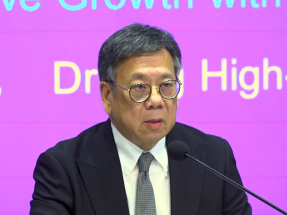
Finance chief Paul Chan on Wednesday revealed plans to transfer HK$150 billion from the Exchange Fund to support the development of the Northern Metropolis and other infrastructure projects.
He said in his budget speech the plan is to put the money into the Capital Works Reserve Fund over two fiscal years, after the Exchange Fund delivered a record-breaking investment income of HK$330 billion last year.
Chan stressed the planned transfer would be done on the premise that there would be no compromise on the Exchange Fund's function to maintain the stability and integrity of local monetary and financial systems.
"As at the end of last year, the total value of assets under the Exchange Fund exceeded $4.1 trillion, which would suffice to maintain monetary and financial stability in Hong Kong," the minister said.
Chan also announced plans to seek an initial capital injection of HK$10 billion from the legislature into the government-owned Hung Shui Kiu Industry Park Company, to help it hit the ground running by the middle of the year.
"[The company] will develop and operate around 23 hectares [of] industry land in Hung Shui Kiu through direct participation and public‑private partnership with a view to bringing in more industries in an accelerated manner," he said.
The minister noted that the first batch of site formation works for university land in Hung Shui Kiu, as well as the innovation and technology plots in the San Tin Technopole will be completed this year.
Further funding will be sought in the coming fiscal year for more site formation and infrastructure developments in the San Tin Technopole, Ngau Tam Mei, as well as building a government complex in Kwu Tung North, he added.
Chan went on to say that officials aim to introduce a bill dedicated to speeding up Northern Metropolis development in the middle of this year, as they plan to conduct a public consultation on the proposal shortly.
The project's supervision office, he added, will speed up large-scale private development through strengthened coordination and the imposition of time limits on the approval process.
Edited by Aaron Tam
Part of Exchange Fund to be used for infrastructure
2026-02-25 HKT 14:38
Share this story


Frank Yung reports


2026-04-29 HKT 14:47
2026-04-22 HKT 15:59
2026-04-14 HKT 21:39
2026-03-08 HKT 12:28
2026-03-01 HKT 13:41

2026-03-01 HKT 13:30
2026-03-01 HKT 13:24
2026-02-28 HKT 15:30
2026-02-28 HKT 13:51

2026-02-28 HKT 12:40
2026-02-27 HKT 19:13
2026-02-27 HKT 16:45
2026-02-27 HKT 16:26
2026-02-27 HKT 16:01
2026-02-27 HKT 12:56

2026-02-27 HKT 12:19
