


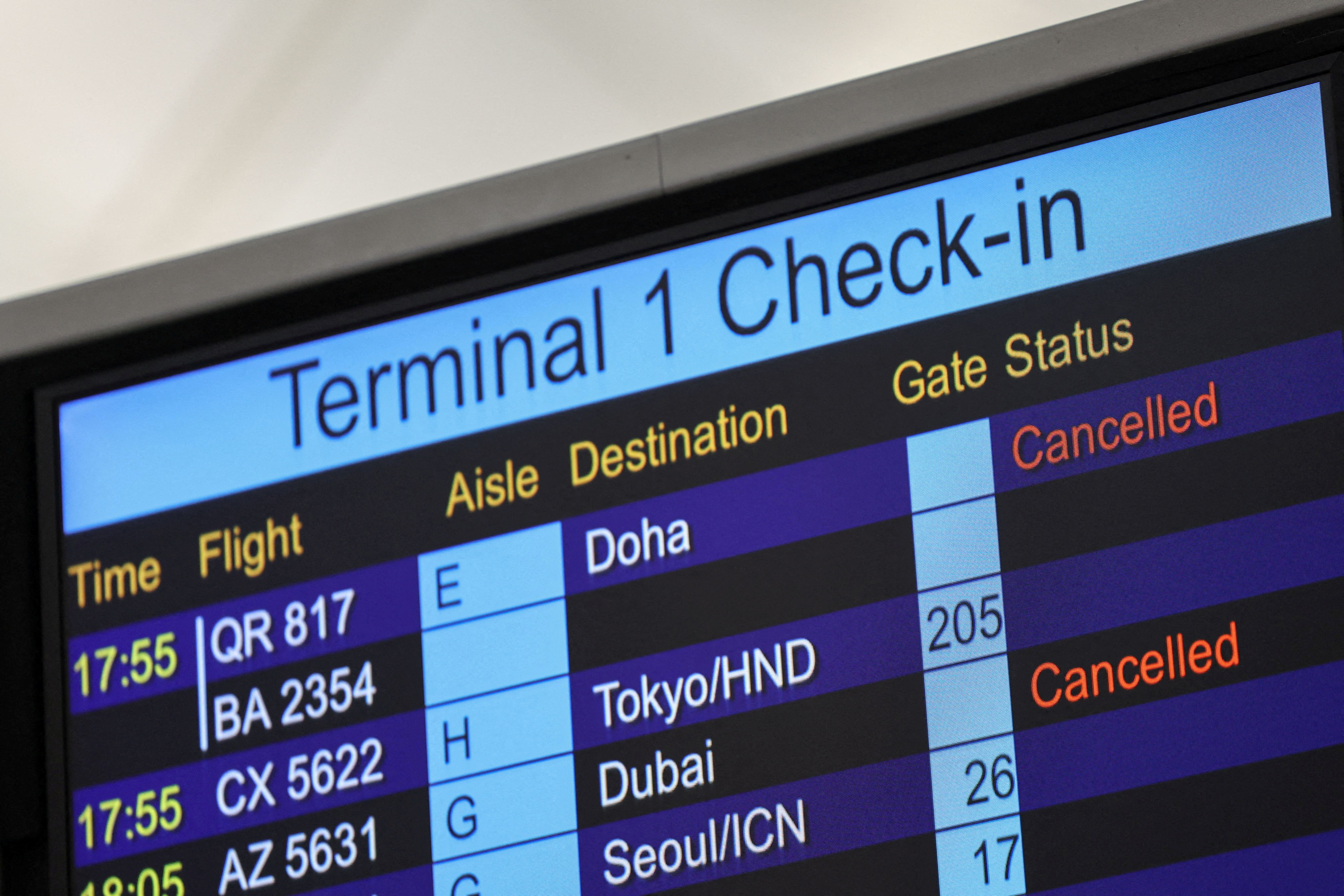
Asian airline shares remained under pressure on Tuesday as the US-Israeli attacks on Iran escalated, with carriers closely monitoring fuel price spikes and many seeing a surge in bookings as passengers switch from Middle Eastern airlines.
Cathay Pacific Airways shares were down more than 2 percent while Air China, China Eastern Airlines and China Southern Airlines all dropped between 3 percent and 5 percent in both the Hong Kong and Shanghai markets.
The CEO of Australia's biggest investment bank Macquarie Group, Shemara Wikramanayake, said on Tuesday the conflict appeared likely to affect the availability of oil, as well as the cost.
"There is going to be a deliverability issue there," said Wikramanayake, whose company is one of the world's largest traders of oil and gas.
Alternatives to Gulf airlines showed a surge in passenger bookings and ticket prices, checks of the carriers' websites showed.
A search on Cathay Pacific's website on Tuesday showed no available economy class seats on the Hong Kong-London route until March 11, with a one-way ticket on that day costing at least HK$21,158, falling to a more normal HK$5,054 later in the month.
For flights from Sydney to London, Qantas is not offering any economy class tickets on flights via its normal Perth and Singapore routings until March 17, when one is available for A$3,129 one way. For earlier dates, it has pricey options with non-traditional stopovers such as Los Angeles and Johannesburg.
Mainland airlines' websites showed air fares on China-UK routes have also surged far above normal levels, with economy seats largely unavailable on near-term departures.
A return economy ticket typically costs under 10,000 yuan, but Air China's only option for Wednesday is business class, with a one-way direct ticket priced at 50,490 yuan.
China Eastern is offering a Wednesday Shanghai-London ticket for 38,108 yuan, also in business class.
Economy seats reappear on Thursday, but prices remain several times higher than usual, with Shanghai-London at 25,808 yuan and Beijing-London at about 23,000 yuan.
Oil prices have surged amid the widening Middle East conflict, potentially driving up the cost of jet fuel and hurting airlines' profits.
Major Gulf hubs, including the world's busiest international airport Dubai, which usually handles over 1,000 flights a day, remained closed for a fourth day due to the conflict. That has left tens of thousands of passengers stranded as aviation faced its biggest test since the Covid-19 pandemic.
Qantas said last week that it had 81 percent of its fuel hedged for the second half of its financial year ending June 30.
Chief executive Vanessa Hudson said Qantas had "pretty good" fuel hedging in place but the spike in oil prices as the United States and Israel attacked Iran was significant for the aviation industry.
"We've got pretty good hedging in place, but these are pretty significant impacts on aviation and we're just continuing to watch how it all unfolds," she said at the Australian Financial Review's business summit as the airline's shares fell for a second day, trading as much as 3.9 percent lower.
Japan Airlines chief financial officer Yuji Saito said on Monday the carrier planned to adjust its fuel surcharge for international flights, but did not provide a timeframe.
In the domestic market "since there is no surcharge, we're offsetting part of the price spike through hedging," he said.
Japan Airlines shares were down 3.5 percent in early trading on Tuesday. (Reuters)
Edited by Thomas McAlinden
Asian region feels bite as fuel prices, fares soar
2026-03-03 HKT 11:24
Share this story


