


Stock markets across Asia were pummelled on Wednesday as investors began panic-selling on fears the Israel-US war on Iran would fan inflation and hammer the global economy.
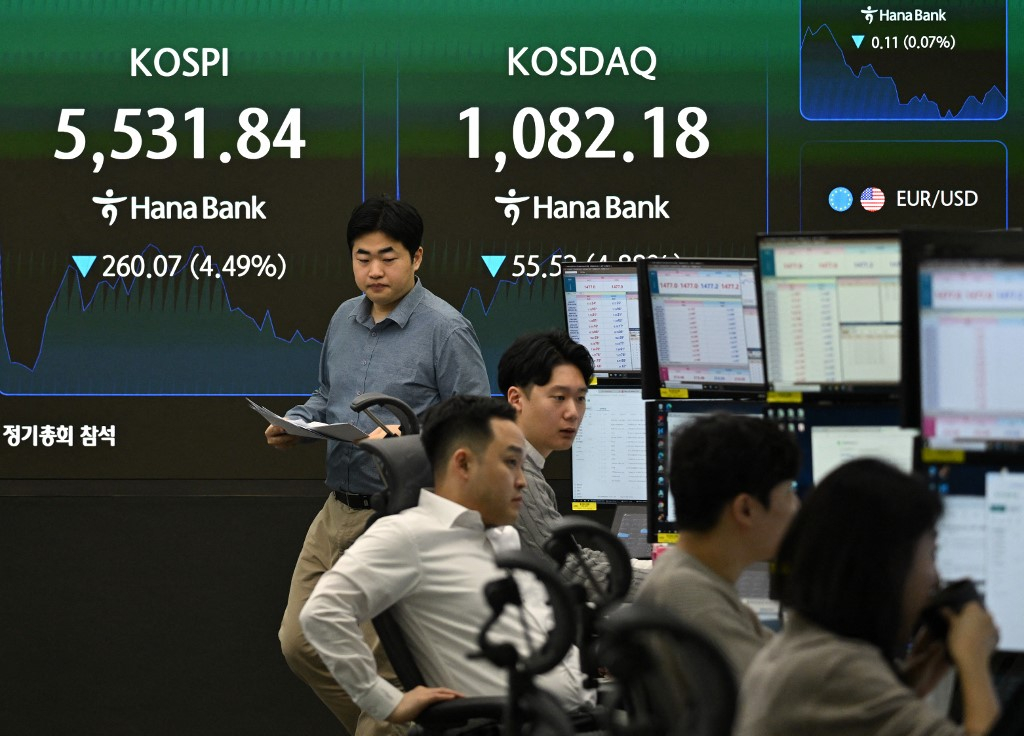
The bloodshed's impact on markets was felt most in Seoul, where the Kospi, which had soared to multiple record highs since the start of the year on the back of the AI tech boom, was sent reeling.
Trading on the index and Kosdaq was halted after they both sank more than eight percent, and when business resumed they extended losses.
The Kospi crashed more than 12 percent – after shedding more than seven percent on Tuesday – as panic-selling set in.
That left the index suffering its worst two-day collapse since 2008 during the global financial crisis.
It has also more than halved the near 50 percent gains enjoyed between the start of the year and Friday.
It rose 76 percent last year.
Chip giants Samsung and SK hynix, which have led Seoul's surge this year, dived 11.7 percent and 9.6 percent respectively.
Japan's Nikkei 225 ended off more than three percent, with chipmakers Advantest and Tokyo Electron losing more than four percent.
Hong Kong and mainland stocks also closed lower on Wednesday, led by oil and maritime shipping companies as investor sentiment remained dampened due to the Iran war.
China's blue-chip CSI300 Index ended 1.1 percent lower, while the Shanghai Composite Index lost one percent.
Hong Kong's benchmark Hang Seng Index hit a six-month low during Wednesday's session and finished two percent lower at 25,249.
The sell-off came as oil prices rallied more than two percent on the fifth day of attacks on the Islamic republic, with observers warning that the choking of supplies from the Middle East could fan inflation and shatter hopes for more interest rate cuts.
US President Donald Trump pledged that if needed, America's navy would escort oil tankers through the Hormuz Strait – through which about a fifth of global oil supplies flow – and ordered Washington to provide insurance for shipping.
On Wednesday Iran's Revolutionary Guards said the route was "under the complete control of the Islamic Republic's Navy".
Iranian strikes on its neighbours threatened to broaden the conflict, while uncertainty about how long the war would take added to upward pressure on crude prices, with both main contracts climbing around three percent on Wednesday.
Both main contracts have soared around 15 percent since Friday, before the attacks began.
Brent hit a high above US$85 a barrel on Tuesday and West Texas Intermediate topped out near US$88.
Some analysts warn they could soon hit US$100.
"Asian equities are now staring at a third consecutive day of losses and the reason is not mysterious," wrote Stephen Innes at SPI Asset Management.
"When crude edges higher, the invoice lands hardest in Asia, where imported energy is not just a line item but a structural dependency.
"Export-driven economies suddenly find themselves recalculating margins with a more expensive barrel sitting quietly in the background of every factory floor and shipping lane."
Chung Hae-chang, analyst at Daishin Securities, added: "Because South Korea, Japan, and China rely heavily on energy shipments that pass through the Strait [of Hormuz], any blockage would have significant negative effects on the market." (AFP/Reuters)
Edited by Tony Sabine
Asian equities in freefall over Mideast crisis
2026-03-04 HKT 16:57
Share this story


