


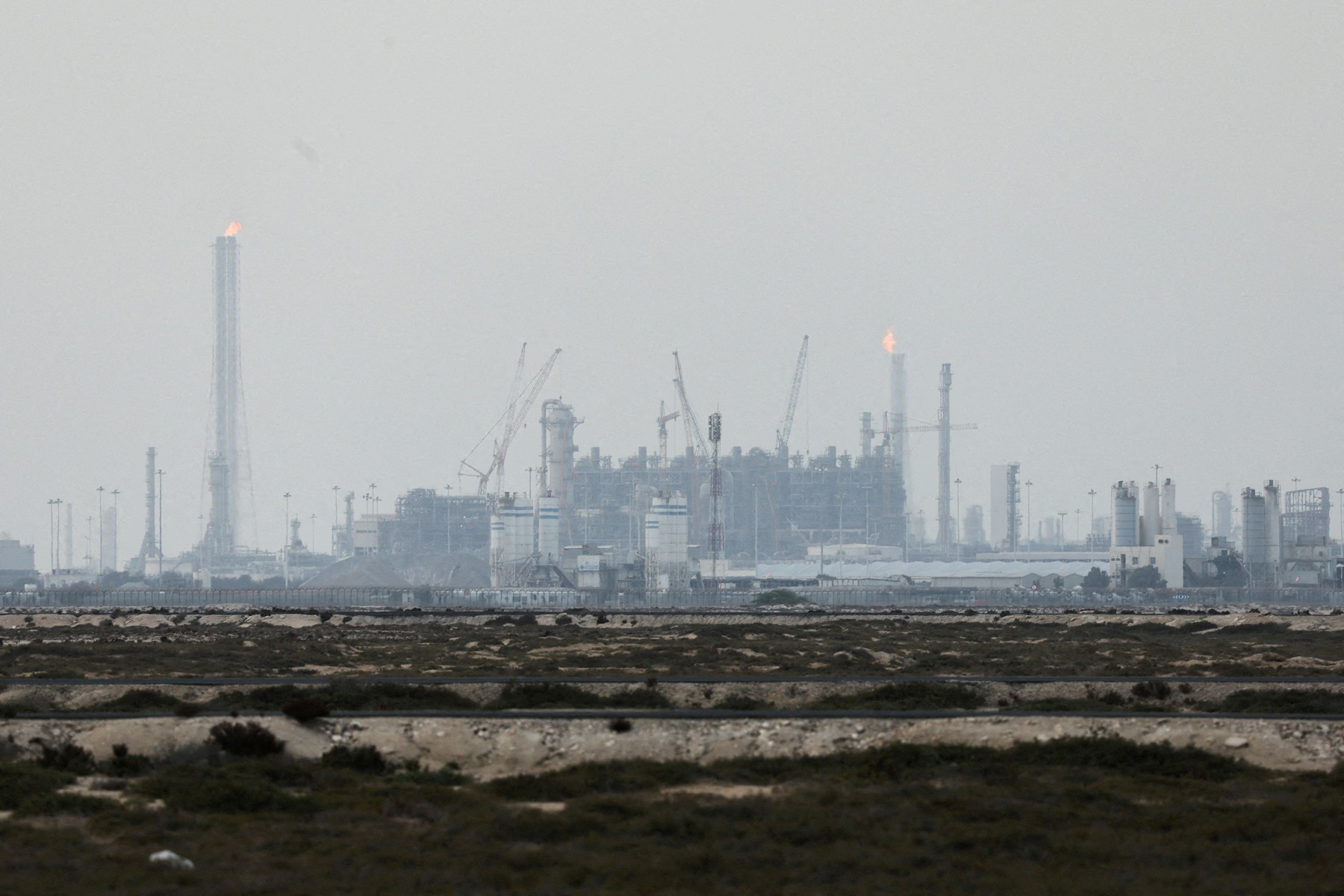
Qatar's state oil giant QatarEnergy said on Wednesday that Iranian missile attacks on Ras Laffan, the site of the country's core LNG processing operations, caused "extensive damage", while the UAE shut gas facilities after intercepting missiles early on Thursday.
The attacks came hours after Iran issued evacuation warnings for several oil facilities across Saudi Arabia, the UAE and Qatar, as it prepared retaliation following strikes on its own energy infrastructure in South Pars and Asaluyeh.
QatarEnergy, the world's second-largest LNG exporter, said in a statement that its emergency response team were deployed immediately to contain fires caused by the attack. No casualties were reported and all personnel were accounted for, it added.
Qatar's interior ministry earlier said the fire was preliminarily brought under control, with no injuries reported.
Ras Laffan, located 80 km north of Doha, is an energy-industry hub and hosts several international companies.
In the UAE, authorities said they were responding to incidents at the Habshan gas facilities and at the Bab oil field caused by falling debris from intercepted missiles. The gas facilities were shut down and no injuries were reported, the Abu Dhabi Media Office said.
The Habshan complex, operated by Abu Dhabi state oil giant ADNOC, is one of the world's largest gas processing facilities, comprising five plants with a total capacity of 6.1 billion standard cubic feet per day (bscfd), according to ADNOC.
Qatar's foreign ministry told Iran's security and military attaches to leave the country within 24 hours and declared them "persona non grata". In a statement, the ministry condemned the attack on Ras Laffan as a "direct threat" to its national security and accused Iran of taking an "irresponsible approach."
Saul Kavonic, head of research at Australia's MST Marquee, said attacks on Ras Laffan "could cause a lasting global gas shortage, but this won't pressure the Trump administration because the US benefits economically from high global gas prices".
The Laffan refinery primarily processes condensate into refined products including aviation fuel.
The Iranian reprisals came hours after US-Israeli strikes hit Iranian facilities on the opposite side of the massive South Pars gas reservoir shared by Iran and Qatar, prompting Iran's President Masoud Pezeshkian to warn of "uncontrollable consequences" of attacks on energy infrastructure.
Iran later warned it would destroy Gulf energy infrastructure if further strikes hit its own energy sector, state media reported. In a statement, Iran's Revolutionary Guards vowed further attacks "until it is completely destroyed", and a "much more severe" response.
Prior to Wednesday's attacks, Tehran had already sought to knock major Gulf refineries offline while also tightening its chokehold on the strait in a quest to inflict maximum pain on the global economy. In the past weeks, Saudi Aramco's sprawling Ras Tanura facility, home to one of the Middle East's largest refineries, was targeted as well as the UAE's Ruwais refinery – one of the largest in the world.
Earlier in March, Iranian attacks forced QatarEnergy to halt liquefied natural gas production last week and declare force majeure. Energy producers in Kuwait made similar declarations, which are a warning that events beyond their control may lead them to miss export targets. (Agencies)
Edited by Cecil Wong
Qatar LNG hub damaged, UAE shuts gas facilities
2026-03-19 HKT 07:50
Share this story


