


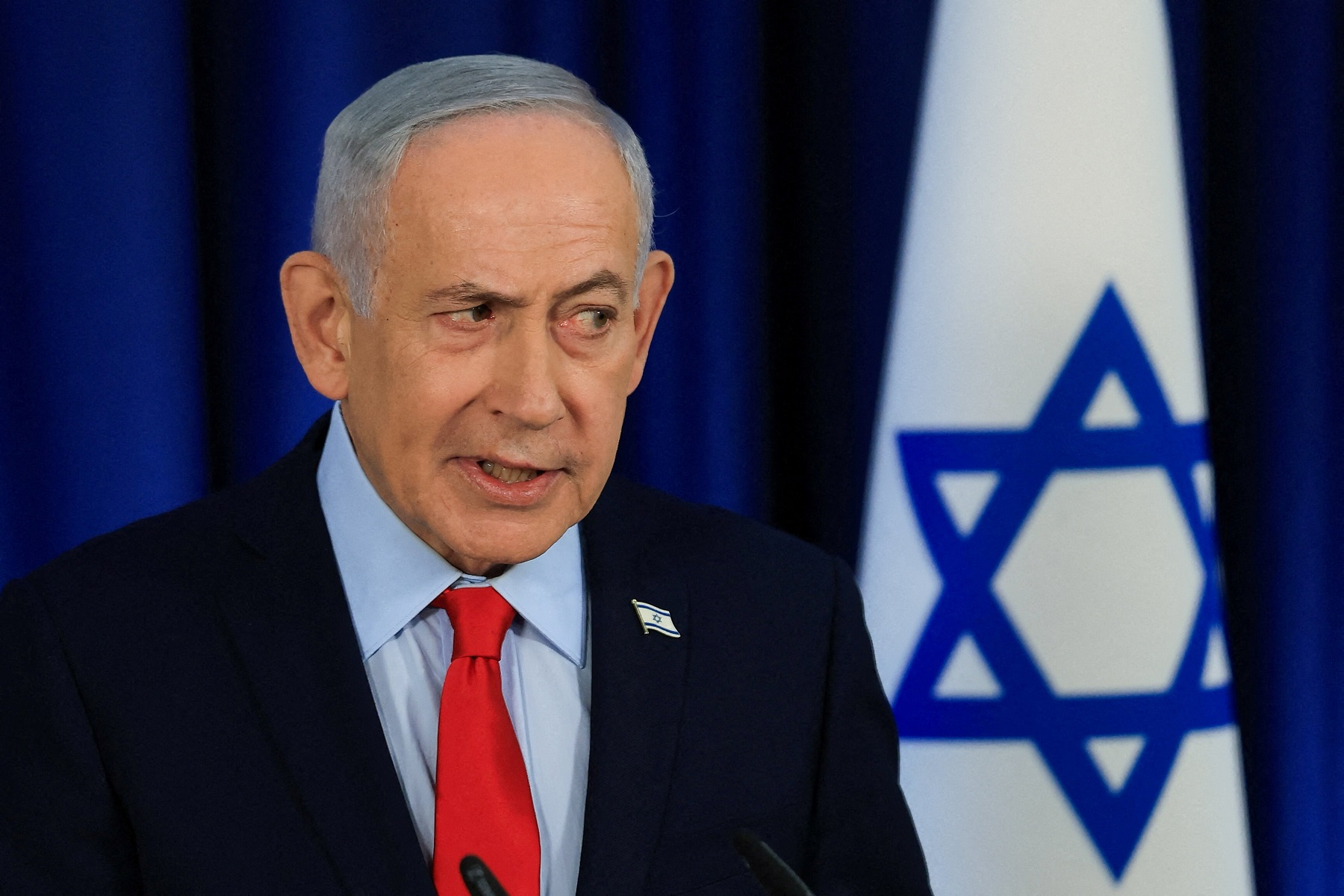
Israeli Prime Minister Benjamin Netanyahu on Thursday said Iran is being "decimated" and it is unclear who is in charge, even as the Islamic Republic kept up attacks on Gulf oil and gas targets that have jolted global markets.
Nearly three weeks into the Middle East war launched by Israel and the United States, Netanyahu said Tehran no longer has the capacity to enrich uranium or manufacture ballistic missiles. He did not provide evidence for either claim.
"We are winning and Iran is being decimated," he said at a press conference.
The European Union, following a meeting of the bloc's leaders in Brussels, called for a "moratorium" meanwhile on strikes against energy and water facilities.
"The European Council calls for de-escalation and maximum restraint, the protection of civilians and civilian infrastructure and full respect of international law by all parties," they said.
Netanyahu hailed his cooperation with US President Donald Trump and said, without providing a specific timeframe, that he sees "this war ending a lot faster than people think."
His comments came after the United States said there was no deadline to end the war that the two countries launched against Iran on February 28.
Netanyahu said he was "not sure who's running Iran right now."
"Mojtaba, the replacement ayatollah, has not shown his face," he said, in a reference to Iran's newly appointed supreme leader, the son of Ayatollah Ali Khamenei, who was killed in an Israeli airstrike on the first day of the war.
"We're seeing cracks, and we're trying to propagate them as fast as we can, not only in the top command, we're seeing cracks in the field," Netanyahu said.
While Israel and the United States expressed confidence in their war efforts, energy markets were left reeling by Iranian attacks on the world's largest liquefied natural gas plant in Qatar and refineries in Saudi Arabia and Kuwait.
Oil markets have already been shaken by Iran's chokehold on the strategic Strait of Hormuz.
Netanyahu said he believes pipelines should be built to transport Middle East oil and gas across the Arabian Peninsula and up to Israeli ports to avoid threats by Iran in the Hormuz Strait and other Gulf waters.
"Just have oil pipelines, gas pipelines, going west through the Arabian Peninsula, right up to Israel, right up to our Mediterranean ports and you've just done away with the choke points forever," Netanyahu said.
"I see that as a real change that will follow this war."
Despite the nearly three-week war, it was still too soon to tell whether Iranians would take to the streets to try to overthrow their government, Netanyahu said.
"It's up to the Iranian people to show that, to choose the moment and to rise to the moment," he said.
Netanyahu said that overthrowing the government would not be possible with air strikes alone, and suggested there might be potential action on the ground. (Agencies)
Edited by Cecil Wong
Iran war could end faster than people think: Netanyahu
2026-03-20 HKT 07:26
Share this story


