


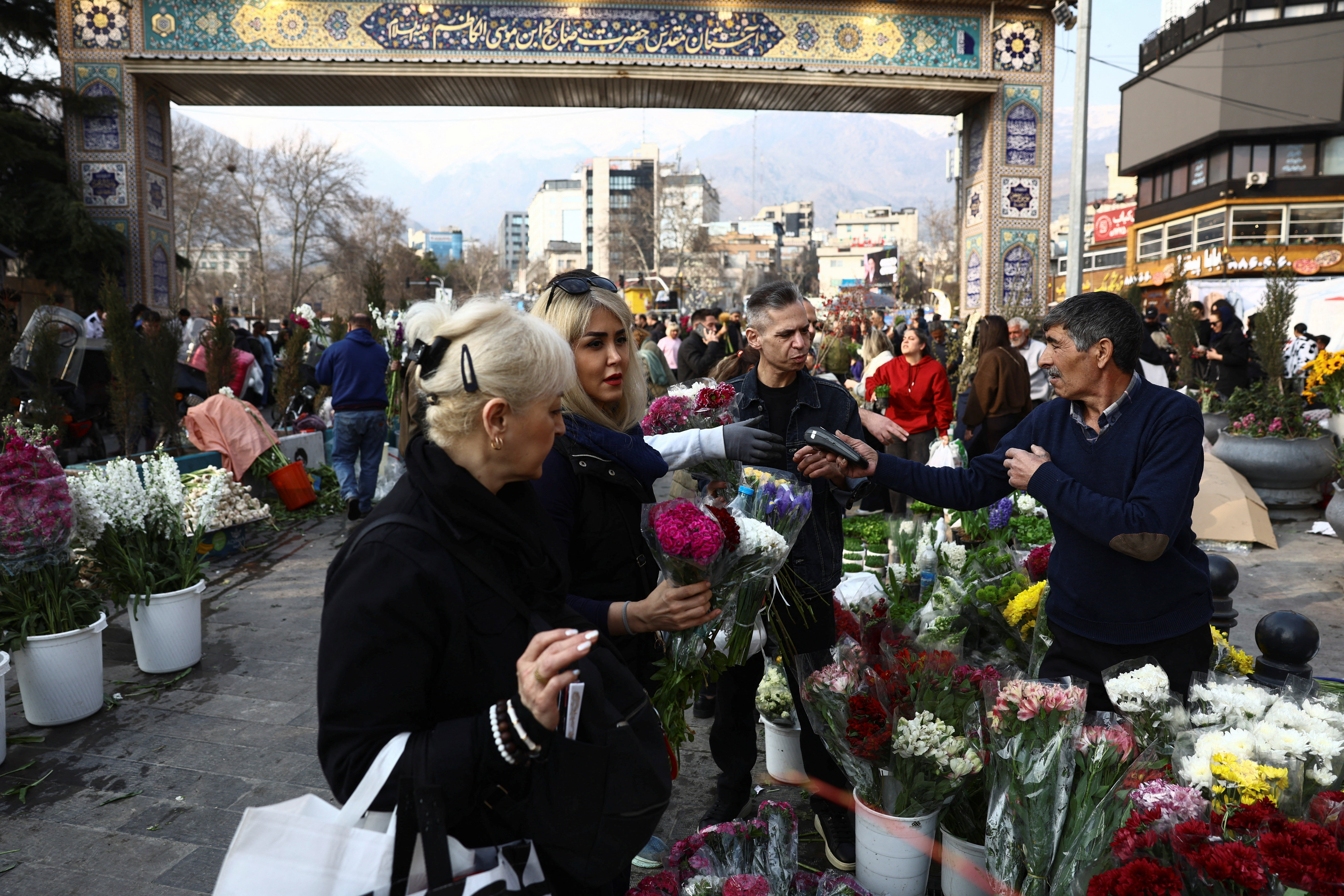
Israel pounded Tehran with airstrikes on Friday as Iranians marked Nowruz, or the Persian New Year, in the midst of a war that has sent shock waves through the global economy and risked drawing Iran’s Arab neighbours directly into the conflict.
Activists reported hearing strikes around Iran’s capital.
The attacks came a day after Israel pledged to refrain from more strikes on a key Iranian gas field and Iran intensified attacks on oil and natural gas facilities around the Gulf.
Heavy explosions shook Dubai early on Friday as air defences intercepted incoming fire over the city, where people were observing Eid al-Fitr, the end of the holy Muslim fasting month of Ramadan, and mosques made the day’s first call to prayers.
Iran kept up its wave of attacks launched at Israel that have sent millions of people to shelters, with sirens sounding across a wide swathe of the north, from Haifa to the Galilee to the border with Lebanon.
It came after an intense day that saw more than a dozen missile launches on Thursday alone, according to Israel’s military.
Global fuel supplies have been under intense pressure because of Iran’s stranglehold on the Strait of Hormuz, a strategic waterway through which a fifth of the world’s oil is transported.
Israeli Prime Minister Benjamin Netanyahu on Thursday said that, at the request of US President Donald Trump, Israel would hold off any further attacks on Iran's offshore South Pars gas field.
Iranian strikes in retaliation have led to already elevated global energy prices further surging and spurred Gulf allies to call for Trump to rein in Netanyahu.
The United Nations Security Council held an urgent closed meeting on Thursday during which Gulf countries stressed the need for Iran to halt attacks on them, said Bahrain’s UN ambassador Jamal Alrowaiei, the Arab representative on the UN’s most powerful body.
Qatar, a key source of natural gas for world markets, said Iranian missiles that caused extensive damage to the Ras Laffan liquefied natural gas facility, reduced its exports by about 17 percent and will cost about US$20 billion in lost revenue a year.
The damage will take up to five years to repair, even though production at the facility had already been halted after earlier attacks.
Two oil refineries in Kuwait, gas operations in Abu Dhabi and Saudi Arabia's Samref refinery in the Red Sea port city of Yanbu have also been targeted by Iran, authorities said.
The UAE said on Friday it disrupted what it called “a terrorist network funded and operated by Lebanon’s Hezbollah and Iran,” arresting its five operatives.
It accused the men of laundering money while “operating within the country under a fictitious commercial cover” that sought to carry out schemes that would threaten the country’s financial stability.
Netanyahu's comments to foreign journalists came amid difficult days for him and Trump, with a top US intelligence official resigning and claiming Israel had pushed the US president into the war while Israeli attacks on Iran's South Pars gas field led to retaliatory strikes by Tehran on the region’s oil and gas fields.
“I misled no one,” Netanyahu said.
“And I didn’t have to convince President Trump about the need to prevent Iran from developing its nuclear programme.”
General Dan Caine, chairman of the Joint Chiefs of Staff, said US forces were attacking deeper into Iranian territory, with warplanes hunting Iranian boats in the strait and dropping 5,000-pound bombs on underground weapons-storage facilities.
Asked later about the possibility, raised overnight by Netanyahu of ground troops being deployed to Iran, Trump responded: “No. I’m not putting troops anywhere.” (Agencies)
Edited by Tony Sabine
Israel pounds Tehran as Iranians usher in New Year
2026-03-20 HKT 13:27
Share this story


