


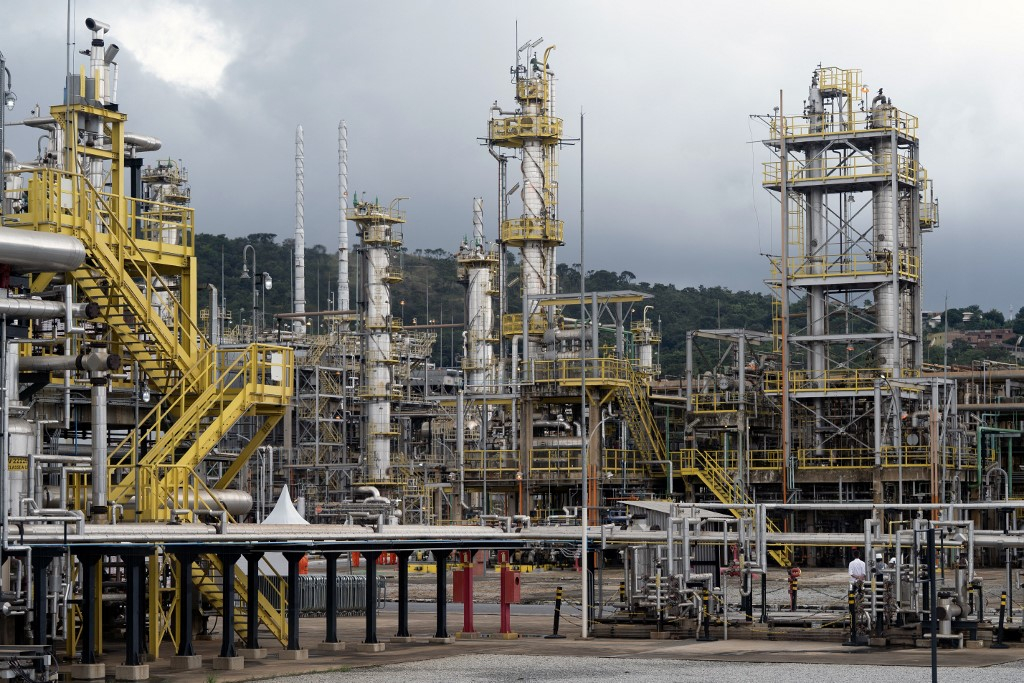
Stocks tumbled while oil prices pushed higher on Friday at the end of a turbulent week in which attacks on Gulf energy infrastructure rattled global markets and sparked fears of a global economic slowdown.
Crude prices jumped further on Friday, with the international benchmark, Brent crude, rising 3.3 percent on Friday to nearly US$112.19 per barrel. The main US contract, West Texas Intermediate, rose 2.3 percent to over US$98 per barrel.
Angelo Kourkafas of Edward Jones, said this week's assaults on energy infrastructure deepened the market's concerns.
"What really matters more is not how high prices are now, but how long prices may stay high, and I think it's that uncertainty that is triggering the volatility," he said.
Coming into this week, investors were anxious over the near-closure of the Strait of Hormuz, through which about 20 percent of the world's crude oil and liquefied natural gas flow.
Early on Friday, drone attacks caused fire at Kuwait's Mina Al-Ahmadi oil refinery.
Energy analysts and consumers are also scrambling to count the cost of Iranian missiles hitting Qatar's huge Ras Laffan natural gas complex on Thursday.
The attack caused "extensive damage" that Qatar's state energy company said could cost US$20 billion a year in lost revenue and take five years to repair.
"Heading into a weekend, investors are unsurprisingly a bit nervous about what may happen, of course nobody knows how it's going to play out," said Kourkafas, who pointed to the rise in government bond yields as a sign markets are more worried about inflation.
All three major US indices finished lower on Friday, with the broad-based S&P 500 losing 1.5 percent.
US Federal Reserve Governor Christopher Waller on Friday expressed concern about inflation in light of the war.
Waller, who has since last year backed interest rate cuts over labour market concerns, said he changed his mind in the last two weeks on the pace of easing due to inflation risks.
"Since that time the Strait of Hormuz was closed, this is looking like it's going to be a much more protracted conflict, and oil prices are going to stay high for a longer time," he told US broadcaster CNBC on Friday.
"So that suggested inflation was more of a concern than I was putting it."
Earlier, European markets ended the day lower, with London's FTSE 100 sliding below the 10,000 level for the first time since early January as bond concerns mounted.
On Thursday, US markets had been buoyed by comments from Israeli Prime Minister Benjamin Netanyahu that the war could end sooner than expected.
But Iran's supreme leader Ayatollah Mojtaba Khamenei remained defiant on Friday, saying that Iranians had dealt a "dizzying blow" to the country's enemies.
Also on Friday, US President Donald Trump ruled out reaching a ceasefire agreement with Iran, saying Washington has the upper hand in the three-week-old war.
"I don't want to do a ceasefire. You know you don't do a ceasefire when you're literally obliterating the other side," Trump told journalists at the White House.
The S&P 500 fell 1.5 percent to 6,506, the Dow fell 1 percent to 45,577, while the Nasdaq fell 2 percent to 21,647. (AFP)
Edited by Robert Kemp
Stocks drop, oil jumps as Mideast war persists
2026-03-21 HKT 07:12
Share this story


