



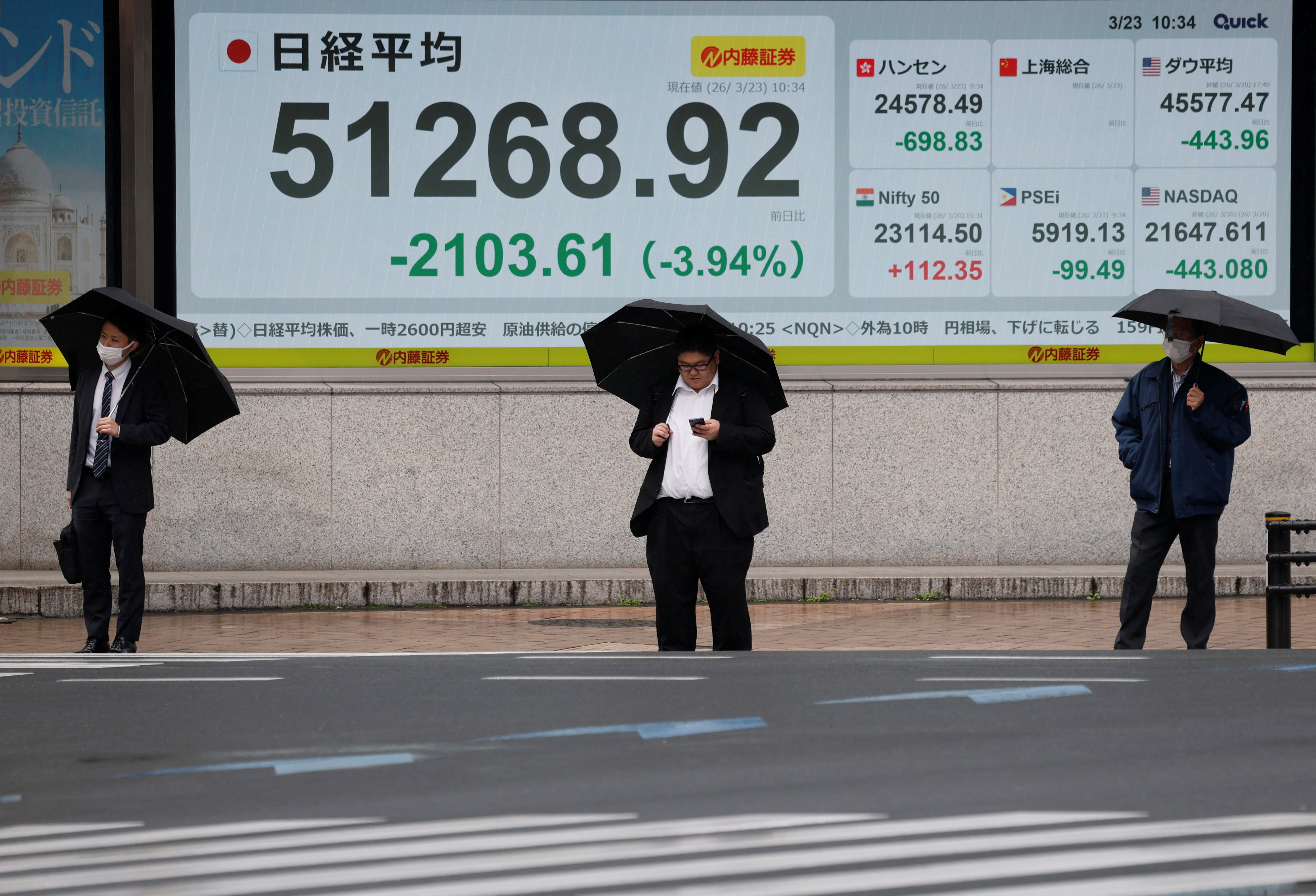
Mainland and Hong Kong stocks fell sharply in early trading on Monday as the escalating Middle East war stoked inflation fears and the potential for higher interest rates globally.
The Hang Seng Index opened trading for the week 488 points, or 1.9 percent, lower at 24,789.
The losses escalated, with the benchmark 781 points, or 3.09 percent, lower at 24,496 in mid-morning trading.
The China enterprises index opened 140 points, or 1.6 percent, down at 8,433 while the tech index was 92 points, or 1.9 percent, lower at 4,780.
Up north, the benchmark Shanghai Composite Index opened 1.32 percent down at 3,904.
The Shenzhen Component Index was 1.78 percent lower at 13,619 while the ChiNext Index, tracking China's Nasdaq-style board of growth enterprises, was down 1.54 percent at 3,300.
In Tokyo, the Nikkei opened down more than 2,100 points, or over four percent, at 51,231.
The benchmark was at 51,531 just before noon.
In Seoul, the benchmark Kospi fell 289 points, or five percent, to 5,491, extending losses even after a trading curb was activated on the index earlier in the session, and the won hit 17-year lows.
The index was at 5,508 just before noon.
The losses came as Iran said on Sunday it would strike the energy and water systems of its Gulf neighbours in retaliation if US President Donald Trump follows through with a threat delivered a day earlier to hit Iran's electricity grid in 48 hours, a major escalation in the three-week-old war.
"The future path of oil prices and their effects on global growth and financial conditions depend on how long the Strait of Hormuz remains closed, which is highly uncertain," Goldman Sachs said in a note.
"For China, the impact hinges on both the demand and supply situation outside of China." (Reuters/Xinhua)
Edited by Tony Sabine
HK, regional stocks hit amid Mideast escalation fears
2026-03-23 HKT 11:12
Share this story


