


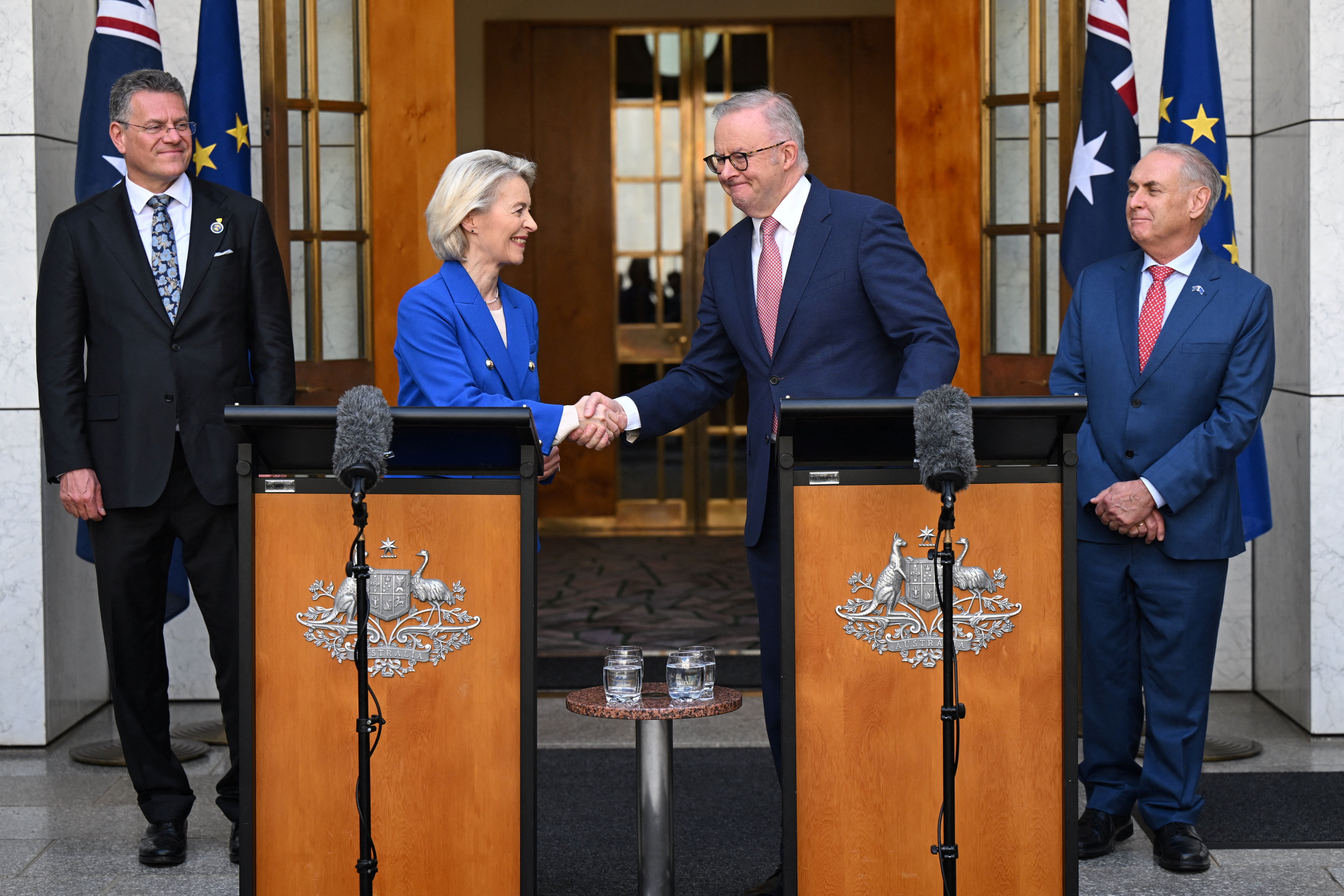
European Union chief Ursula von der Leyen and Australian Prime Minister Anthony Albanese struck a long-awaited free trade deal on Tuesday, compromising to boost exports in the face of global uncertainty over trade.
Von der Leyen's visit to Australia with trade commissioner Maros Sefcovic in tow comes as the 27-nation bloc and the oil-import-reliant nation navigate renewed energy vulnerability sparked by the war in the Middle East.
The trade accord is the latest inked by Brussels in a push to diversify trade as Europe faces challenges from the United States and China.
The two sides also inked an agreement to step up defence co-operation as well as critical raw materials.
"The EU and Australia may be geographically far apart but we couldn't be closer in terms of how we see the world," said von der Leyen.
"We are sending a strong signal to the rest of the world that friendship and co-operation is what matters most in times of turbulence," she added.
Key sticking points on Australian use of European geographical names and access for Australian beef to Europe were overcome to reach a deal after eight years of negotiations.
A compromise will see Australian winemakers allowed to use the term prosecco domestically, but stop using it for exports after 10 years.
Australia will be allowed to keep using some geographical names, such as feta and gruyere, where producers have used the name for at least five years.
European car makers will benefit from Australia raising the threshold for a luxury car tax on electric vehicles – three quarters of EVs will now become exempt.
Under the trade deal, the EU said it expected exports to Australia to grow by a third over a decade – with dairy and car makers seeing strong growth of around 50 percent.
The quota of Australian beef allowed into the EU will increase more than 10 times the current level over the next decade, although that falls short of the level Australian farmers had been seeking.
EU firms exported to Australia 37 billion euros worth of goods last year and 31 billion euros of services in 2024. (AFP)
Edited by Thomas McAlinden
EU and Australia strike free-trade deal
2026-03-24 HKT 11:34
Share this story


