


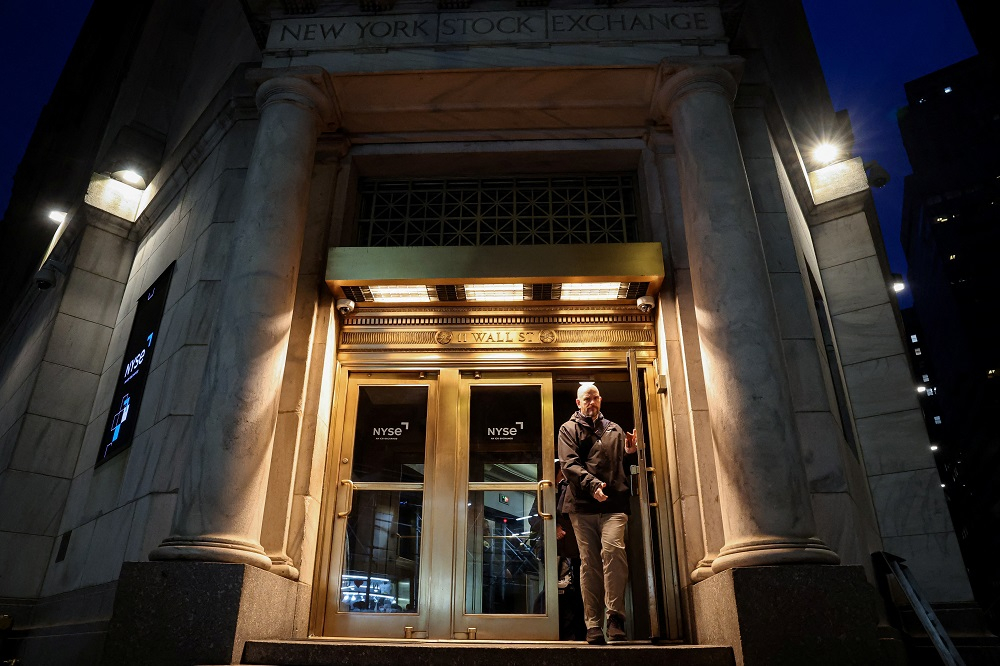
Wall Street indexes lost ground in Tuesday's volatile session as investors swayed between fears of rising oil prices and hopes for a resolution to the US-Israeli war on Iran, as US President Donald Trump claimed progress in talks even as reports suggested that more American troops were headed to the Middle East.
US Treasury yields rose on uncertainty about the war and a weak auction of 2-year Treasury notes, also adding pressure to equity markets.
Indexes regained some ground after Trump told reporters that the United States was talking to "the right people" in Iran in order to reach an agreement to end hostilities and that Iran has agreed they will never have nuclear weapons.
But reports that the Pentagon is expected to send thousands of more troops from the elite 82nd Airborne Division to the Middle East caused some concerns that the war could drag on and keep oil prices high.
Wall Street indexes on Monday had marked their biggest one-day gain since February 6 as oil prices fell after Trump had postponed strikes against Iranian power plants and announced talks with Iran even as Tehran denied negotiations with the US.
But energy prices rose on Tuesday with crude oil futures settling up more than 4 percent.
"Stocks are trying to find their footing as investors are keeping one eye on social media and the other eye on every headline. We're very short-term oriented," said Carol Schleif, chief market strategist at BMO Private Wealth.
"Markets are trying to hold onto the optimism they had yesterday. They're so ready to move beyond war talk even if it's not 100 percent settled," said Schleif but she added, "There's a lot of nervousness. People are watching oil and watching interest rates and worrying do we go higher for longer on both energy and interest rates because that could start negatively impacting growth."
Kevin Gordon, head of macro research and strategy at the Schwab Centre for Financial Research in New York also pointed to a "double whammy" of higher oil prices and higher rates as a "stagflationary backdrop, which, needless to say, is not a positive backdrop for the stock market."
The S&P 500 fell 0.4 percent, to 6,556, the Dow fell 0.2 percent, to 46,124, while the Nasdaq fell 0.8 percent, to 21,761.
Higher oil prices have revived inflation jitters and complicated the interest rate outlook for central banks. The US Federal Reserve struck a hawkish tone last week, projecting only one reduction in 2026.
Traders are no longer pricing in any rate cuts this year, compared with two reductions expected before the Middle East conflict erupted.
Expectations for rate hikes nudged higher amid escalating tensions last week and the latest bets were for a more than 30 percent chance of a hike by year-end, according to CME's FedWatch Tool. (Reuters)
Edited by Cecil Wong
US stocks fall, oil prices rebound as war drags on
2026-03-25 HKT 07:02
Share this story


