


Mainland stocks closed largely flat in choppy trading on Monday while Hong Kong shares tumbled, as the escalating conflict in the Middle East continued to dent risk appetite in broader Asia markets.
The benchmark Hang Seng Index ended the day down 201 points, or 0.81 percent, at 24,750.
The China enterprises index was down 54 points, or 0.65 percent, at 8,399 while the tech index was down almost 88 points, or 1.84 percent, at 4,690 to its lowest level since April 2025.
Up north, the benchmark Shanghai Composite Index lost up to one percent before recouping losses before ending up almost 10 points, or 0.24 percent, at 3,923.
The Shenzhen Component Index was 34 points, or 0.25 percent, lower at 13,726 while the ChiNext Index, tracking China's Nasdaq-style board of growth enterprises, lost 22 points, or 0.68 percent, to close at 3,273.
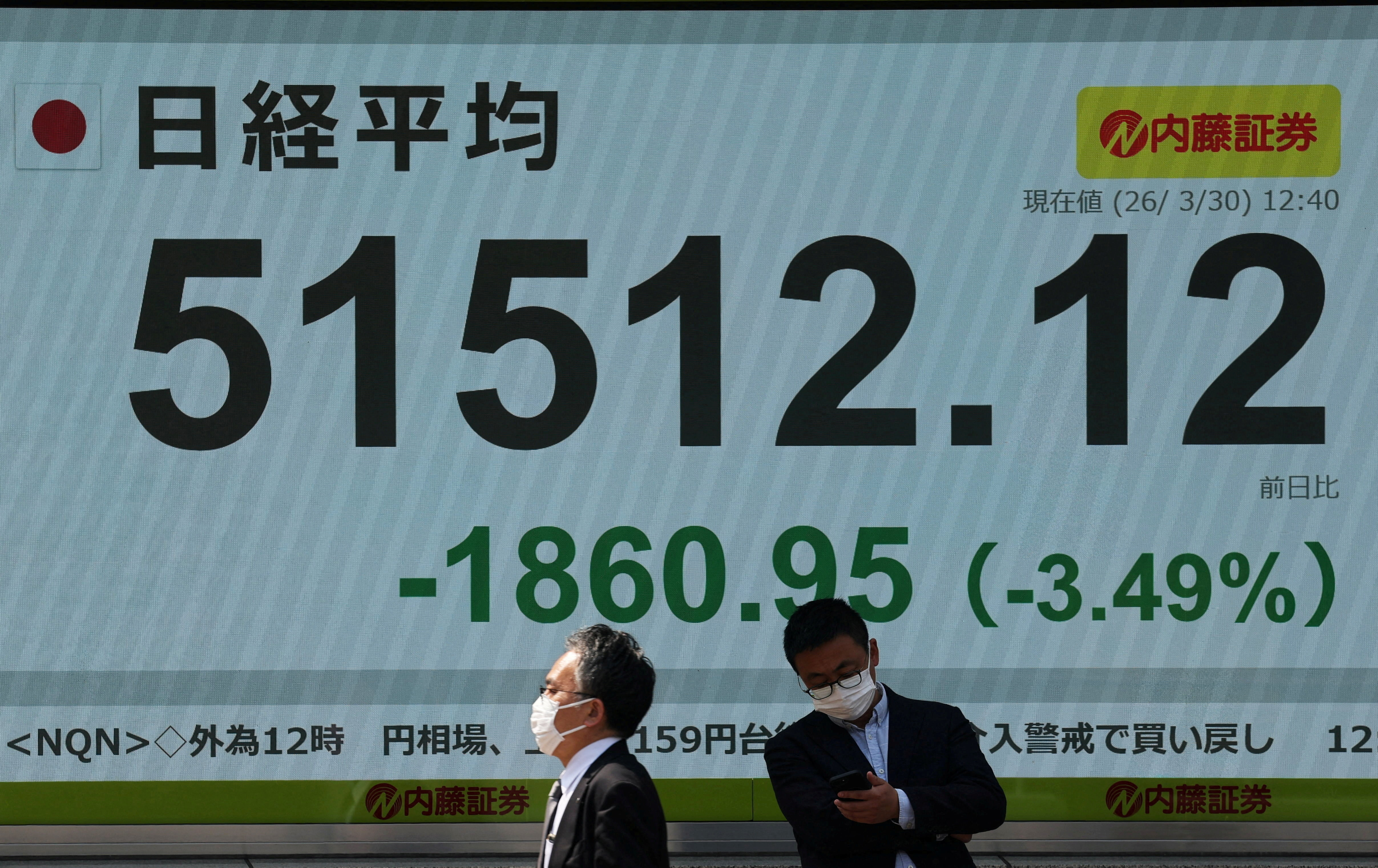
Broader Asian equities declined, with Japan's Nikkei share average tumbling on Monday while benchmark bond yields briefly touched a 27-year high before retreating, as the widening Middle East war fuelled recession concerns.
The Nikkei closed down 1,497 points, or 2.8 percent, at 51,885, having fallen up to 5.3 percent earlier in the session before recovering some ground.
Japan's key stock gauge is down nearly 12 percent for the month so far, on track for its biggest monthly drop since October 2008 at the time of the global financial crisis.
In Seoul, the benchmark Kospi closed down 161 points, or 2.97 percent, at 5,277.
Hopes of Gulf peace talks were overshadowed by uncertainties as the United States builds up ground troops, while attacks on Israel by Yemen's Iran-aligned Houthis further complicated the war.
"With Middle East tensions rising over the weekend, markets now face headwinds from both geopolitical risks and weak technical signals, making a sharp turnaround unlikely for the near term," analysts at Nanhua Futures said in a note.
Still, expectations of supportive domestic policy measures provide a floor, and downside is limited following previous corrections at the beginning of the year, Nanhua analysts added.
The benchmark Shanghai Composite Index has slipped 6.7 percent so far in March, which has largely wiped out all the year-to-date gains and put the index on track for the worst monthly drop since January 2024.
However, Chinese equities still prove to be more resilient compared with other markets in the region, and that relative outperformance is set to become increasingly pronounced as the war drags on, analysts at BNP said in a note.
The bank said it maintained its preference for China's materials, industrials and technology sectors within the medium- to longer-term.
Among best performers, the gold sector index added 3.4 percent, the defences sector index climbed 1.4 percent and the semiconductor sector added two percent. (Reuters/Xinhua)
Edited by Tony Sabine
HK, mainland stocks feel heat as conflict escalates
2026-03-30 HKT 17:09
Share this story


