


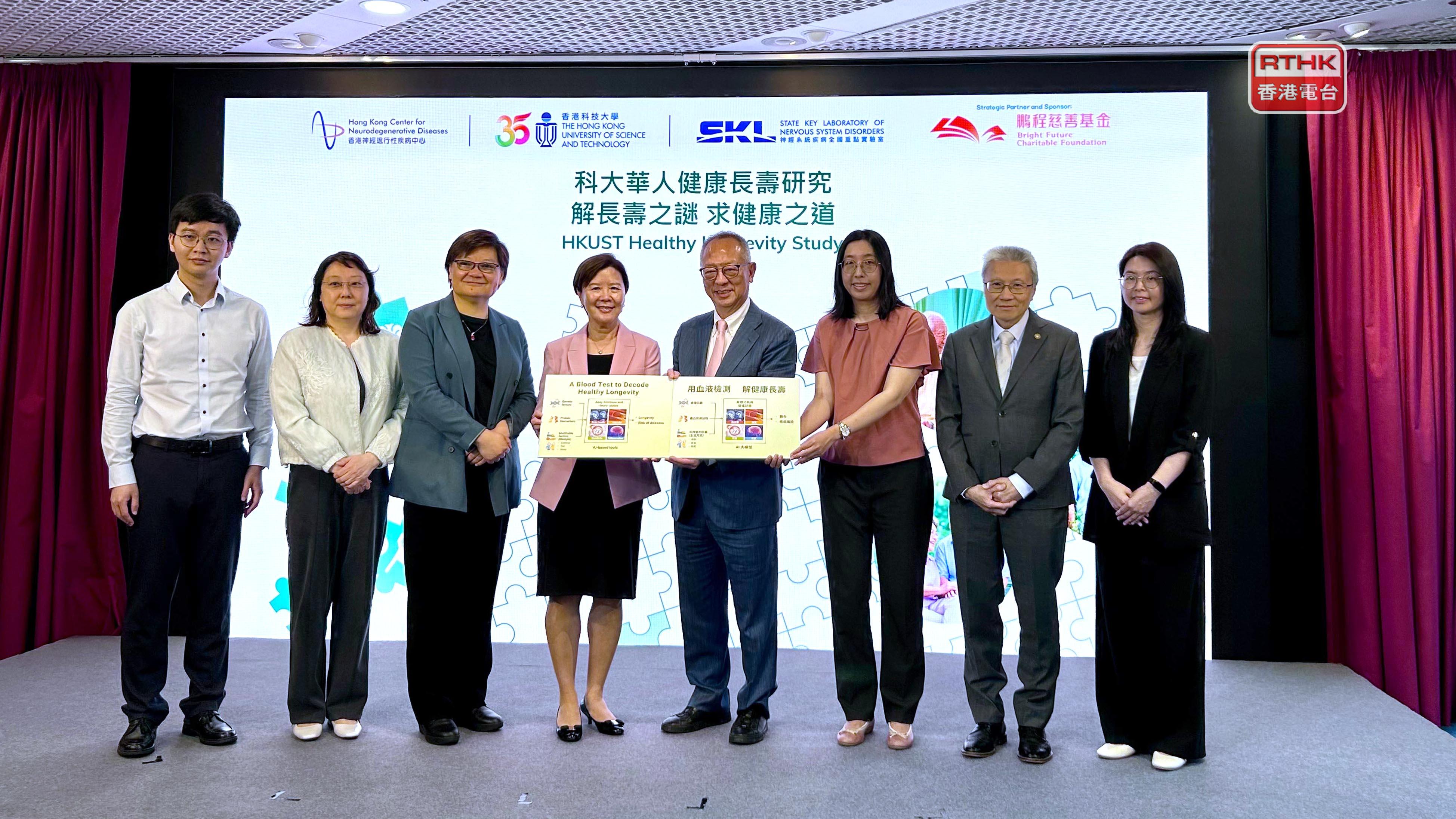
Researchers at the Hong Kong University of Science and Technology (HKUST) are turning to a select group of the city’s oldest residents to unlock the secrets of healthy longevity.
Their focus is not just on extending life, but on ensuring those extra years are healthy ones — an especially urgent goal as Hong Kong holds the title of the world’s longest-living region for the tenth consecutive year.
The newly launched Healthy Longevity Study, a five-year research initiative, is recruiting 500 Chinese seniors aged 90 or above.
They said participants would receive free blood tests and health assessments, and their contributions would help build what researchers hope will become a foundational resource for personalised ageing science.
"Population ageing is a major challenge in Hong Kong and worldwide, creating a significant burden for the elderly, their families as well as the healthcare system," said Anna Wong, research assistant professor of the division of life science at HKUST.
"So now the key question is: how to live longer, and at the same time, how to live healthy."
While Hong Kong’s nonagenarian population has more than doubled in a decade — from approximately 46,000 residents aged 90 or above in 2011 to 102,000 in 2021 — Wong noted that scientific understanding of healthy ageing in Chinese populations remains surprisingly limited.
"When we look at a lot of the studies on longevity, they are mainly from European descent. There is still a lack of data on Chinese elderly," she said.
"We still don’t fully understand the biology of healthy longevity, especially in the local Chinese population."
The study aims to fill that gap, in which Wong said an interdisciplinary team would combine advanced blood-based biomarker detection, multi-omics data analysis and artificial intelligence to move beyond simple statistical associations.
She said blood samples would be collected to generate multi-omics data on genetics, biomarkers and metabolites.
At the same time, participants would also provide lifestyle information through questionnaires focused on modifiable factors such as exercise, diet and sleep.
"Finally, we’ll use AI-based technologies to integrate all the data to analyse comprehensively and ultimately to understand the biology of healthy longevity," Wong said.
The project will be conducted in two phases: the first two years focused on recruitment, and the subsequent three years dedicated to experiments, data analysis and preparing papers for publication.
Edited by Tony Sabine
HKUST launches health longevity study
2026-04-08 HKT 16:17
Share this story


Anna Wong speaks to Hailey Yip

