


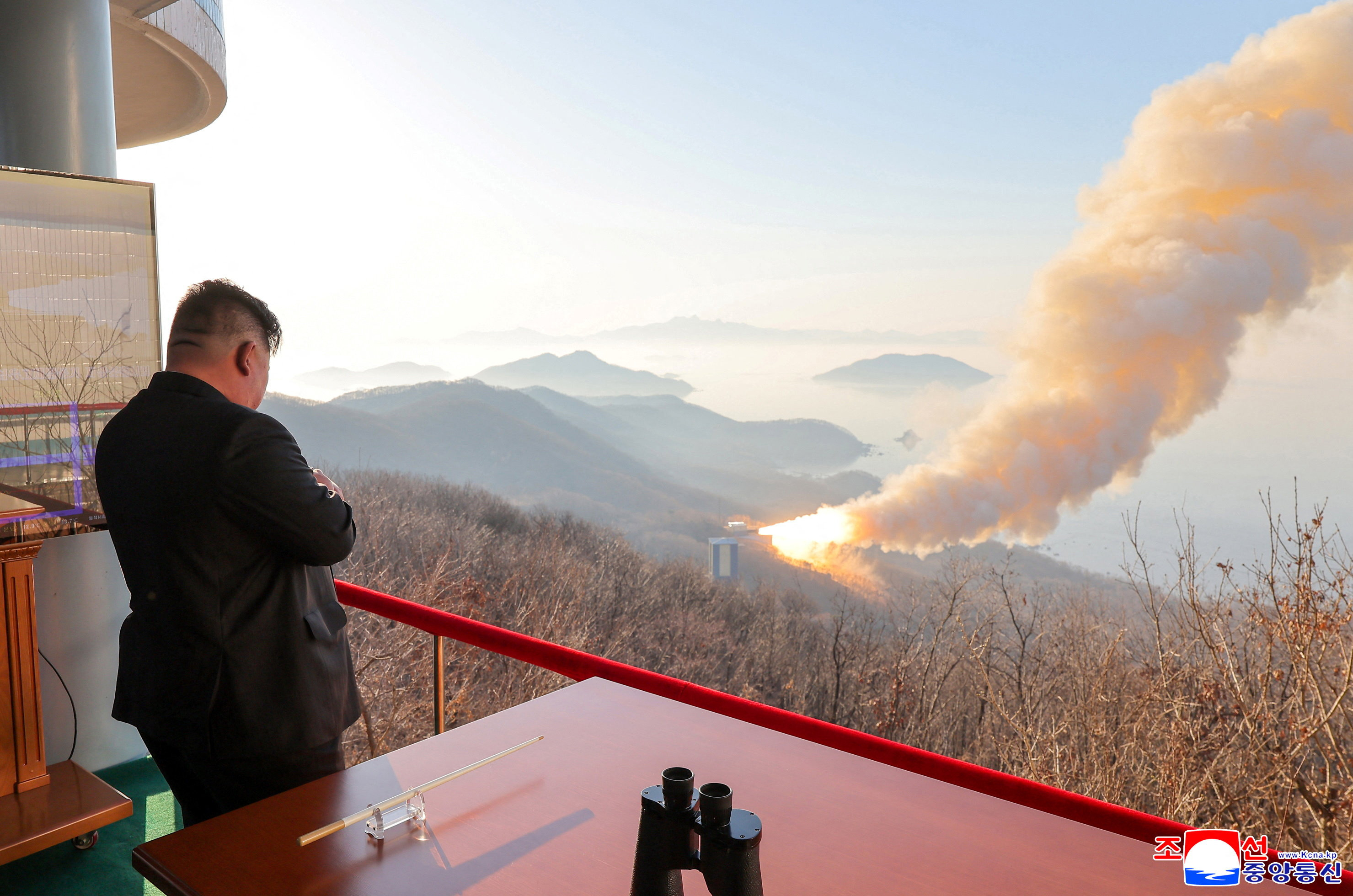
The Democratic People's Republic of Korea (DPRK) tested a new cluster-bomb warhead on a ballistic missile and an electromagnetic weapon this week, state media KCNA reported on Thursday, in a move seen as part of efforts to showcase the country's capacity to fight a modern war.
The country's Academy of Defence Science and the Missile Administration also conducted tests of carbon-fibre bombs and a mobile short-range anti-aircraft missile system, KCNA said.
Kim Jong-sik, a general who oversaw the tests, said the electromagnetic weapon system and carbon-fibre bombs were "special assets" for the DPRK's military, KCNA reported.
South Korea's Joint Chiefs of Staff said on Wednesday that the DPRK had test-fired multiple missiles over several days.
Analysts also see the tests as likely to be a show of force in cutting-edge conventional weapon systems by the nuclear-armed DPRK for its adversaries and allies.
Foreign Minister Wang Yi is scheduled to make a two-day visit to the DPRK starting on Thursday. There has also been speculation that US President Donald Trump may try to hold a summit with North Korean leader Kim Jong-un on the sidelines of his visit to China in mid-May.
Without specifying the number of ballistic missiles launched, the DPRK said it had tested its mobile short-range anti-aircraft missile system as well as the combat capabilities of its tactical ballistic missile warhead.
One test proved the surface-to-surface tactical ballistic missile called Hwasongpho-11 Ka, which is tipped with a cluster-bomb warhead, was able to "reduce to ashes any target" covering an area of up to seven hectares, KCNA said.
The electromagnetic weapon system could have the capacity to disable electronic circuits in the enemy's assets, with the potential ability to cripple South Korea's F-35A stealth fighter jet or Aegis-equipped destroyers, Lim Eul-chul, a professor at Kyungnam University in South Korea, said.
Carbon-fibre bombs, developed by advanced militaries such as the United States and China, are capable of crippling infrastructure like power plants by sprinkling conductive strands of carbon fibre over a target. Lim said they could be a potent weapon in any conflict. (Reuters)
Edited by Thomas McAlinden
DPRK tests new cluster-bomb warhead in missile firing
2026-04-09 HKT 12:57
Share this story


