


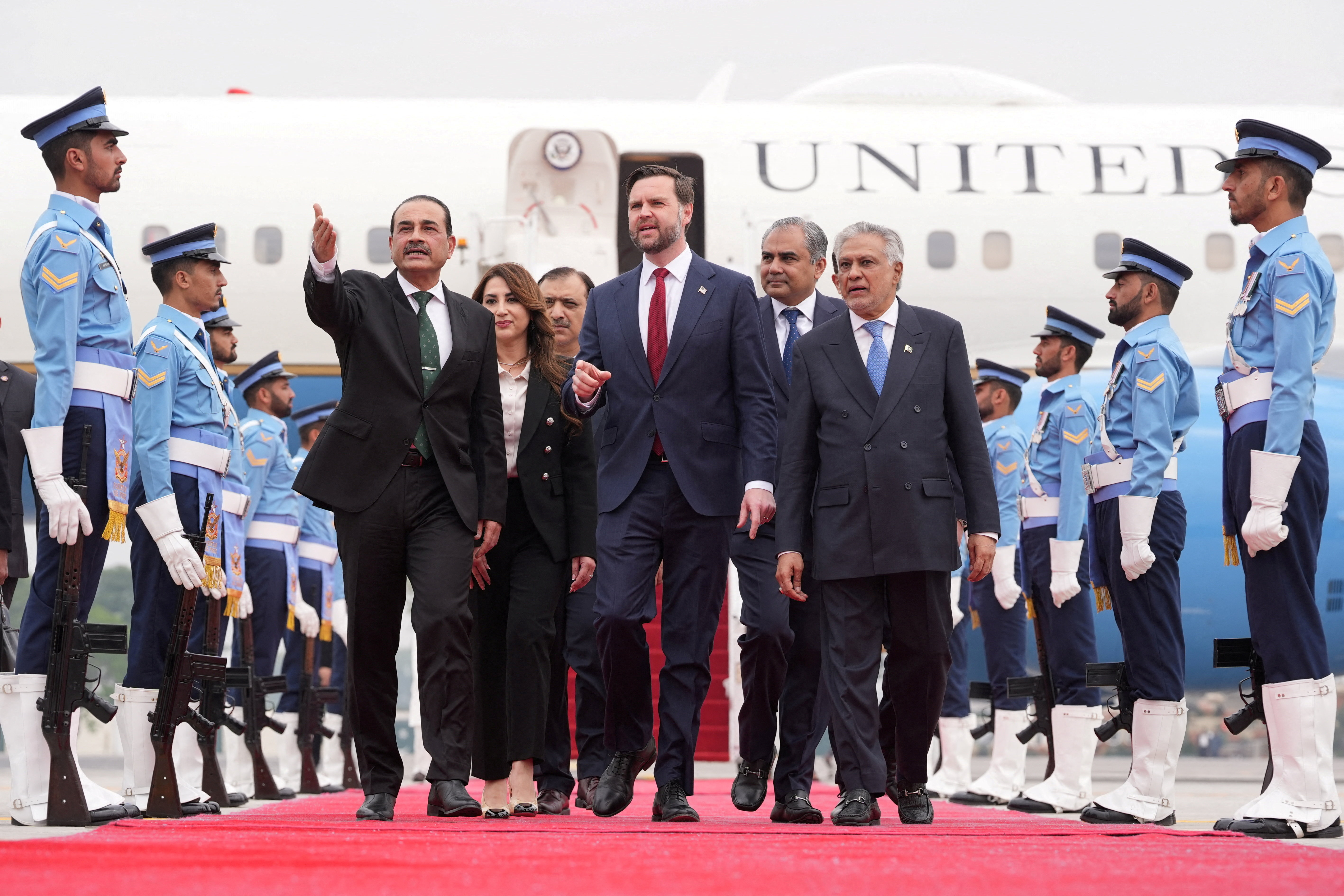
US Vice President JD Vance arrived in Islamabad on Saturday for talks with Iran that the Pakistani prime minister hosting the warring sides called a "make-or-break" effort to permanently halt weeks of fighting in the Middle East.
An Iranian delegation led by parliamentary speaker Mohammad Bagher Ghalibaf arrived overnight at an airbase near the capital, disembarking from the commercial plane to embrace Pakistan's powerful army chief Asim Munir, who also shares a personal rapport with US President Donald Trump.
Munir also greeted Vance, escorting him down a red carpet at the Nur Khan air base, where US special envoy Steve Witkoff and Trump's son-in-law Jared Kushner were already waiting.
The foes still appeared to be far apart on key issues, including the opening up of the strategic Strait of Hormuz and were quick to express their mutual suspicion.
"We have good intentions but we do not trust," Ghalibaf said shortly after landing, according to Iran's state broadcaster. "Our experience in negotiating with the Americans has always been met with failure and broken promises."
For his part, Vance has, before leaving for Islamabad, said "if they're going to try to play us, then they're going to find the negotiating team is not that receptive".
The ceasefire is already under strain, notably from Israel's continued strikes in Lebanon, where on Wednesday it carried out its heaviest bombardment since Hezbollah entered the Middle East war in early March, killing hundreds of people less than 48 hours after the truce came into force.
Referring to efforts to permanently end fighting that began with US-Israeli strikes on Iran on February 28, Pakistani Prime Minister Shehbaz Sharif said "an even more difficult stage lies ahead", calling it the equivalent of 'make or break'."
It was unclear what time the talks would get underway, though the Tasnim news agency reported Iran's delegation would meet with Sharif at 1pm local time, or 4pm Hong Kong time.
Iran, which brought a more than 70-strong delegation to Pakistan, has insisted on the truce covering Lebanon and the unfreezing of its assets for the Islamabad talks to go ahead, neither of which has materialised so far.
On the US side, Trump has demanded the opening of the Strait of Hormuz as a condition for the two-week ceasefire and vowed on Friday to have it open soon "with or without" Iran's co-operation.
Security was tight in the Pakistani capital on Saturday, with a heavy police and paramilitary presence on the streets and road diversions around the "red zone" where government and diplomatic buildings are located and the city's main luxury hotel, which can host delegations, cleared of its normal well-heeled clientele.
It was not known whether the two sides would meet face to face, or whether they would mirror an indirect format used in Oman-mediated talks before the war.
Pakistan has formed a team of subject matter specialists to facilitate the two sides in negotiations on navigation, nuclear and other key matters, a diplomatic source said.
The negotiations will be closely watched by other key regional players, with Egypt and Turkey having helped with mediation, along with China, all of which Pakistan was still co-ordinating closely with for the talks, the source said.
Complicating the path to a permanent ceasefire was Israel's assertion that the current truce does not cover Lebanon, at odds with Iran and Pakistan's stance, with air strikes continuing in Lebanon on Friday against Iran-backed Hezbollah despite Tehran's demand that they be halted as a condition of the truce with Washington. (AFP)
Edited by Thomas McAlinden
Mistrust as Vance arrives for 'make-or-break' talks
2026-04-11 HKT 15:58
Share this story


