


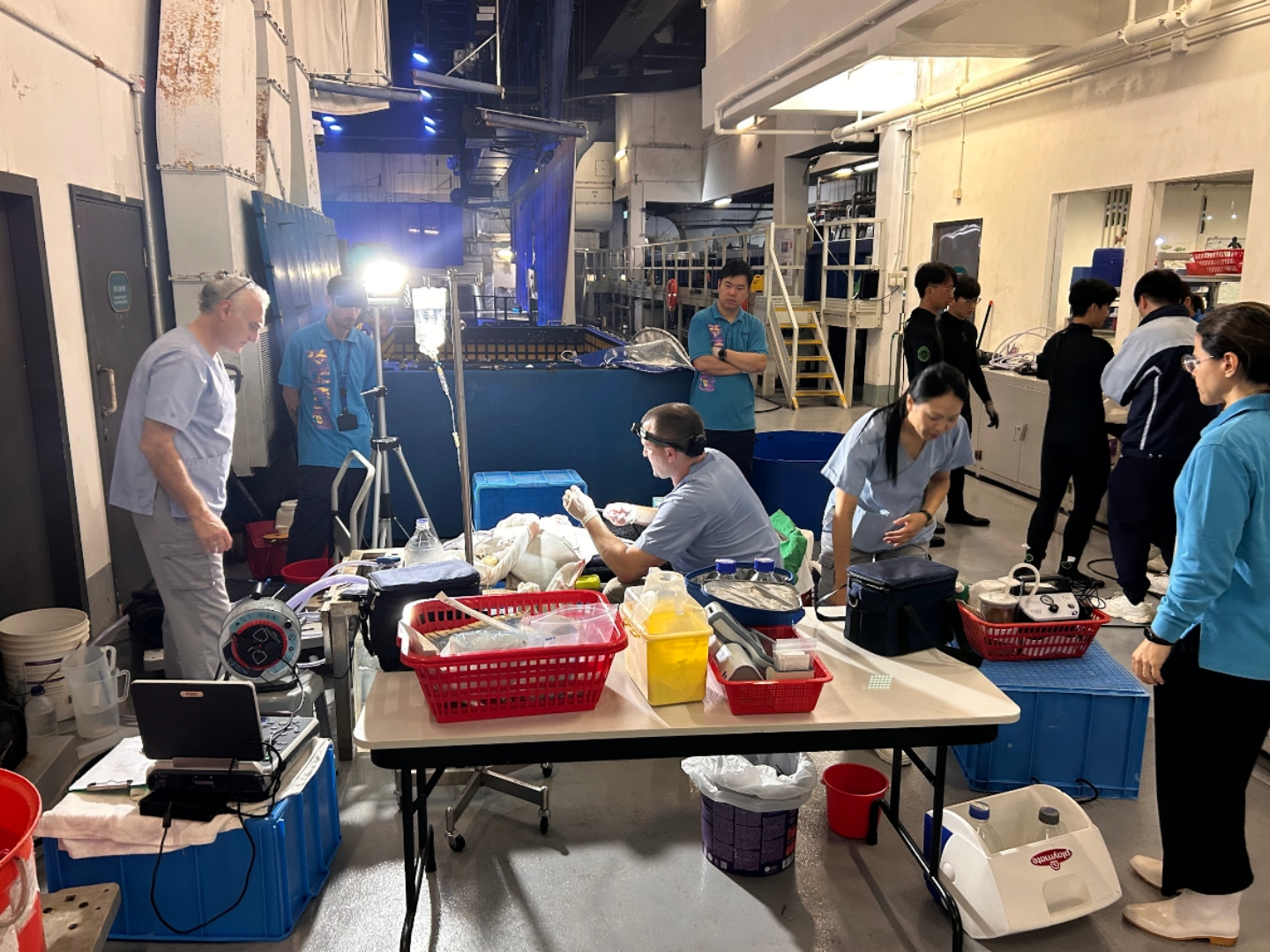
Ocean Park said its veterinary team has successfully saved a cownose ray from a life-threatening gastric rupture in what experts believe may be a world-first surgical achievement.
In an announcement that coincides with World Veterinary Day on Saturday, the park said the approximately 20-year-old male ray was discovered to have excessive fluid buildup and a persistent intestinal protrusion during a routine health examination in late March.
Further diagnostic testing revealed a grave internal injury: foreign objects, including remnants of a fish head and squid tentacles, had escaped into the ray's body cavity, indicating a severe stomach wall perforation.
A subsequent CT scan confirmed the extent of the damage, with Ocean Park saying that the condition would have been fatal without surgical intervention.
The team performed a two-hour exploratory surgery under general anaesthesia the following day, in which surgeons removed the foreign debris and repaired the stomach perforation.
Open surgery on elasmobranchs – the class of marine animals that includes sharks and rays – presents unique challenges, in which veterinarians must manage anaesthesia on an aquatic animal outside of water, navigate the complexities of gastric surgery and contend with poor wound healing and post-operative infection risks.
"This was truly one of the rarest cases our team has ever encountered," said Paolo Martelli, the park's director of veterinary services.
"We are not aware of any global precedents for a gastric rupture of this nature in a cownose ray receiving such an emergency and extensive surgical repair, making this a potentially pioneering achievement in marine veterinary medicine."
The ray is now in a stable condition, with the surgical wound showing no signs of complications. The veterinary team said it would continue to monitor its recovery closely.
Ocean Park highlighted the case as part of its ongoing commitment to animal care, research and conservation, noting that the expertise of its veterinary staff not only ensures the well-being of the park's animal ambassadors but also contributes valuable insights to global veterinary science.
Edited by Thomas McAlinden
Vets show guts in fish-out-of-water surgery on ray
2026-04-25 HKT 14:47
Share this story


