


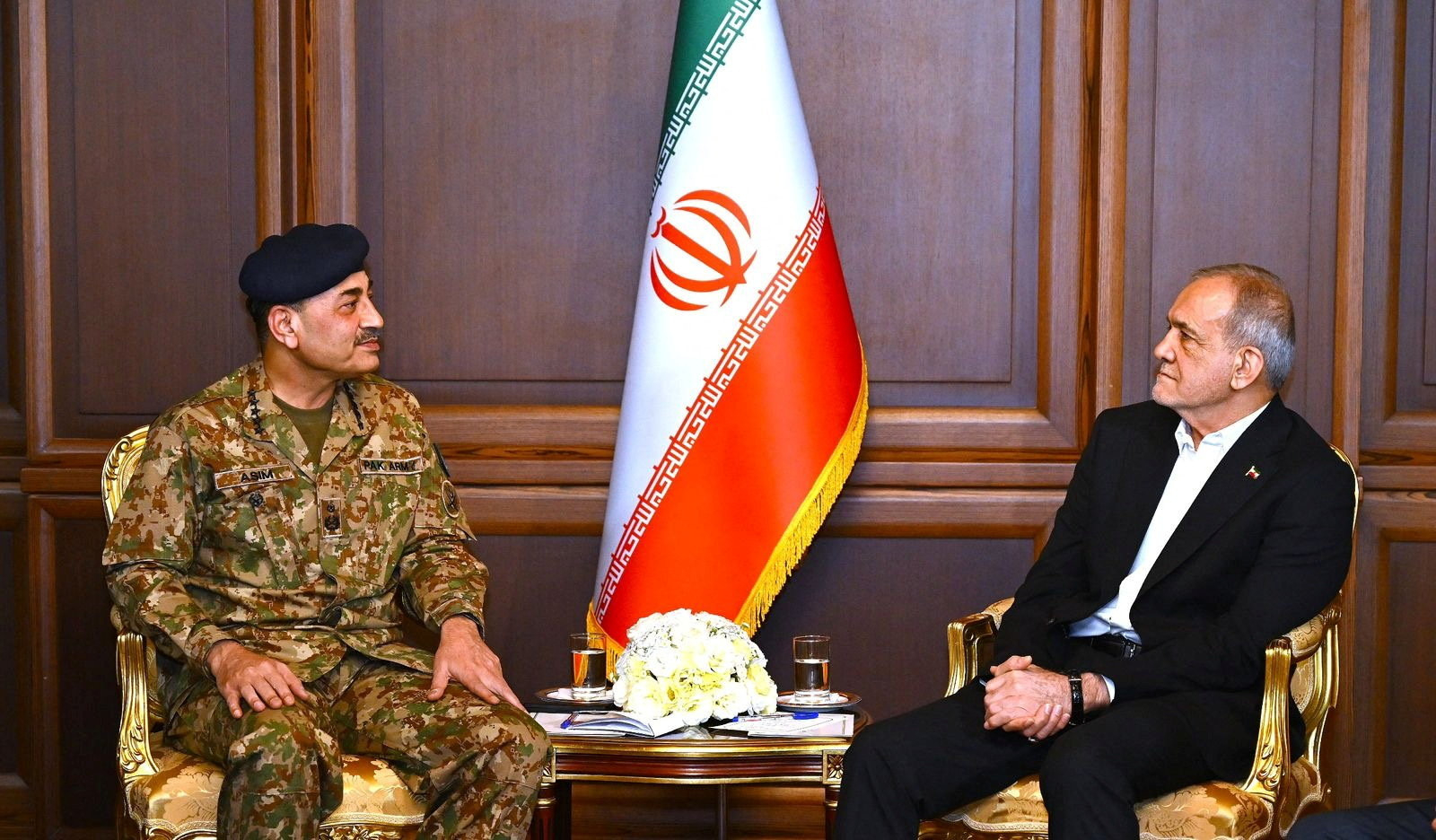
Iran's President Masoud Pezeshkian said on Thursday a US naval blockade of Iranian ports would deepen disruptions in the Gulf and fail to achieve its objectives.
"Any attempt to impose a maritime blockade or restrictions is contrary to international law... and is doomed to fail," he said in a statement.
Pezeshkian added that such measures would "not only fail to enhance regional security, but are in fact a source of tension and a disruption to lasting stability in the Persian Gulf".
The United States imposed a naval blockade on Iran's ports and coasts on April 13, days after a ceasefire paused its war with Iran.
Iran's military has kept shut the strategic Strait of Hormuz, a vital conduit for global oil and gas shipments, and recently threatened to "respond" if the US blockade continued.
On Wednesday, the military adviser to Iran's supreme leader Mojtaba Khamenei reiterated the warning, without elaborating.
"We will not tolerate the naval blockade. If it continues, Iran will respond," Mohsen Rezaei, a former commander-in-chief of Iran's Revolutionary Guards who was named as a military adviser by Khamenei in March told state TV.
He also warned against a new round of fighting between the US and Iran, saying it could possibly see US ships sunk and "its soldiers will be killed."
"If the US starts another war, it should expect that we take a large number of them prisoner," he added.
Oil Minister Mohsen Paknejad said the US "will not gain any results" from its blockade, dismissing any concerns over oil supply and distribution.
"Oil industry employees are working around the clock to ensure that there is no problem in providing services," he told state TV.
Also on Wednesday, Iran's army navy commander Shahram Irani signalled that Iran will deploy "in the very near future" naval weaponry which it has recently developed.
Pezeshkian's warning came as US news website Axios reported that President Donald Trump would receive a briefing on Thursday that will see the leader of the US Central Command, Brad Cooper, outline new plans for potential military action against Iran.
Centcom has prepared a plan for a "short and powerful" wave of strikes on Iran, likely including infrastructure targets, it reported, citing sources.
Another plan expected to be shared with Trump is focused on taking over part of the Strait of Hormuz to reopen it to commercial shipping, the report added, saying such an operation may involve ground forces.
Washington hopes to make Iran more flexible at the negotiating table on nuclear issues, Axios reported.
Another option that might come up in the briefing, which will also see the chairman of the Joint Chiefs of Staff Dan Caine attend, is a special forces operation to secure Iran's stockpile of highly enriched uranium, it said. (AFP & Reuters)
Edited by Thomas McAlinden
US warned again on blockade amid talk of new strikes
2026-04-30 HKT 16:52
Share this story


