


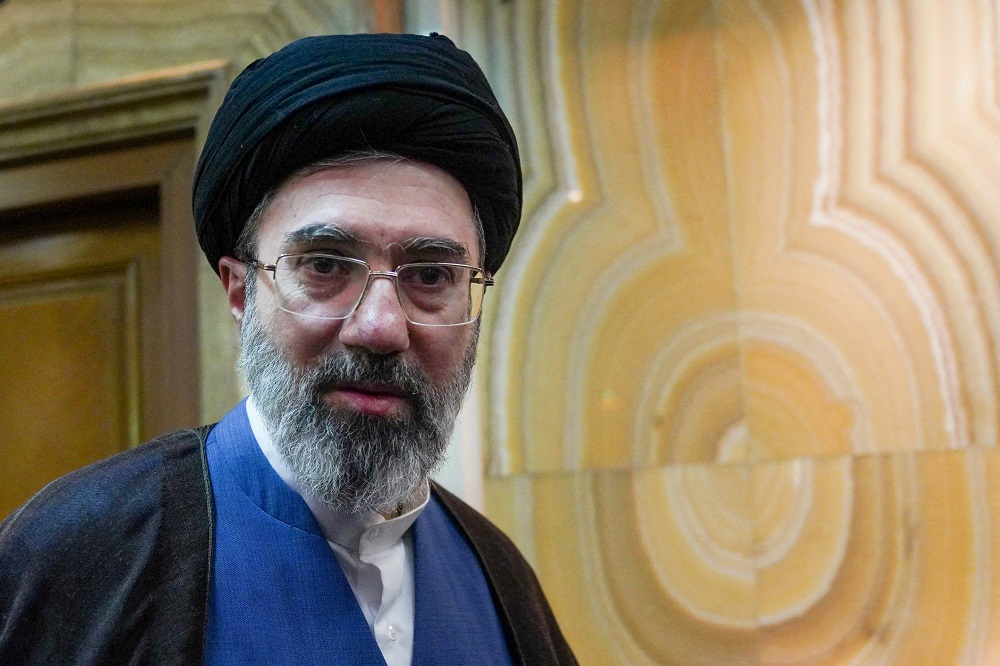
Iran's supreme leader declared on Thursday that the United States had suffered a shameful defeat, defiantly rejecting a warning from US President Donald Trump that an economically punishing US naval blockade could be enforced for months to come.
Oil prices hit a four-year high, then fell back slightly, before Mojtaba Khamenei issued a written message read out on state television declaring that Iran was now in the driver's seat in the crisis.
"Today, two months after the largest military deployment and aggression by the world's bullies in the region, and the United States' disgraceful defeat in its plans, a new chapter is unfolding for the Persian Gulf and the Strait of Hormuz," he said, hailing Iran's control over shipping in the strait.
He went on to predict a bright future for the Gulf without the United States, saying those who interfere in the region from afar "have no place there except at the bottom of its waters."
Khamenei was wounded in the initial US-Israeli strikes that killed his father Ali Khamenei, and has not been seen in public since being named his successor as supreme leader last month.
The United States imposed a blockade on Iran's ports two weeks ago, while the Islamic republic has maintained its stranglehold over the strategic Strait of Hormuz since the start of the Middle East war at the end of February.
Now Washington is seeking to set up an international coalition comprising allied states and shipping firms to coordinate safe passage through Hormuz, a State Department official said – while maintaining its blockade of ships serving Iran.
And Iran's parliament speaker Mohammad Bagher Ghalibaf said control of Hormuz would allow Tehran to "provide itself and its neighbours with the precious blessing of a future free from American presence and interference."
Trump is expected to receive a briefing on Thursday on new plans for potential military action in Iran from Admiral Brad Cooper, the head of US Central Command, two sources with knowledge of US planning told news site Axios.
Israeli Defence Minister Israel Katz warned, meanwhile, that it was "possible that we may soon have to act again" against Iran to achieve the war's objectives.
But the commander of the Iranian Revolutionary Guards aerospace force, Majid Mousavi, said that even a "short and tactical" enemy operation would be met with "with painful, prolonged, and extensive strikes."
This week Trump has reportedly told oil executives and national security officials to prepare for a long US blockade designed to force Tehran to surrender its nuclear programme, and, speaking to Axios, said: "They are choking like a stuffed pig."
US Central Command said on Wednesday in a social media post that it had reached a "significant milestone after successfully redirecting the 42nd commercial vessel attempting to violate the blockade."
Iranian President Masoud Pezeshkian said that the blockade of his country's ports was effectively an "extension of military operations" by Washington, in spite of the ongoing ceasefire.
"Continuation of this oppressive approach is intolerable," he added.
Oil prices struck a four-year high on Thursday. International benchmark Brent crude soared more than seven percent to US$126 a barrel, but then eased in afternoon trading in London.
UN chief Antonio Guterres said the closure of Hormuz was "strangling the global economy" and International Energy Agency chief Fatih Birol told a meeting at his Paris headquarters: "The world is facing the biggest energy crisis in history."
Trump faces domestic political pressure to end the war, which is unpopular even with much of his base, and has increased costs for American consumers and unnerved US allies.
Iran's economy is also suffering and the rial has fallen to historic lows against the dollar. (AFP)
Edited by Robert Kemp
Iran's supreme leader rejects Trump's blockade warning
2026-05-01 HKT 10:01
Share this story


