


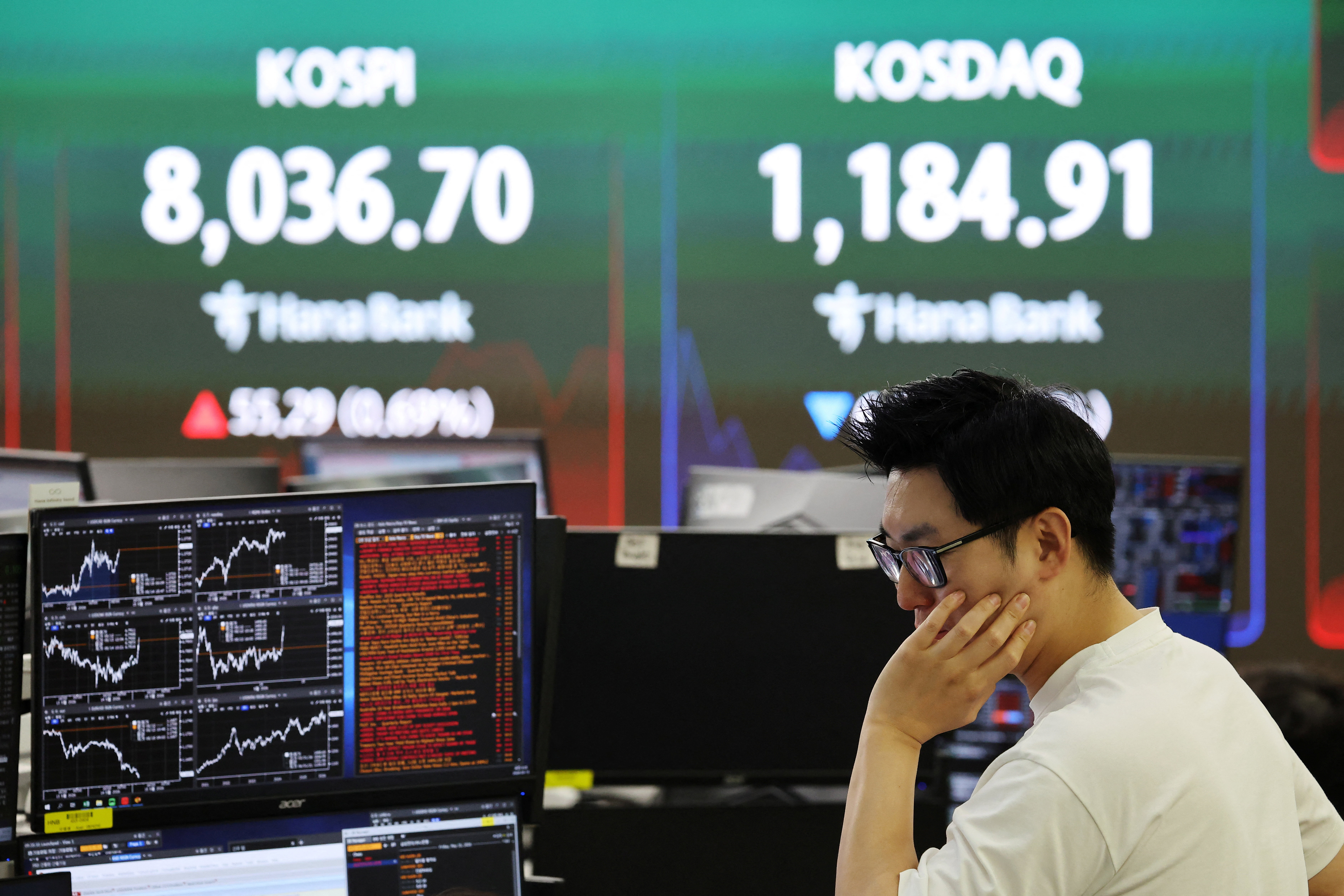
Mainland stocks fell on Friday amid a broader market selloff as a two-day summit between President Xi Jinping and his US counterpart, Donald Trump, produced few deals between the world's top two economies to excite investors.
In Hong Kong, the benchmark Hang Seng Index dropped 426 points, or 1.6 percent, to 25,962 on turnover of HK$325.39 billion.
The China enterprises index was 167 points, or 1.9 percent, down at 8,691 while the tech index was 135 points, or 2.7 percent, lower at 4,941.
Up north, the benchmark Shanghai Composite Index ended down 42 points, or 1.02 percent, at 4,135.
The Shenzhen Component Index closed 184 points, or 1.17 percent, lower at 15,561 while the ChiNext closed 22 points, or 0.56 percent, at 3,929.
China’s blue-chip CSI300 Index too fell over one percent as investors' euphoria over tech stocks gave way to inflation fears amid rising wagers of US rate hikes this year.
In Tokyo, the Nikkei reversed early gains of up to 0.9 percent to end the day down 1,244 points, or two percent, sending the benchmark index to a weekly loss as traders took profits on high-flying tech shares heading into the weekend.
In Seoul, the Kospi fell sharply to end 488 points, or 6.12 percent, at 7,493, reversing early gains that had lifted the benchmark index to record highs, as falling chipmakers broke a five-week run of gains.
The South Korean benchmark ended the week 0.1 percent lower.
The losses came as Trump and Xi concluded on Friday their two-day summit.
"I think we were optimistically looking at the meeting and maybe half expecting some huge trade agreement to be proposed or announced, and from that view, it has disappointed," said Nick Twidale, chief market analyst at ATFX Global.
It was undecided whether the October trade truce will be extended after it expires later this year, US Trade Representative Jamieson Greer told Bloomberg TV on Friday, but added that deals had been firmed up on Chinese purchases of farm goods and beef.
Investor attention will be on whether detailed agreements are announced now that the summit is over.
"This [summit] was not a meeting aimed at a full reset of US-China relations," said Cliff Zhao, chief economist at CCB International.
It was more about promoting high-level communication, reducing near-term uncertainty, and setting clearer boundaries for competition, he said. (Reuters/Xinhua)
Edited by Tony Sabine
HK stocks slip as summit ends with dearth of deals
2026-05-15 HKT 16:48
Share this story


