


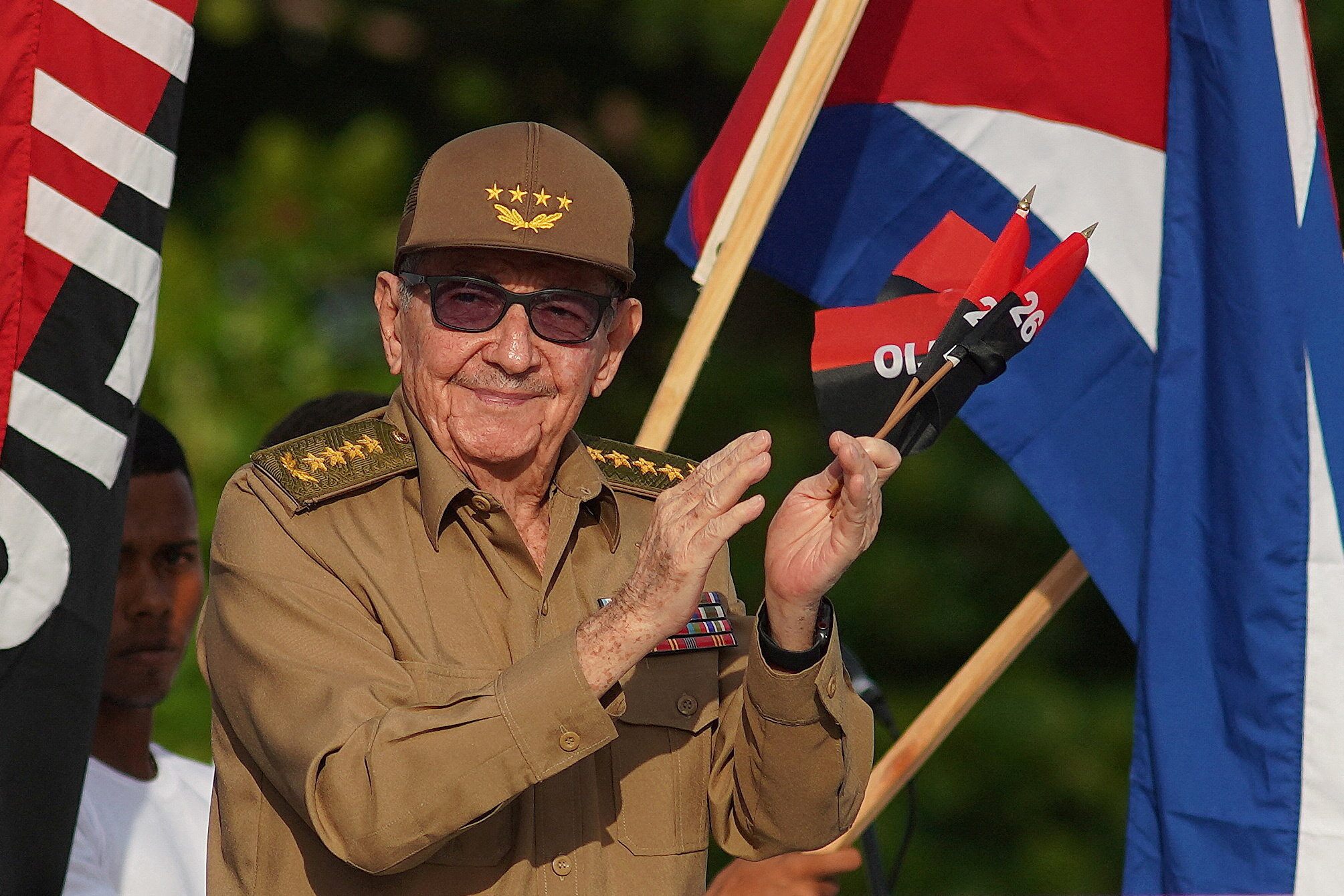
The United States announced murder charges against former Cuban president Raúl Castro on Wednesday, a major escalation in Washington's pressure campaign against the island.
The charges against Castro and five fighter pilots in the Cuban military stem from a 1996 incident in which Cuban jets shot down planes operated by a group of Cuban exiles.
Raúl Castro, 94, was charged with one count of conspiracy to kill US nationals, four counts of murder, and two counts of destruction of aircraft. He appeared in public in Cuba earlier this month and there is no evidence he has left the island or that he will be extradited.
"From the shores of Havana to the banks of the Panama Canal, we will drive out the forces of lawlessness and crime and foreign encroachment," Trump said at a Coast Guard Academy event in New London, Connecticut, earlier on Wednesday.
Speaking at a ceremony in Miami to honour the victims of the 1996 incident, US acting Attorney General Todd Blanche did not directly answer questions about whether the US military would arrest Castro.
Blanche said he expected Castro to one day face the charges.
"There was a warrant issued for his arrest, so we expect that he will show up here by his own will or by another way," Blanche said to applause in a packed auditorium of government officials and Cuban Americans.
In a post on X, President Miguel Diaz-Canel said Cuba had acted legitimately to defend its territory in shooting down the planes. He said the indictment appeared to be intended to justify military action against Cuba, which he said would be a mistake.
"It is a political manoeuvre, devoid of any legal foundation," Diaz-Canel said.
Diaz-Canel said on Monday that the island does not represent a threat.
The charges come months after the US capture of Venezuelan President Nicolas Maduro on January 3 to face drug trafficking charges in New York. Maduro, a socialist aligned with Havana, pleaded not guilty.
Trump has repeatedly signalled that the Cuban government could be next after Venezuela to fall, and earlier this month even said Washington would be "taking over" the Caribbean island, about 145 kilometres from Florida, "almost immediately."
In a video message to Cuban people in Spanish, Secretary of State Marco Rubio, a Cuban-American, accused the Havana leadership of theft, corruption and oppression.
"President Trump is offering a new path between the US and a new Cuba," Rubio said.
"A new Cuba where you have a real opportunity to choose who governs your country and vote to replace them if they are not doing a good job."
Rubio earlier on Wednesday offered Cuba US$100 million in aid, and blamed Cuba's leaders for shortages of electricity, food and fuel. Cuban Foreign Minister Bruno Rodriguez called that offer cynical, citing the "devastating effect" of the US economic blockade.
Born in 1931, Raúl Castro was a key figure alongside his older brother in the guerrilla war that toppled US-backed dictator Fulgencio Batista.
After taking power, Fidel Castro struck an alliance with the Soviet Union, then seized US-owned businesses and properties. The US has since maintained an economic embargo on the nation of about 10 million.
Raúl Castro helped defeat the US-organised Bay of Pigs invasion in 1961, and served as defence minister for decades. He succeeded his brother as president in 2008 and stepped down in 2018, but remains a powerful behind-the-scenes figure in Cuban politics. (Agencies)
Edited by Cecil Wong
US charges ex-Cuban leader Raúl Castro with murder
2026-05-21 HKT 06:35
Share this story


Jamie Clarke reports

