


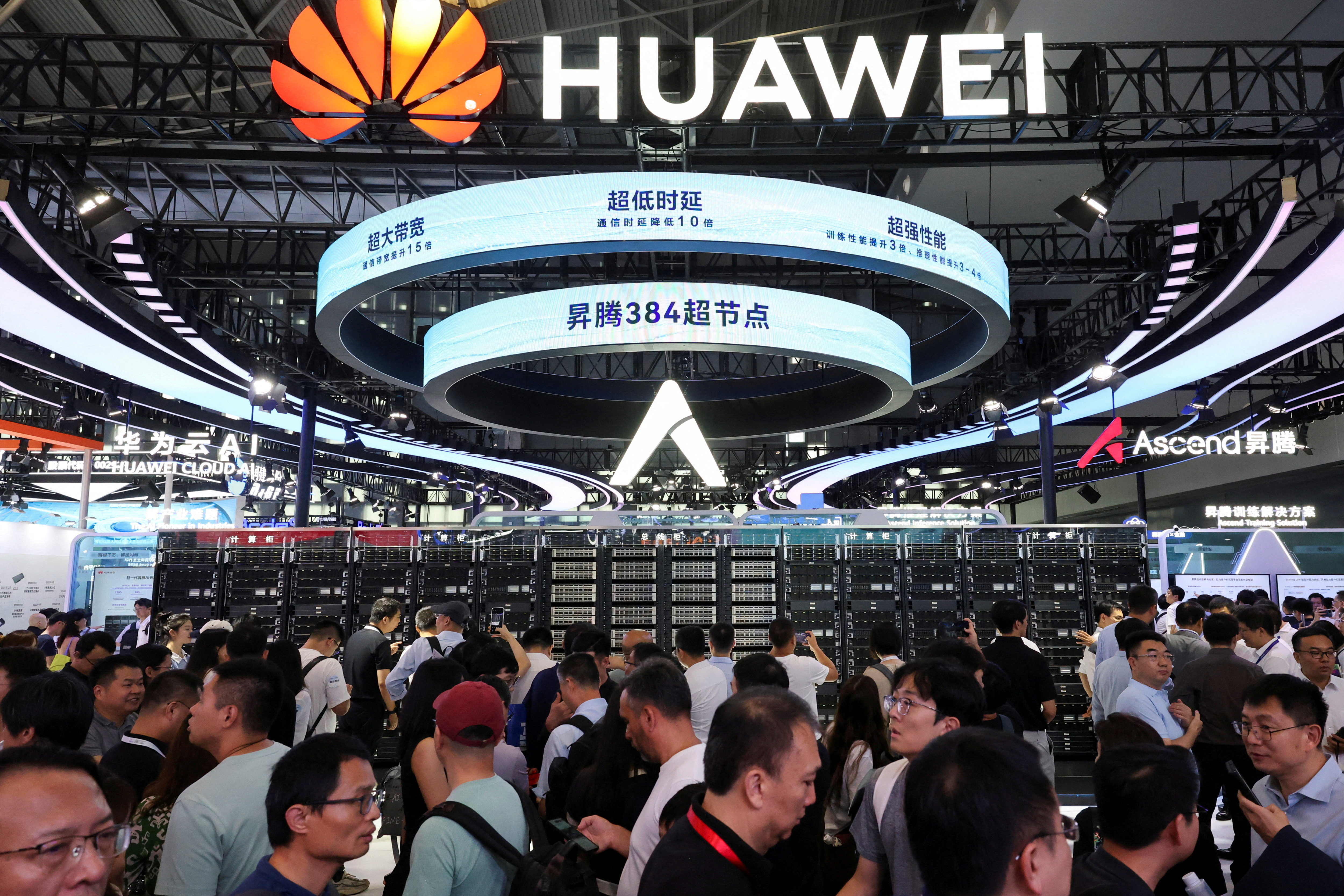
Huawei Technologies expects to design high-end chips by 2031 with transistor density equivalent to 1.4-nanometre processes despite US sanctions that have made it hard for China to build the world's most advanced chips.
The projection, made by Huawei on Monday in a statement, was the most eye-catching claim of what the company calls the Tau Scaling Law, a new principle for improving chips as the industry can no longer rely mainly on making transistors smaller.
He Tingbo, president of Huawei's semiconductor business and director of its scientist committee, introduced the new concept in a keynote speech titled "New Semiconductor Path in Practice" at the 2026 IEEE International Symposium on Circuits and Systems in Shanghai on Monday, the company said.
Although Huawei did not provide independent performance data, the target is significant because 1.4 nanometres is expected to be close to the global frontier for advanced chipmaking around the end of the decade.
The Tau Scaling Law focuses on cutting the time it takes signals and data to move through chips and computing systems, Huawei said.
If successful, it could offer the company a way to improve performance and chip density despite US restrictions on China's access to the most advanced semiconductor equipment.
Huawei said its Kirin chips scheduled to launch this autumn would be the first to use a related architecture called LogicFolding, which the company said would shorten wiring inside chips and considerably improve performance.
It had designed and mass-produced 381 chips over the past six years based on the Tau Scaling Law, for use in industries including smartphones and AI computing, the company said. (Reuters)
Edited by Aaron Tam
Huawei reveals chip design breakthrough
2026-05-25 HKT 17:00
Share this story


