


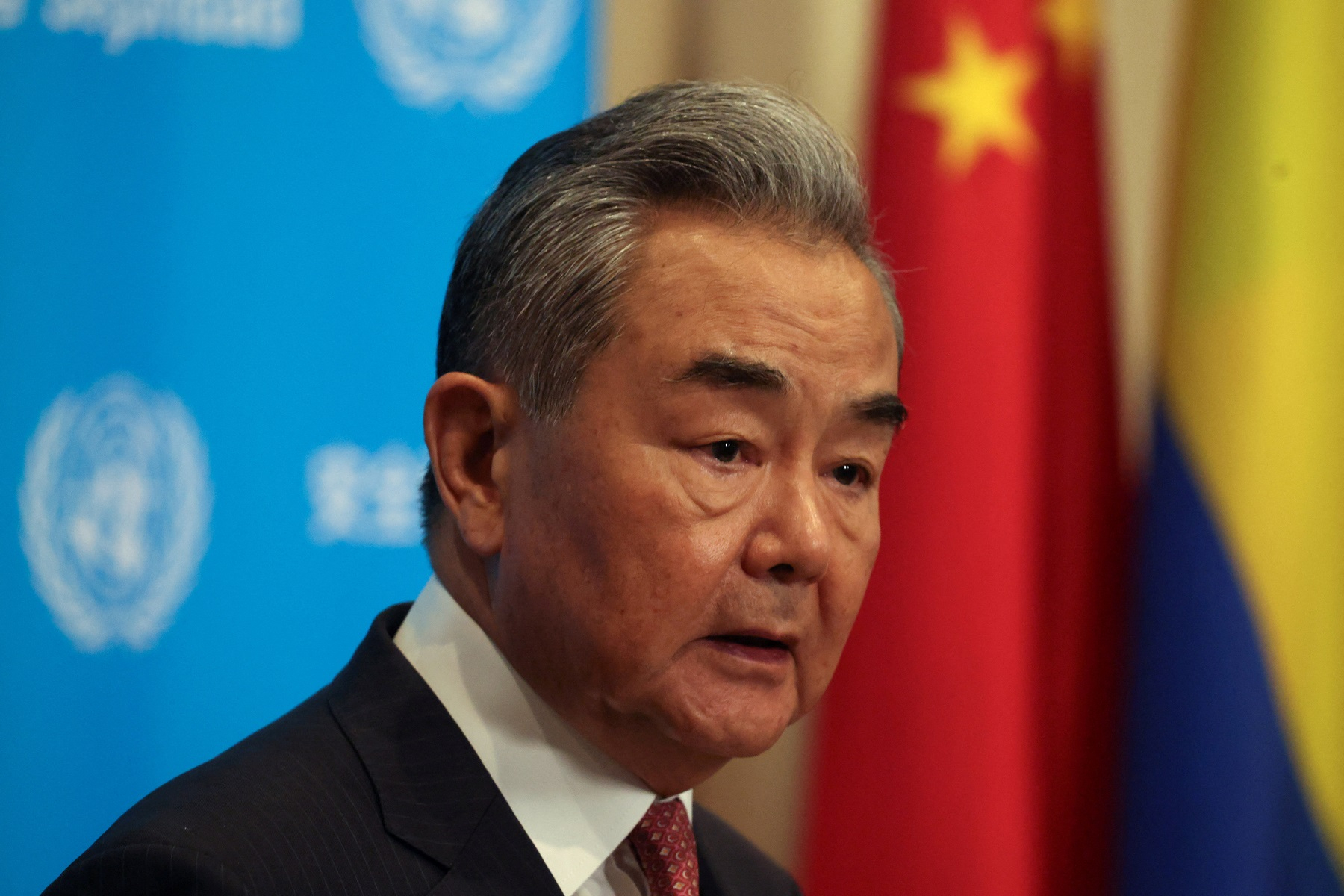
Foreign Minister Wang Yi said on Tuesday he hoped parties in the Iran conflict can stay committed to pursuing a ceasefire and continue to meet each other halfway.
Iran said on Tuesday the United States had violated the ceasefire after the US conducted what it called defensive strikes in southern Iran.
"We hope that the parties concerned can stay committed to pursuing a ceasefire and continue to meet each other halfway, so that peace can return to the Middle East as early as possible," Wang told reporters at the United Nations in New York after chairing a meeting of the 15-member Security Council.
"As we have been saying, it takes more than one cold day to freeze three feet of ice, and long-standing issues cannot be resolved overnight," Wang added.
"However, every step forward in the negotiation brings more hope to peace, and one day earlier the conflict is ended means less civilian casualties."
Iran's foreign ministry said US strikes in Iran's southern Hormozgan province, where Iranian media reported sounds of explosions early on Tuesday, represented a "gross violation" of a tenuous ceasefire in place for nearly seven weeks. The US said its attacks were defensive in nature, targeting missile sites and boats attempting to lay mines.
US Secretary of State Marco Rubio, meanwhile, said it could take "a few days" to negotiate a deal to halt the conflict, after both sides had previously indicated progress on an initial agreement that would end hostilities and restart shipping through the Strait.
That initial agreement would give negotiators 60 days to tackle more complex issues including Iran's nuclear programme.
Iranian media reported that the country's negotiators had been pushing for the memorandum to include the release of billions of dollars of frozen assets.
Following the US strikes, Rubio told reporters on his plane in India that the Strait of Hormuz had to be open "one way or the other".
The war, which began with US and Israeli strikes on Iran on February 28, has caused an unprecedented oil supply shock, pushing up the costs of fuel, fertiliser and food.
Traffic through the Strait of Hormuz, which normally carries about a fifth of global trade in oil and liquefied natural gas, has been a fraction of its usual level since the war began.
Iran's Revolutionary Guards said 25 oil tankers and other vessels had passed through the strait with its permission over the past 24 hours. Global benchmark Brent crude futures rose by about 3.5 percent on Tuesday to around US$100 a barrel.
The Revolutionary Guards said on Tuesday they reserved the right to retaliate to the strikes. They said air defence units had downed a US drone and fired at another drone and a fighter jet which they said had entered Iranian airspace over the Gulf region.
In comments posted on his Telegram channel on the occasion of the annual hajj pilgrimage, Iran's Supreme Leader Ayatollah Mojtaba Khamenei said: "From now on, the slogans 'Death to America' and 'Death to Israel' will be the slogans of the Islamic nation and the oppressed people of the world." (Reuters)
Edited by Cecil Wong
Wang Yi calls for compromise in Middle East conflict
2026-05-27 HKT 07:24
Share this story


