


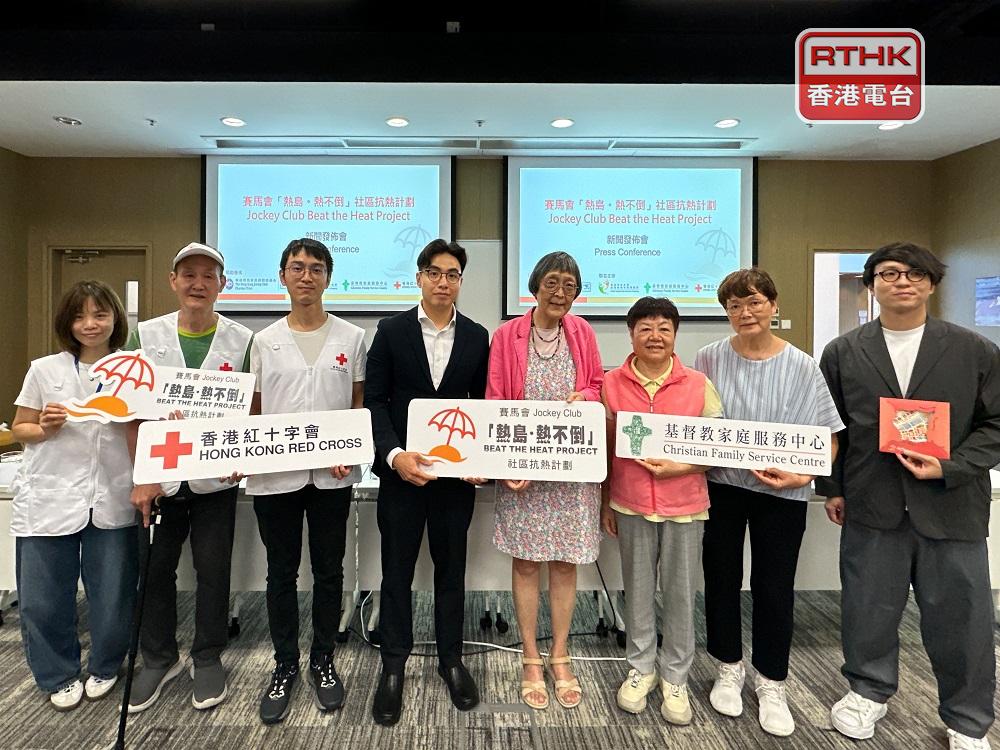
The current heat wave gripping Hong Kong has helped highlight the significance of a project offering help to the elderly through personalised interventions and heat-relief supplies.
According to the Observatory, a new record of hot nights for May could be set if the temperature hits 28 degrees Celsius or more in the following nights.
There have already been five consecutive hot nights since Saturday, and the current record for the month stands at six.
On Thursday, Sheung Shui recorded a maximum temperature of 37 C. It's expected to be extremely hot again on Friday, with the mercury rising to 35 C in urban areas and 37 C in the New Territories.
The “Beat the Heat” project, launched by four institutions, has so far helped more than 1,500 elderly in Yau Tsim Mong and Kwun Tong cope with extreme heat.
Running from March 2024 to February 2027, the project is co-organised by the Chinese University of Hong Kong, the university's Jockey Club Institute of Ageing, the Christian Family Service Centre and the Hong Kong Red Cross.
As part of the scheme, social workers, nurses and community volunteers provide home visits and education on heat knowledge, assess heat risks, and recommend practical changes to matters such as electric fans, curtains, decluttering and personal hydration, with the average age of the elderly being 77.
In Yau Tsim Mong, project participants receive a map of hot and cool spots, heat-relief supplies and minor home upgrades.
In Kwun Tong, seven cooling stations have been set up in public housing estates, offering air-conditioning and elderly-friendly facilities.
Eric Lai, co-principal investigator of the project from the university, said significant improvements in heat-health knowledge and quality of life were registered in project participants, including an increased likelihood of cooler comfort at home, better self-rated health and reduced heat-related symptoms.
"One of the most common misconceptions that we have encountered during public education is about the perception of heat, with many of them feeling that the [ambient] temperature is not hot," Lai said.
"That's quite common because it is a natural ageing process that, as we grow older, we have a decreased sensitivity to the environment, so even when the environment is, by young people's standard, hot, but older people might not feel it is so."
Lai said that is why the project group has been distributing thermometers to the elderly so that they can tell when their homes need to be dehumified, ventilation has to be improved and air-conditioners need to be turned on – even when they do not feel hot.
He added that if discomfort caused by hot weather was not promptly addressed, it might cause heat cramps or heat exhaustion.
Wong, who has been living in Yau Tsim Mong for 10 years, said he could not sleep well during summers due to the heat.
Project volunteer helped by installing LED lights, getting him a dehumidifier and alleviating clutter in his residence.
“It reached 35 to 36 degrees Celsius at night back then, but it’s only 27 to 28 degrees now,” Wong said.
Based on findings, Lai said, the project group will develop a community service protocol next year with the aim of integrating it into existing district services.
To cope with heat, he reminded people to stay hydrated even if they did not feel thirsty in summer.
Lai also urged people to keep their homes well ventilated.
Edited by Edmond Fong
Relief for the elderly amid scorcher
2026-05-28 HKT 19:27
Share this story


CUHK's Eric Lai speaks to Henry Siu

