


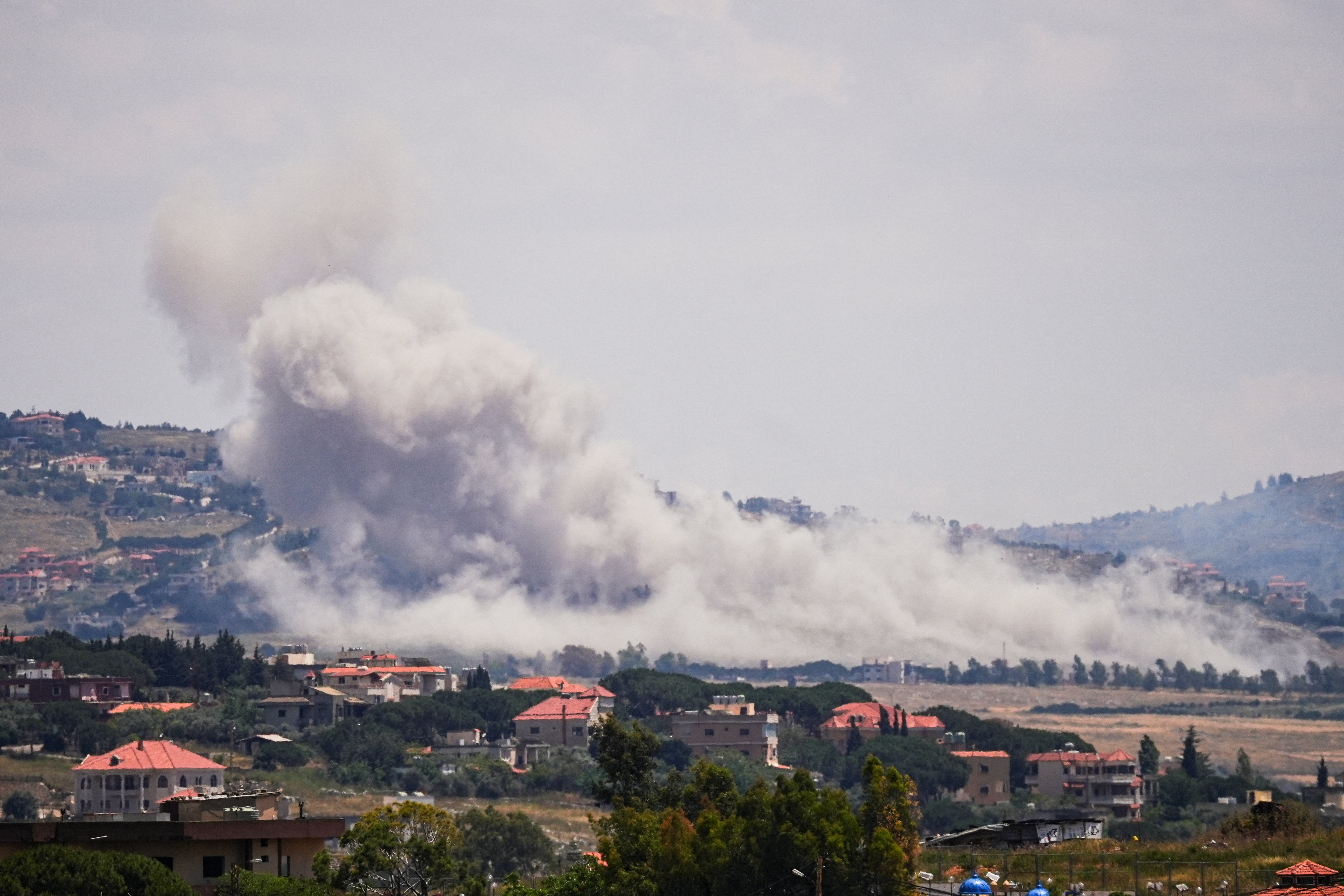
Israeli Prime Minister Benjamin Netanyahu said his country's forces had pushed deeper into Lebanon, even as military delegations from both countries held landmark security talks in Washington.
Israel kept up its heavy bombardment of south Lebanon, prompting President Joseph Aoun to emphasise in a call with US Secretary of State Marco Rubio "the need to exert all efforts to reach a ceasefire".
A truce to halt the fighting between Israel and Tehran-backed Hezbollah officially took effect on April 17 but has never been observed, with Iran insisting that Lebanon be included in any agreement with the United States to end the wider war that engulfed the region in February.
Both Israel and Hezbollah accuse each other of violating the ceasefire and justify their attacks by the other's alleged breaches.
Netanyahu announced on Friday that Israeli forces had advanced beyond a river that runs around 30 kilometres north of the Lebanon-Israel frontier.
"Our forces have crossed the Litani, they have moved up to the commanding terrain," he said in a video released by his office, adding Israel was "hitting Hezbollah head on".
Israel and Lebanon began direct talks in April, with a fourth round expected next week in Washington following Friday's meeting at the Pentagon, running parallel to efforts by the US to strike a deal with Iran to end the regional war and blockade of the strategic Strait of Hormuz.
Fighting raged despite the talks with Israeli strikes in the southern city of Tyre killing 11 people, according to Lebanon's health ministry, which called the bombardment a "flagrant violation of humanitarian law".
Hezbollah said it had launched attacks targeting soldiers, barracks and a military camp in northern Israel on Friday and Israel's military in the early hours of Saturday morning confirmed it had intercepted several projectiles from Lebanon, with one hitting near the Israeli town of Kiryat Shmona.
Hezbollah also said its forces attacked Israeli troops trying to advance near the medieval Beaufort fortress, also known as Qalaat al-Chakif, a site Israel's forces had used as a base during their two-decade occupation of southern Lebanon ending in 2000.
On Friday, Lebanon's state-run National News Agency reported Israeli airstrikes on more than 20 locations in the south, before and after its military issued evacuation warnings for eight towns, sparking a huge wave of displacement
Lebanon's health ministry said on Friday Israeli attacks have killed at least 3,355 people since March 2 – an increase of 31 compared to Thursday when Israeli carried out the first airstrike near Beirut in weeks. (AFP)
Edited by Tony Sabine
Israeli forces push deeper into Lebanon amid talks
2026-05-30 HKT 13:35
Share this story


