


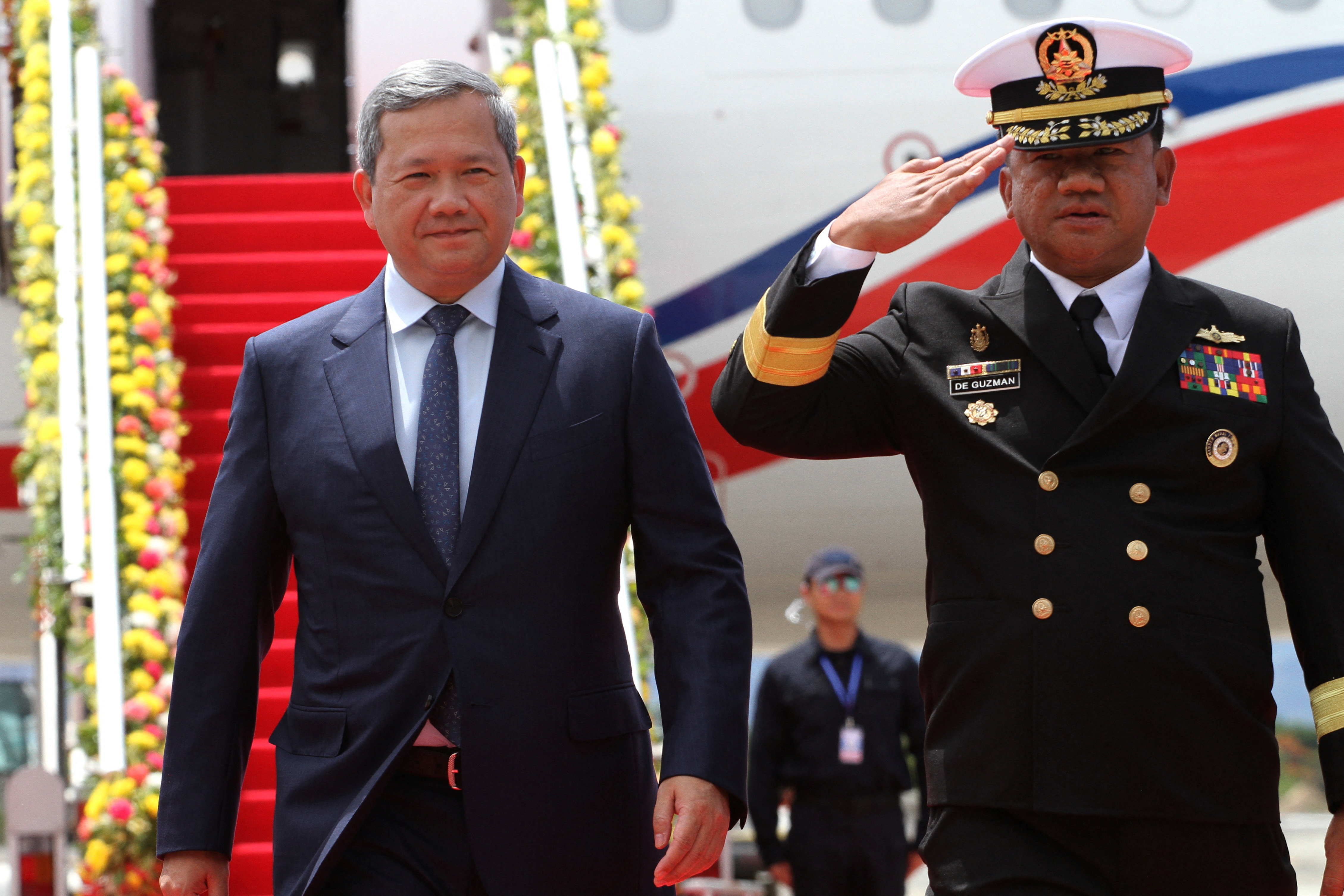
Cambodia said on Tuesday it informed the United Nations and Thailand that it had launched a compulsory conciliation process under international law aimed at resolving a long-running maritime boundary dispute with Bangkok.
The move follows a Thai government decision last month to unilaterally terminate a 2001 agreement with Cambodia that provided a framework for negotiations over the disputed area in the Gulf of Thailand where the two countries' maritime claims overlap.
"We have taken this step to protect Cambodia's sovereignty and maritime rights in accordance with international law," Cambodian Prime Minister Hun Manet said.
Manet's Thai counterpart, Anutin Charnvirakul, said he was not aware of the Cambodian move.
Thailand's cancellation was part of a campaign pledge by Anutin, who won re-election in February on a wave of nationalistic sentiment after two rounds of deadly military clashes between the countries last year along their disputed border.
Under the United Nations Convention on the Law of the Sea, a compulsory conciliation process allows a panel of independent experts to examine a dispute and make recommendations, although its findings are not legally binding on either party.
Thailand has previously said it would use convention as a reference framework while pursuing direct negotiations with Cambodia on maritime boundary demarcation.
The two countries each lay claim to approximately 26,000 square kilometres of sea in the Gulf of Thailand, known as the overlapping claims area, which is estimated to hold nearly 339.8 billion cubic metres of natural gas and large quantities of oil, worth about US$300 billion.
The oil shock from the Iran conflict has created renewed urgency to resolve the dispute and unlock the undersea energy resources, Cambodia's energy minister said last week.
Cambodia has appointed Foreign Minister Prak Sokhonn as its agent for the proceedings, alongside Danish diplomat Peter Taksøe-Jensen and French academic Jean-Marc Thouvenin to act as conciliators, the government said in a statement.
"Thailand now has 21 days to appoint two of its own conciliators," Cambodia said.
The conciliators will then select a chair to finalise a conciliation commission, overseen by the UN Secretary-General, the statement added.
Thailand has repeatedly rejected Cambodian efforts to resolve disputes through international mechanisms, including the International Court of Justice, insisting that such issues should be settled through bilateral negotiations.
A ceasefire has been in place between the two countries since late December following two rounds of fighting along stretches of their 817-kilometre border last year.
Both sides have accused the other of initiating the fighting, which killed nearly 150 people and displaced hundreds of thousands. (Reuters)
Edited by Thomas McAlinden
Cambodia pushes for maritime conciliation with Thais
2026-06-02 HKT 15:13
Share this story


