


President Xi Jinping arrived in Pyongyang on Monday for a state visit to the Democratic People's Republic of Korea.
Kim Jong-un, president of State Affairs of the Democratic People's Republic of Korea (DPRK), and his wife, Ri Sol-ju, welcomed Xi and his wife, Peng Liyuan, at the airport.
After Xi walked down the airstairs, Kim shook hands with him warmly.
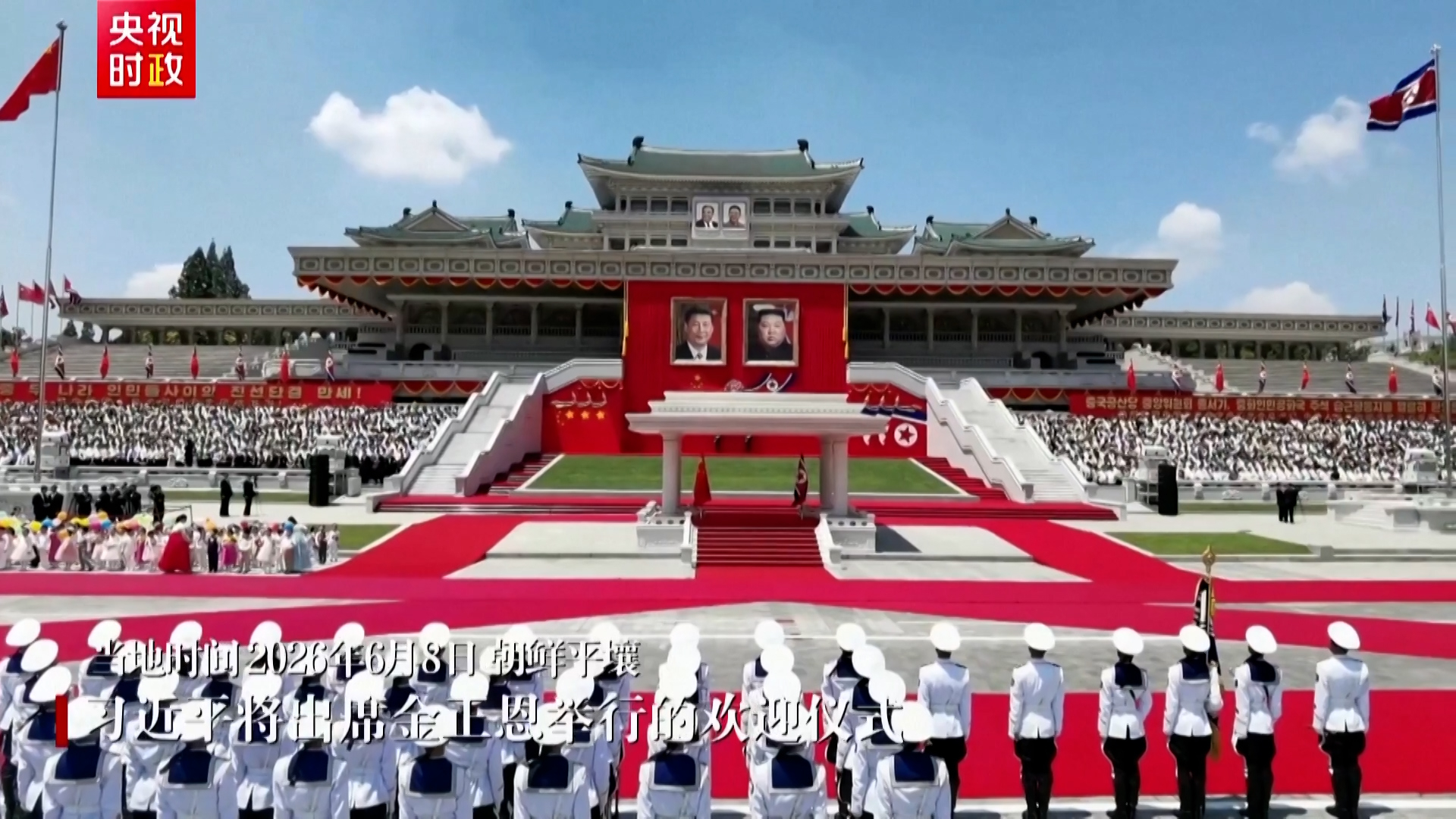
Kim held a grand welcome ceremony for Xi at Kim Il Sung Square in Pyongyang.
The top leaders of the two parties and the two countries jointly ascended the review stand.
Amid a 21-gun salute, the military band played the national anthems of China and the DPRK.
Accompanied by Kim, Xi inspected the honour guard of the three services of the Korean People's Army.
After that, Xi watched a march-past with Kim.
Dressed in festive attire, people from all walks of life in Pyongyang, along with children and teenagers, holding flags, flowers and balloons, extended their sincere welcome to the visitors with warm applause and cheers.
En route from the airport to Kim Il Sung Square and from the square to the Kumsusan State Guesthouse, people of the DPRK lined both sides of the streets, waving to welcome Xi's arrival.
In a signed article published on Monday on Rodong Sinmun prior to his arrival, Xi said he looked forward to meeting with Kim to discuss the traditional friendship between the two countries, and exchange views on the overall development of bilateral relations.
China has been the main trading partner of the DPRK by far for decades and a key source of diplomatic and economic support for the country, which has been hit by multiple international sanctions.
A banner that read "We warmly welcome Comrade Xi Jinping" and hailing the two countries' "unbreakable friendship" hung below Chinese and DPRK flags at the airport.
Xi made the trip, his first one overseas this year, after hosting back-to-back summits in Beijing with US President Donald Trump and Russia's Vladimir Putin in Beijing, and as DPRK's nuclear talks with Washington remain deadlocked.
The White House said last month that Xi and Trump "confirmed their shared goal to denuclearise" the DPRK during their summit in Beijing.
However, leader Kim's powerful sister said on the eve of Xi's arrival that the DPRK's nuclear weapons programme was "the line of no retreat".
Kim has also been emboldened by the Ukraine conflict, securing critical support from Moscow after sending troops to fight alongside Russian forces.
Some analysts say the summit could be Xi's way of countering Russia's growing influence over North Korea, but Ku Minseon, a diplomacy professor at DePaul University, stressed that "overall, Moscow is not a major power like China".
"Moscow-Pyongyang power relations are more equal than Beijing-Pyongyang; Moscow needs Kim for their war in Ukraine as much as Kim needs technology sharing and food from Russia," she said.
In an article published on the front page of the DPRK's Rodong Sinmun, Xi pledged closer cooperation.
"No matter how the times change or how the international situation evolves, the traditional friendship between the People's Republic of China and the Democratic People's Republic of Korea is always invincible," Xi wrote.
Xi last met Kim in September, when he invited the DPRK leader and Putin to a military parade in Beijing marking the 80th anniversary of the victory in the Chinese People's War of Resistance Against Japanese Aggression and the World Anti-Fascist War. (Xinhua/AFP)
Edited by Tony Sabine
Kim on hand as Xi arrives in Pyongyang
2026-06-08 HKT 15:20
Share this story


