


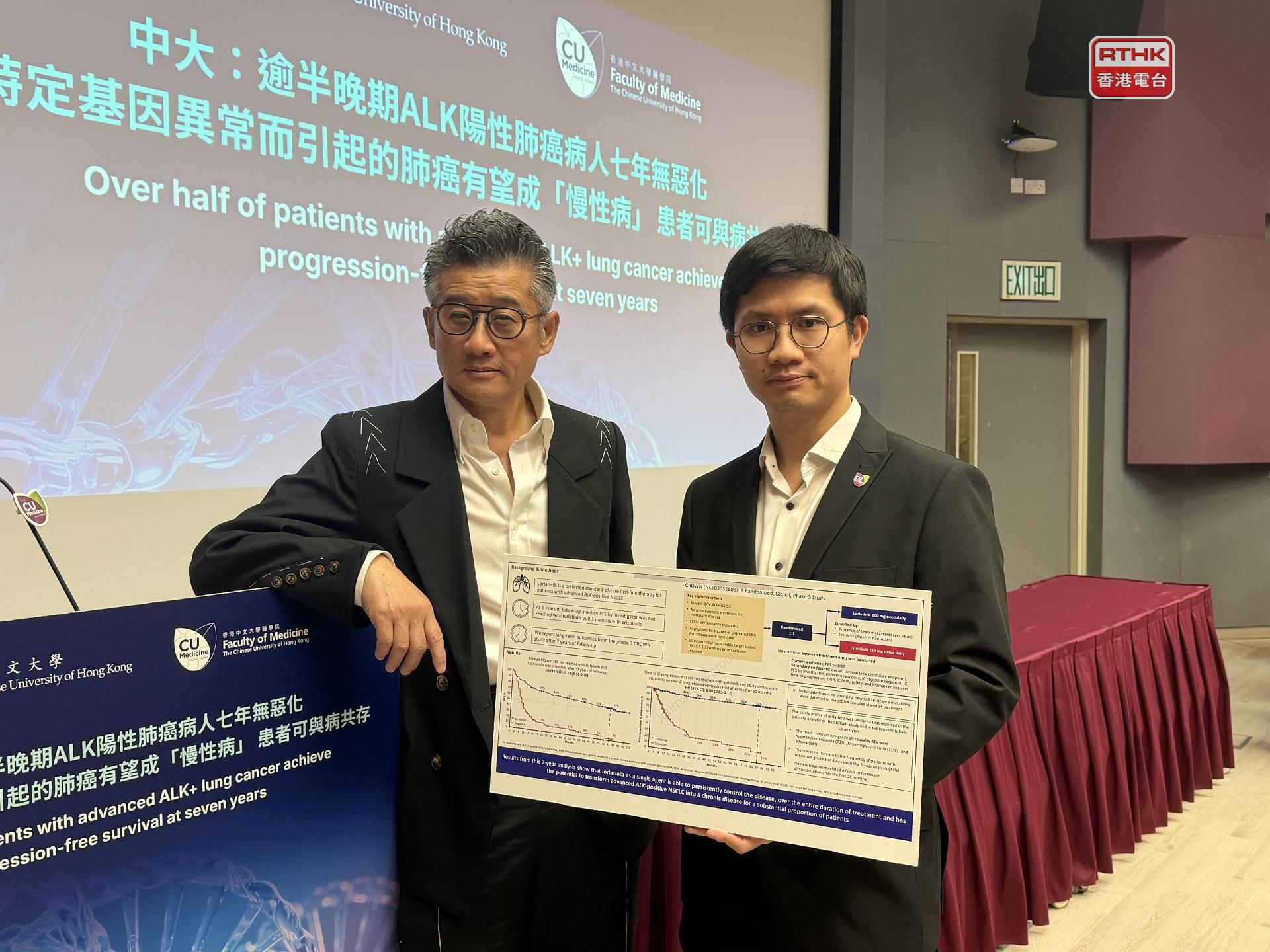
A new drug has shown major promise on its ability to suppress advanced lung cancer into a manageable chronic disease, according to researchers from the Chinese University of Hong Kong's Faculty of Medicine (CU Medicine).
In a global clinical trial spanning seven years, CU Medicine enrolled 296 advanced lung cancer patients with the ALK -- Anaplastic Lymphoma Kinase -- genomic mutation.
The ALK mutation is a genetic alteration of DNA that causes lung cells to grow abnormally, and ultimately become cancer cells.
Around half, or 149, were treated with the drug lorlatinib, a third-generation targeted therapy. The others were administered a first-generation agent as control.
Of those patients who took lorlatinib, 55 percent remained progression-free after seven years -- the longest-ever period achieved by lung cancer targeted therapies.
By comparison, only 3 percent of the other group had reached that mark, with their median PFS, or progression free survival, standing at just over nine months.
Researchers also found that 92 percent of patients who received lorlatinib were free of intracranial progression after seven years, despite a high chance of lung cancer metastasising to the brain.
"If [the patient] is doing well and progression-free at the second year [of treatment], there is a close to 80 percent chance that [the patient] will continue to be well and progression-free at the end of seven years," said Professor Tony Mok, who chairs the Department of Clinical Oncology at CU Medicine.
Lorlatinib has also been found to be safe for long-term use, barring common side effects including high cholesterol, edema, weight gain and cognitive dysfunction.
Professor Mok noted that most of these side effects can be mitigated by medication or lifestyle changes.
Cognitive dysfunction, meanwhile, can be effectively managed by reducing the dosage of lorlatinib without compromising its therapeutic efficacy, he added.
Edited by Raymond Yeung
Drug in trial works wonders for lung cancer patients
2026-06-10 HKT 17:51
Share this story


CU Medicine's Professor Tony Mok speaks to Eugenia Ma

