


The US Supreme Court refused on Monday to let Donald Trump fire Federal Reserve Governor Lisa Cook as it stood firm to preserve the central bank's cherished independence against an unprecedented challenge by the Republican president.
The court, in a 5-4 ruling, blocked Trump's bid to become the first president to remove a Fed official since Congress created the central bank in 1913.
In his second term as president, Trump has tested the limits of presidential power in numerous other ways as well.
Conservative Chief Justice John Roberts and fellow conservative Justice Brett Kavanaugh were in the majority, along with the court's three liberal justices.
Conservative Justices Clarence Thomas, Samuel Alito, Neil Gorsuch and Amy Coney Barrett dissented.
The ruling follows the February 20 decision by the justices in another case with major economic ramifications to strike down most of Trump's sweeping global tariffs, a ruling that elicited a vitriolic condemnation of the court by the president.
Roberts, who authored the ruling, said Trump "failed to afford Cook the procedural protections to which she was entitled by statute. Without such protections, she could not properly dispute the charges the president laid against her."
The Fed governors "do not serve at the president’s pleasure – they instead serve staggered 14 year terms, and may be removed only 'for cause,'" Roberts added.
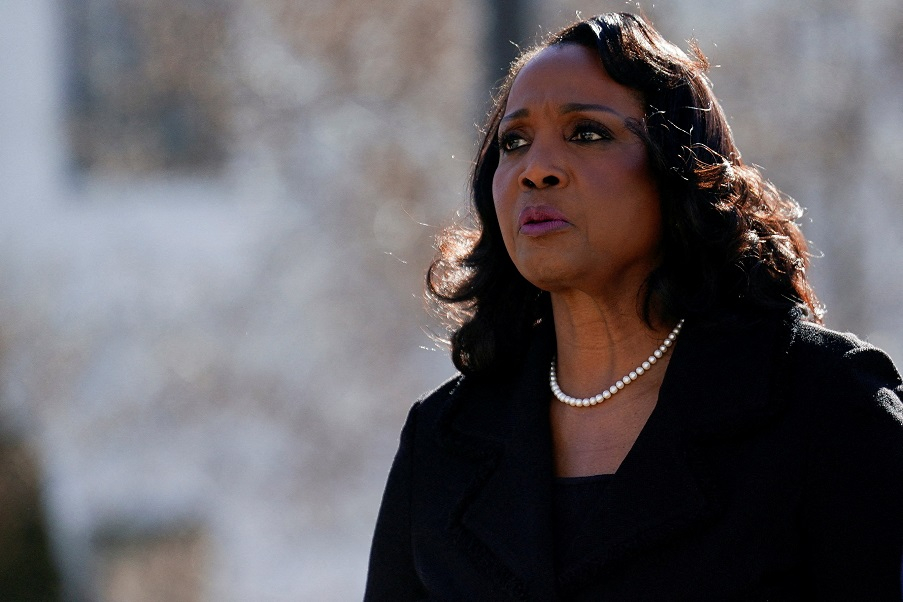
Trump last August had cited unproven mortgage fraud allegations in trying to oust Cook, the first Black woman to serve as a Fed governor, while she called that a pretext to remove her for monetary policy differences.
The justices denied a request from Trump's Justice Department to lift a judge's order barring him from immediately firing Cook while her legal challenge to the termination continues to play out.
Cook denied Trump's allegations.
The Fed is the world's most important central bank, an institution that determines the cost of credit for the United States and beyond and which has been in Trump's crosshairs since his return to the presidency in January 2025.
Cook's term in the job was due to run until 2038. She was appointed by Democratic former president Joe Biden in 2022.
Trump's targeting of Cook and a separate criminal investigation his administration launched in January, but later dropped, against then-Fed Chair Jerome Powell together represented the biggest challenge to the central bank's independence since its founding.
May 15 was the final day of Powell's eight years as Fed chair, though he remains a member of its Board of Governors. The US Senate on May 13 voted to confirm Trump's nominee Kevin Warsh as Powell's successor, and he was sworn in on May 22.
When the justices in October agreed to hear the case involving Cook, they left her in the post for the time being. The Supreme Court heard arguments in the case in January, with Cook and Powell in attendance.
Trump has heaped pressure on the central bank to cut interest rates more rapidly and more deeply than it has been willing to do as it combats persistent inflation, and lashed out repeatedly at Powell for not complying with his wishes.
The Cook case has ramifications for the Fed's ability to set interest rates without regard to the wishes of politicians, widely seen as critical to any central bank's ability to carry out tasks such as keeping inflation under control.
As a Fed governor, Cook helps set US monetary policy with the rest of the central bank's seven-member board and the heads of the 12 regional Fed banks.
But other than at the nation’s central bank, the court held that presidents have free rein to fire the heads of independent federal agencies at will, despite federal laws that require a cause for such dismissals and a 91-year-old decision that had limited executive authority.
With the six conservative justices in the majority, the nine-member court jettisoned its unanimous decision in Humphrey’s Executor that had limited when presidents can fire agencies' board members – in part to try to ensure decision-making free of political influence.
The justices ruled in the case of former Federal Trade Commission member Rebecca Slaughter, whom Trump fired without cause despite a provision of federal law that requires a reason.
The logic of the decision extends to other agencies, including the National Labor Relations Board, the Merit Systems Protection Board and the Consumer Product Safety Commission, where Trump also has fired board members. (Reuters/AP)
Edited by Edmond Fong
US top court rejects Trump's bid to fire Fed governor
2026-06-29 HKT 22:47
Share this story


