


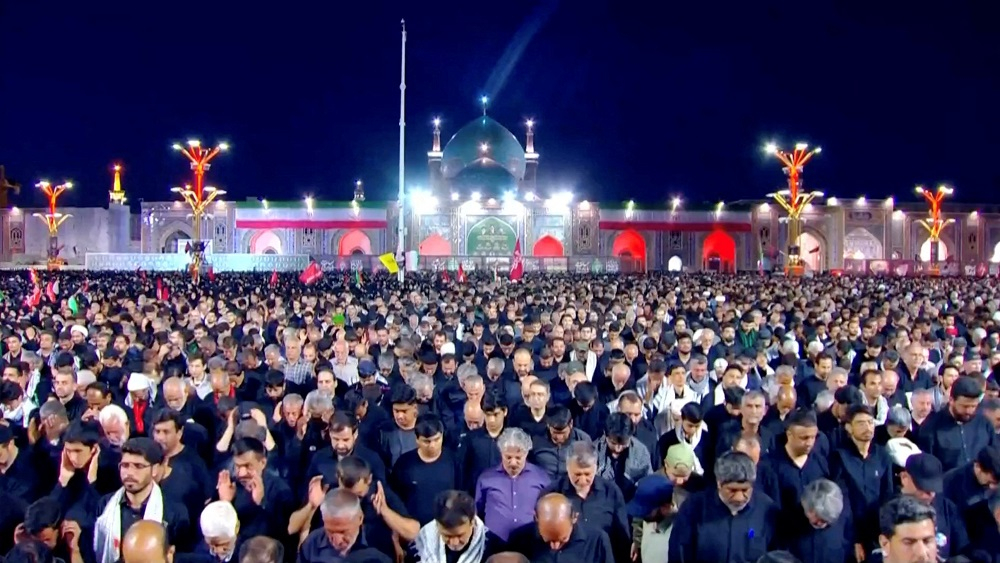
Iran's former supreme leader Ayatollah Ali Khamenei has been laid to rest, months after being killed in the opening salvos of the Iran war.
He ruled Iran for nearly 37 years before being killed in the US and Israeli airstrikes that started the war on February 28. He was laid to rest in his hometown of Mashhad early Friday after days of public mourning.
The funeral processions began on Saturday, with authorities shutting down streets, airspace and daily life in Tehran, Iran’s capital, and other cities, as throngs commemorated the man who led Iran for decades.
Meanwhile, Iranian armed forces launched attacks on US military infrastructure in Gulf states on Thursday following US strikes on Iran's southern coastal and eastern provinces, further eroding a three-week-old ceasefire.
Iranian media later reported multiple explosions across southern Iran, including Bushehr, where one of the country's nuclear plants is located, along with Konarak, Choghadak and Bandar Abbas. A US official said there had been no American strikes in recent hours.
Iran's army said in a statement released by state media that it had launched attacks on US Patriot systems in Kuwait, an early-warning site in Qatar and a US Army fuel depot in Bahrain.
Kuwait said its armed forces had engaged a cruise missile, three ballistic missiles and 10 drones in its airspace, and that one person had been injured by falling shrapnel.
Sirens also sounded in Jordan after missiles launched from Iran were detected, the state news agency reported. Eight were intercepted, with no injuries or damage reported.
The Revolutionary Guards later said Iran had fired 10 ballistic missiles at Jordan's Azraq military base, used by US forces, and also at a US military control centre in the Middle East, without elaborating.
Qatar, which hosts the largest US base in the region and has often mediated between Washington and its adversaries including Tehran, condemned attacks on commercial shipping but also called for a return to diplomacy. The foreign ministers of Türkiye and Oman also stressed the need to avoid further military escalation in separate calls with their Iranian counterpart, Abbas Araghchi.
Attacks on Qatari and Saudi shipping vessels earlier this week had upended the ceasefire, with US President Donald Trump declaring the truce "over." Washington was still committed to finding a resolution with Iran and "technical talks continue", according to a second US official.
Iran's Revolutionary Guards Navy said the US attacks and intervention in redirecting shipping through the Strait of Hormuz were disrupting the waterway's reopening.
The Guards said the number of vessels transiting the strait under Iranian supervision had recovered to about 50 percent of pre-war levels over the past two weeks, adding that permission was being granted only to ships using routes designated by Tehran.
Any further US intervention will draw a "crushing response", the Guards said.
The US military said its strikes were aimed at keeping the strait open after it accused Iranian forces of attacking three tankers in the area.
Oil prices fell back on Thursday after spiking on concerns the fighting would disrupt global supplies. (Agencies)
Edited by Cecil Wong
Iran buries Khamenei after new US fighting erupts
2026-07-10 HKT 07:20
Share this story


