


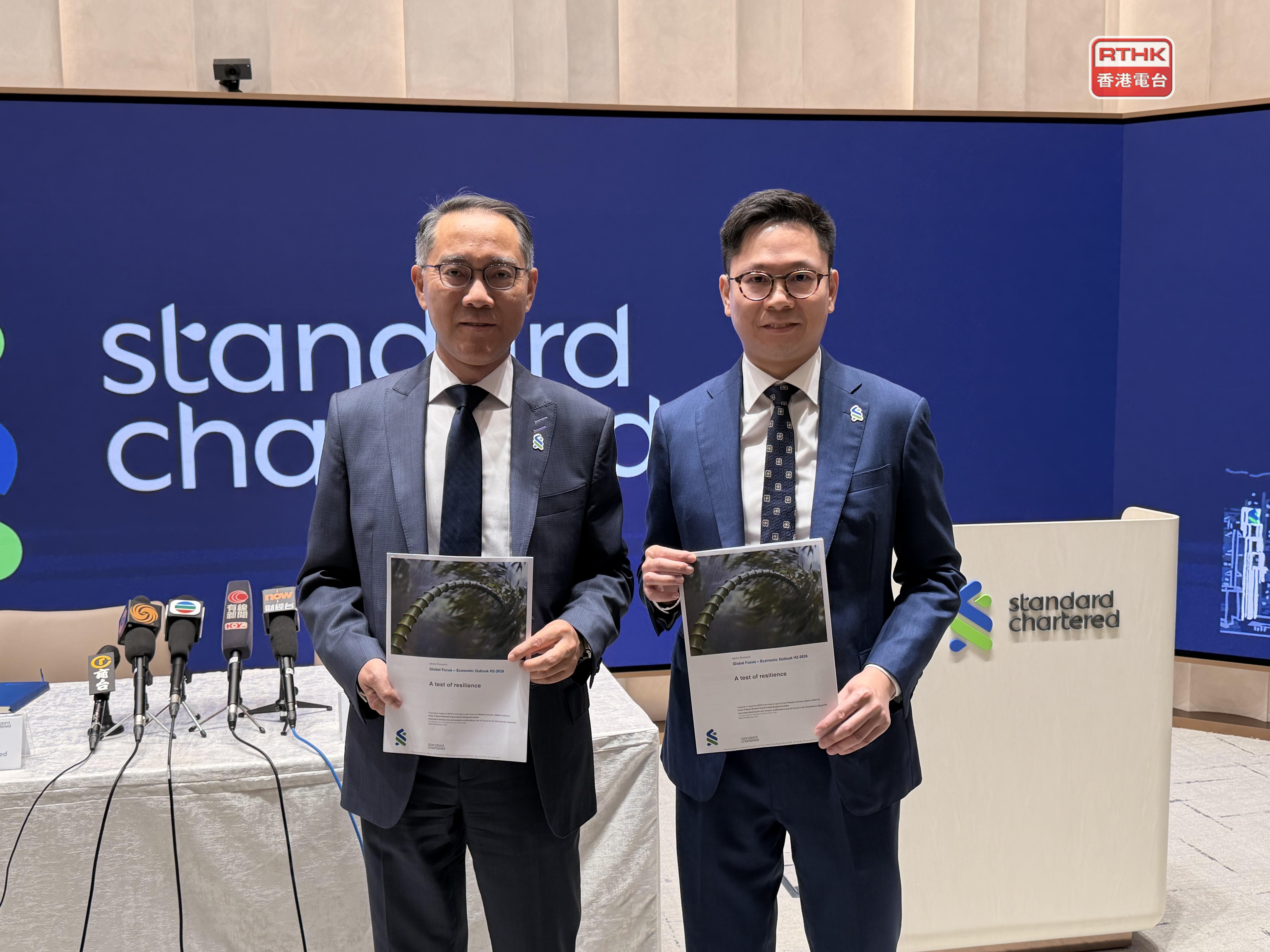
Standard Chartered on Monday maintained its forecast that China's economy would grow by 4.6 percent year-on-year for 2026, with policymakers from Beijing to ramp up fiscal support to aid key infrastructure projects.
The prediction came as the country last week reported that its second-quarter growth slowed to 4.3 percent, after a five percent expansion seen in the first quarter.
Speaking at a press conference, Ding Shuang, Head of Greater China and North Asia Economic Research at the bank, noted that the country's growth had been uneven, with exports soaring on the global AI boom, but domestic sectors continuing to show weakness.
But policymakers, Ding said, may still be more focused on existing policies and increase fiscal spending to implement budget plans.
"Fiscal spending declined in April and May, and most likely in the second quarter as well, and that became a drag on the macroeconomy," he told RTHK.
"But also, that means if they fully implement the annual budget, there will be more room [for fiscal spending] in the second half [of the year].
"I think they will urge the local governments to speed up the special bond issuance to finance more projects, including infrastructure projects," he added.
Notably, he pointed to the "six network" construction projects that have been outlined in the country's 15th Five-Year Plan, namely networks of water, new-type power grid, computing power, next-generation communication, urban underground pipelines, and logistics.
He also expects spending to be accelerated in AI, as well as projects related to people's livelihoods.
Separately, Tommy Wu, a senior economist at the bank, forecast that Hong Kong's economy will continue its current growth momentum and rise by 4.3 percent year-on-year in 2026, which would be higher than the 3.6-percent expansion seen in 2025.
But he also noted uncertainties and risks, such as if the current AI super cycle that has been fuelling the city's trade and logistics industries growth suddenly pauses.
"If we do see a global AI stock market correction, perhaps that may have an impact on what the US hyperscalers or other tech companies globally would invest, at least in a very short term," he told RTHK.
"Taking a more medium-to-longer term perspective, I think the AI super cycle is actually structural because basically no countries want to lose out in the AI race.
"But it's still possible that because of reasons such as a stock market correction, or if it takes time to absorb the AI or the semiconductors inventories, then this may create some sort of transitory or cyclical slowdown," he added.
The bank also forecast that the global economic growth rate would slow to three percent this year, from its previous prediction of 3.4 percent, due to uncertainties including the Iran war, US tariffs as well as inflationary concerns.
Edited by Aaron Tam
China's economy to grow 4.6pc this year: StanChart
2026-07-20 HKT 17:13
Share this story


