


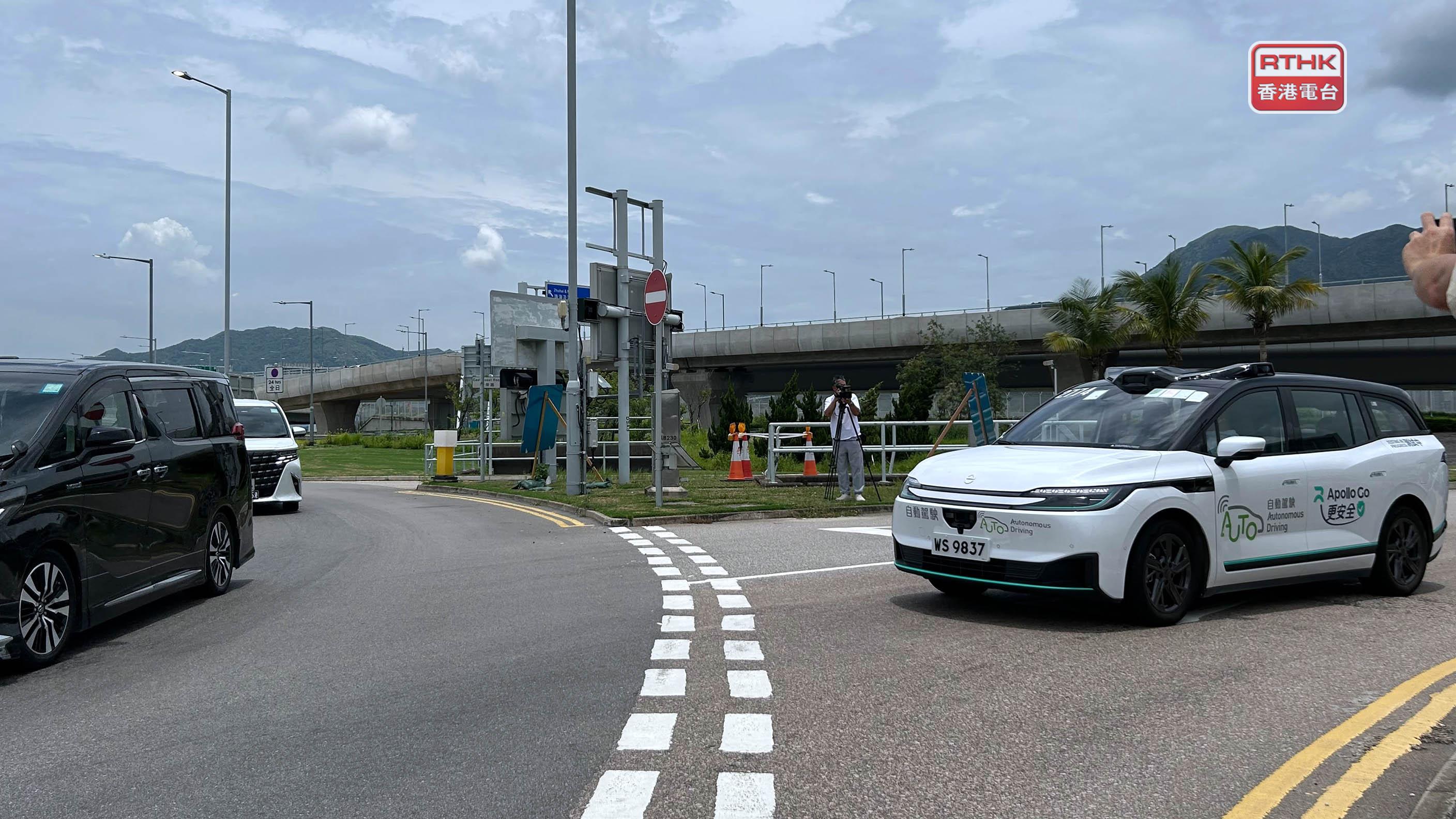
Hong Kong’s approval of fully driverless autonomous vehicles on its airport island has been hailed as a landmark moment for the industry, with experts on Thursday calling it a world first for right-hand drive markets.
Gary Zhang, director of the Smart Transportation Alliance and a member of the government’s Autonomous Vehicle Applications Promotion Working Group, said the green light sends a powerful signal to the international community.
"I think this milestone sends a very clear message to global players that now it's also achievable and now it's also feasible to really deploy driverless operations on open roads in Hong Kong's city areas," he said.
The former lawmaker said Hong Kong is likely to be the first among right-hand drive jurisdictions – most of which are Commonwealth places – to authorise such vehicles for public-road use without a safety driver onboard.
Saying the city is technologically "on par" with the mainland and the United States, Zhang highlighted its strategic edge as a launchpad for mainland firms eyeing Commonwealth and Southeast Asian markets.
The public won’t have to wait long to see the technology in action, he added.
"Hong Kong citizens will see really driverless vehicles moving around in Hong Kong, maybe in just a few days."
As for commercial robotaxi services, his timeline was ambitious: "We're actually talking about months, definitely not years."
Still, Zhang sounded a note of caution, warning that the greatest obstacle lies beyond engineering.
"The biggest challenge isn't really the technology," he said.
"It's about our transportation policy. So how do we balance the interests of different stakeholders, especially those with vested interests?"
He stressed the need for broader social dialogue to forge consensus.
Ryan Ip, vice-president of Our Hong Kong Foundation, also welcomed the announcement, describing it as "a significant step" towards commercialising autonomous driving.
He pointed to a fundamental shift in operations: previously, tests still required a safety driver in the vehicle, maintaining a one-car, one-person model.
Now, he said, the new framework allows for truly driverless vehicles, with remote operators monitoring multiple cars from a control centre.
Ip, however, underscored the importance of rigorous safety protocols.
"Safety remains the top priority," he said, adding that reliable technology, stable signal connections and clear intervention rules would be essential.
He proposed starting with a one-to-one operator-to-vehicle ratio and gradually relaxing it as more data is collected.
Both experts agreed that while the technology is ready, the city’s next frontier lies in navigating policy and public acceptance – factors that will ultimately determine how quickly driverless cars become a familiar sight on Hong Kong’s streets.
Edited by Tony Sabine
Experts all aboard in driverless vehicles push
2026-07-23 HKT 16:58
Share this story


