


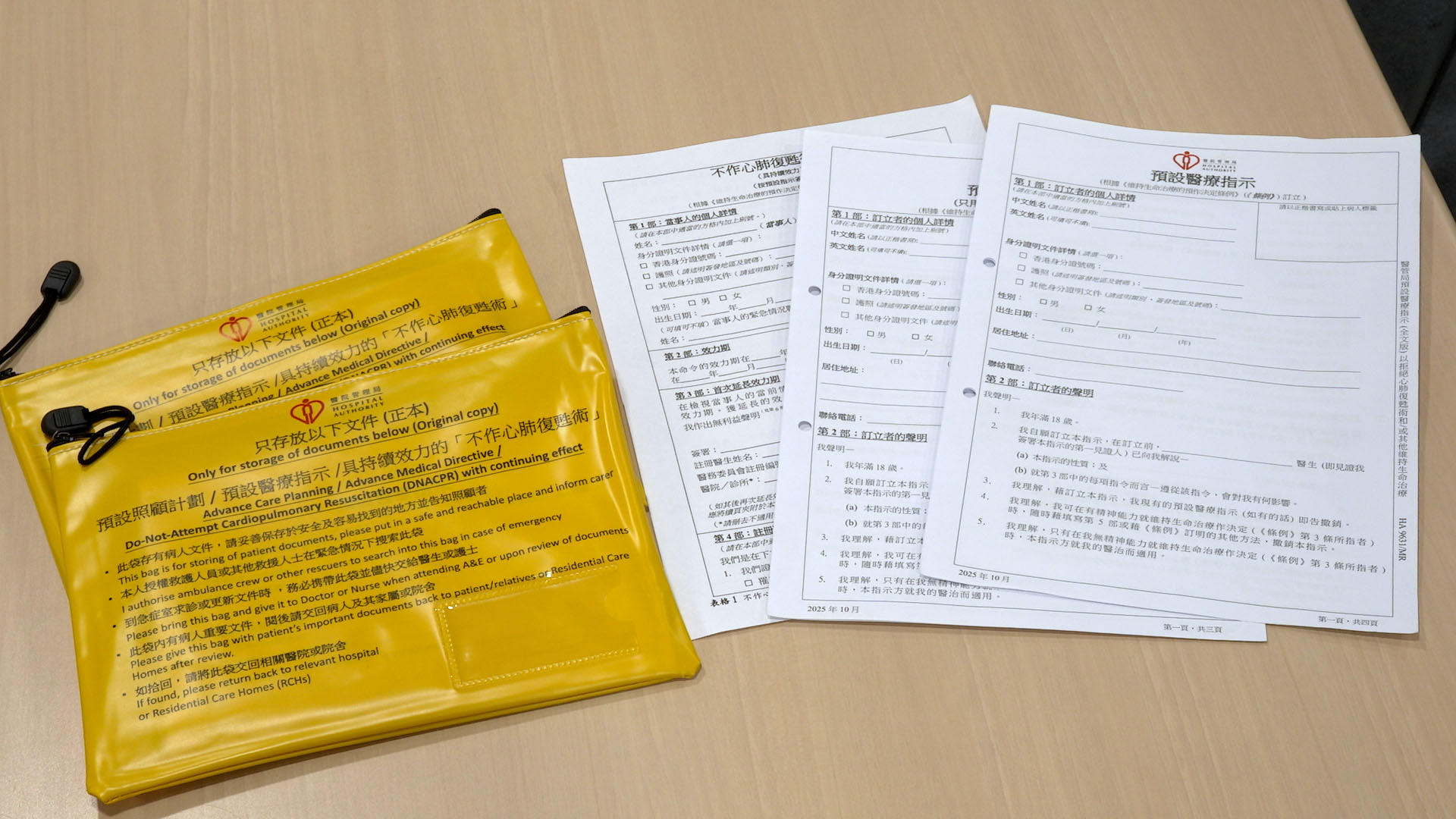
The Fire Services Department said on Friday rescue personnel will only stop attempting resuscitation in life-or-death emergencies when they have no doubts about the validity of a do-not-attempt-cardiopulmonary-resuscitation order.
Under the new end-of-life decisions law that takes effect next Friday, terminally-ill patients can have their advance medical directives and do-not-attempt cardiopulmonary resuscitation (DNACPR) orders uploaded to the “e-Health system”, allowing them not to receive life-sustaining treatment under specific conditions.
As for pre-hospital care, assistant chief ambulance officer Tong Sze-ho said emergency personnel will always go to assess patients even if they have been informed about the applicability of the order or directive during 999 calls.
Tong said rescue personnel will only stop attempting resuscitation when they see a valid and applicable DNACPR order.
“So how do we define valid? The order has to be made on a specified written form designated by law," he said at a press briefing.
"The form must be the original or a copy signed by a lawyer or a doctor. If an electronic or a self-printed copy is presented, legally speaking we cannot consider them to be valid documents.”
Tong said if emergency officers are unable to verify the document, they will carry on with their resuscitation efforts under the principle of “save lives first when in doubt”.
He urged family members and caregivers to put the yellow pouch required under the law to hold the DNACPR order near a patient to make it easily identifiable by rescue personnel.
However, he said that if emergency personnel were to discover that the patient’s cardiac arrest did not come from natural causes, they would disregard the order and continue with their resuscitation efforts.
Wan Kuang-an, medical director at the Fire Services Department, said that even if a valid DNACPR order is presented, patients will always be sent to the nearest hospital and provided with basic treatment on the way.
“The order does not mean patients refuse basic treatment or hospice care. Therefore, the rescue personnel can still provide appropriate care based on the patient’s circumstances," he said.
The department has provided training for nearly 10,000 officers across its fire services, ambulance operations, and communication divisions and established a new set of internal action guidelines ahead of the law's coming into force.
The Auxiliary Medical Service has also provided four training sessions for nearly 1,000 members and arranged tests for them. Those who have not completed training will not be put on duty.
The Hong Kong St John Ambulance Brigade has also held briefing sessions since May and updated the action guidelines for its members.
Edited by Aaron Tam
Valid DNACPR order required to cease resuscitation
2026-07-24 HKT 18:51
Share this story


