


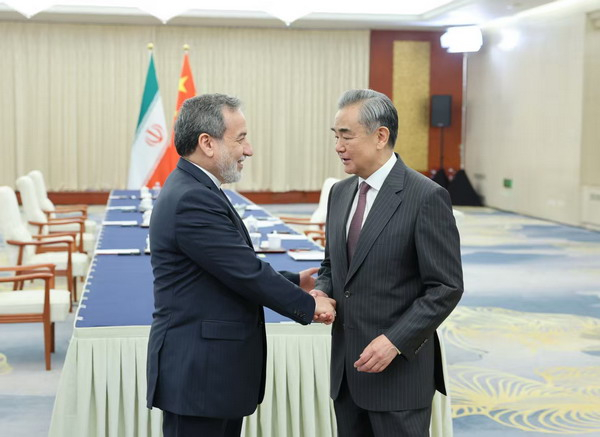
Foreign Minister Wang Yi called for an early resumption of negotiations on the Middle East war in a meeting with his Iranian counterpart Seyed Abbas Araghchi in Kyrgyzstan.
The one-on-one was part of a series of meetings with his counterparts on the sidelines of a meeting of the council of the ministers of foreign affairs of the Shanghai Cooperation Organization (SCO) member states on Friday.
During the talks with Araghchi, Wang said the immediate priority should be the implementation of a memorandum of understanding aimed at easing tensions in the Middle East and Gulf region, which the latest outbreak of tit-for-tat attacks has thrown into question.
He said China is deeply concerned about the renewed escalation of tensions, saying the MoU signed more than a month ago was a valuable outcome of mediation efforts by multiple parties and reflected the aspirations of the Iranian people and other peoples in the region for peace and stability.
"The door to negotiations, once opened, should not be closed, and as long as there is hope for peace, it should not be given up," Wang said.
China, he added, will continue to act in line with the four-point proposal on maintaining and promoting peace and stability in the Middle East, support mediation efforts by Pakistan and other parties, facilitate the early resumption of dialogue and negotiations, properly address issues related to the Strait of Hormuz, improve relations among neighbouring countries, advance collective security among Gulf states, and help restore peace and stability in the Middle East at an early date.
Araghchi urged the United States to honour its commitments, exercise restraint, work with Iran towards the same goal, and seek a reasonable solution.
In another meeting with Russian Foreign Minister Sergey Lavrov, Wang said China wished Russia success in its State Duma elections.
Noting that this year marks the 25th anniversary of the signing of the China-Russia Treaty of Good-Neighbourliness and Friendly Cooperation and the 25th anniversary of the SCO, Wang said the treaty has guided the two countries in setting an example of a new type of state-to-state and major-country relations.
The SCO has become a force for global stability with growing international influence, Wang said, adding that both sides should jointly support the organisation's development, carry forward the Shanghai Spirit, and inject new vitality into improving global governance and building a community with a shared future for humanity.
China and Russia should strengthen strategic coordination, uphold the outcomes of World War II, and never allow Japan to rearm, Wang said, adding that he expected Russia to continue supporting the Asia-Pacific Economic Cooperation's "China Year" events.
Lavrov said President Vladimir Putin's visit to China this year and the more than 50 meetings between the two heads of state have continuously elevated bilateral relations to new heights.
Russia, he added, remains highly vigilant against and firmly opposes Japan's accelerated re-militarisation and pursuit of nuclear weapons capability.
Wang also held meetings with Pakistani Deputy Prime Minister and Foreign Minister Mohammad Ishaq Dar as well as his counterparts from Uzbekistan, Tajikistan and Belarus. (Agencies)
Edited by Azam Khan
Wang Yi, Araghchi urge return to Mideast dialogue
2026-07-25 HKT 15:20
Share this story


