


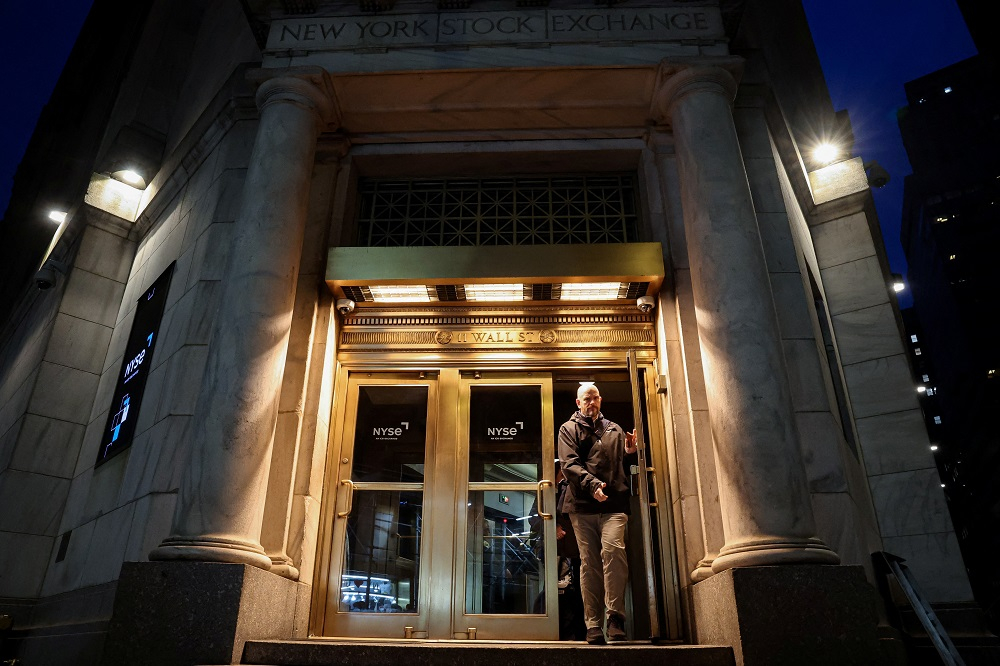
Wall Street stocks finished sharply lower on Wednesday after the US Federal Reserve kept interest rates unchanged despite lofty US inflation as escalations in the Middle East war pushed oil prices skywards.
Major US indices ended down more than 1.5 percent after initially greeting the Fed's decision to keep interest rates level.
However, markets shifted course during Fed Chair Kevin Warsh's press conference where he pledged to achieve price stability and return inflation to the US central bank's two percent target, as he simultaneously defended a decision to not hike interest rates.
"The market is getting mixed messages from the Fed," said Adam Sarhan of 50 Park Investments.
"Basically, we're left with a situation where the problem is not solved," said Sarhan of inflation that stood at 3.5 percent in June on an annual basis.
Besides the Fed decision, the market also digested the latest spike in oil prices after US President Donald Trump vowed to hit back hard at Iran after it attacked US bases in Jordan.
On Wednesday, Saudi Arabia and the United States announced strikes on militant bases in Iraq, while US ally Israel accused Iran-backed Hezbollah of a truce violation.
International benchmark Brent oil futures shot up nearly eight percent to US$90.74 a barrel.
"We continue to see oil prices and inflation pressures moving higher as inventories drain further amid the lack of peace in the Persian Gulf," said a note from Bart Melek of TD Securities.
Equity investors have also been on guard about earnings from large technology companies at the nexus of the buildout of artificial intelligence infrastructure central to the US economic growth outlook.
After a blowout second quarter, the Nasdaq-100 index earlier this week slipped into a correction, defined as a drop of 10 percent or more.
Investors worry that major US companies are deepening a web of AI-linked investments and continuing to funnel billions into the emerging technology at the expense of free cash flow.
Meta Platforms dropped 4 percent in extended trade after the social media company said it now expects 2026 capital expenditure to be between US$130 billion and US$145 billion, compared with its prior forecast of US$125 billion to US$145 billion.
Also after the bell, Microsoft climbed 0.6 percent after it topped Wall Street estimates for quarterly cloud revenue growth, a sign its massive spending on AI infrastructure was paying off.
At the Fed meeting, Warsh reiterated his commitment to achieving price stability.
"We are on the job. We will deliver. We are focused like a laser, making sure we can do it," he said, adding that there was "no magic wand" with which the Fed could lower inflation quickly.
But DoubleLine CEO Jeffrey Gundlach told CNBC that the bond market's reaction showed it was sceptical of Warsh's statements.
The yield on the 30-year US Treasury hit 5.22 percent, well above the 4.61 percent level before the start of the Middle East war.
"If you really want to get to two percent, I think you have to raise interest rates," Gundlach told CNBC. "The bond market vigilantes are saying, 'If you really want us to believe your rhetoric, you've got to start acting.'"
Arun Sundaram, senior vice president at CFRA Research, said the jump in the 30-year Treasury yield "is likely a signal that investors doubt the Fed's credibility in returning inflation to its two percent target."
The dollar also pulled back against the euro and other major currencies.
The S&P 500 fell 1.5 percent, to 7,316, the Dow fell 2.2 percent, to 51,594, while the Nasdaq fell 1.7 percent, to 24,442. (Agencies)
Edited by Cecil Wong
Oil prices surge, US stocks fall as Fed holds rates
2026-07-30 HKT 06:53
Share this story


