


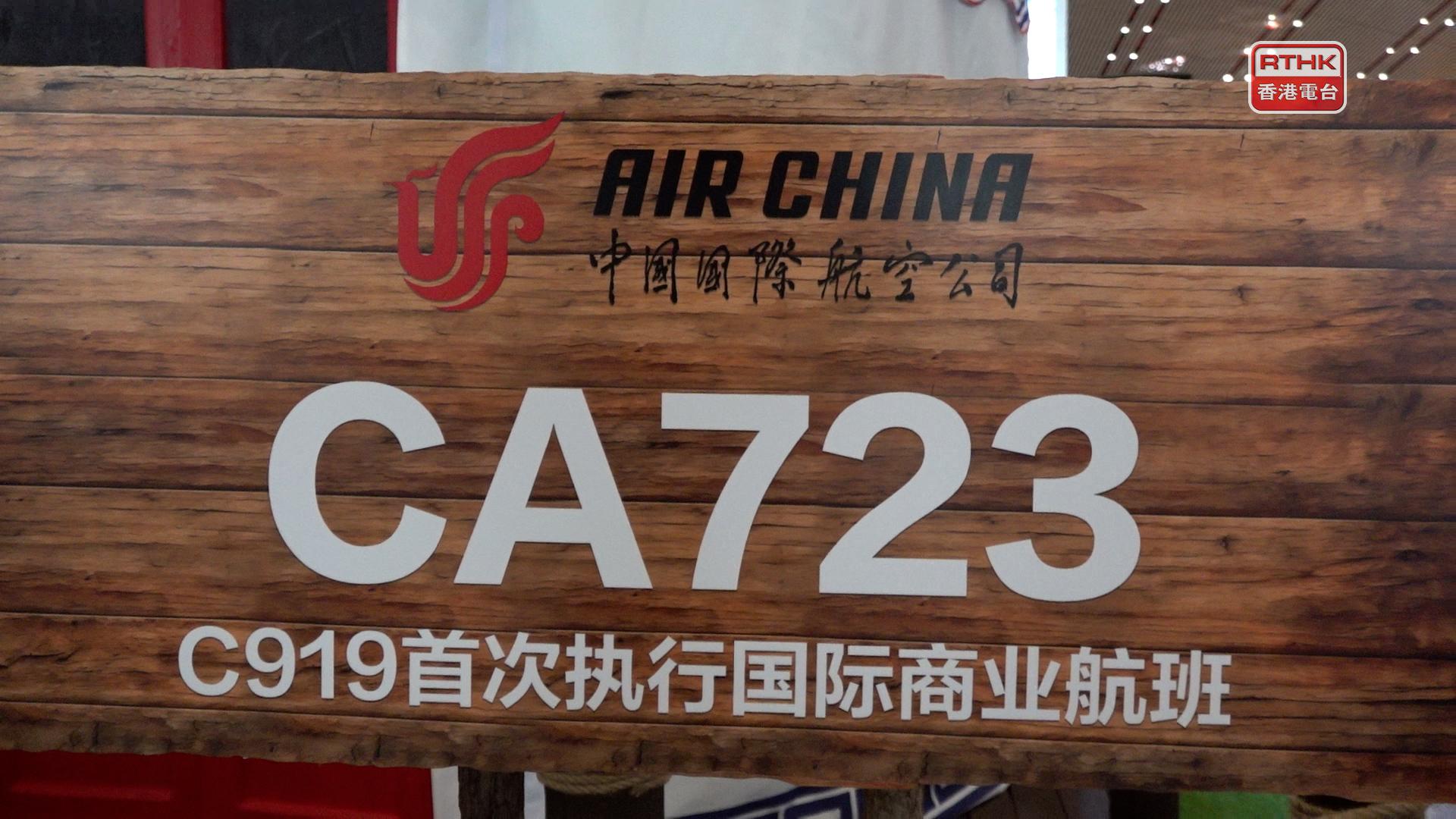
China's home-grown C919 narrowbody passenger jet on Wednesday launched its first international commercial route, connecting Beijing with Ulaanbaatar, the capital of Mongolia, according to Air China.
The inaugural flight, CA723, departed from Beijing Capital International Airport at around 3pm, before arriving at Chinggis Khaan International Airport in Ulaanbaatar at around 5.15pm.
Meanwhile, the return flight, CA724, was scheduled to depart from Ulaanbaatar at 7pm and arrive in Beijing at around 9pm.
The route will operate daily.
Speaking in an interview with RTHK in Beijing, a tourist surnamed Jiang noted that it was his first time to take a flight using the domestically developed C919.
"I feel very excited. Previously I didn't know [that we're taking the C919 passenger jet], but our tour guide just told us about it.
"I've always wanted to experience the C919 jet, and fortunately, I got the chance to do so today," he said.
Separately, a passenger from Taiwan, surnamed Tang, said he looked forward to visiting Mongolia after travelling in Beijing over the past few days.
"I haven't taken a C919 flight before. I think it'll be very memorable," he told RTHK.
Another visitor, surnamed Peng, believed the new route marked an important step for the C919 as it embarks on routes abroad.
The C919 is the country's first large passenger jetliner, developed in accordance with international standards and with independent intellectual property rights.
It is 38.9 metres long, 3.96 metres wide and 11.95 metres high, with a capacity to carry 158 passengers.
As of August 10, the C919 passenger jet was serving 57 routes linking 25 cities, including Harbin, Xi'an, Chengdu, Chongqing, Wuhan, Changsha, Guangzhou, Xiamen, Hangzhou and Shanghai, handling more than 7.5 million passenger trips, according to official data.
The aircraft also completed its first scheduled commercial flight outside the mainland from Shanghai to Hong Kong on January 1, 2025.
It's currently operated by Air China, China Eastern Airlines and China Southern Airlines, according to its developer, the Commercial Aircraft Corporation of China.
Edited by Tony Sabine
C919 jet serves first int'l route to Mongolia
2026-08-12 HKT 17:39
Share this story


