


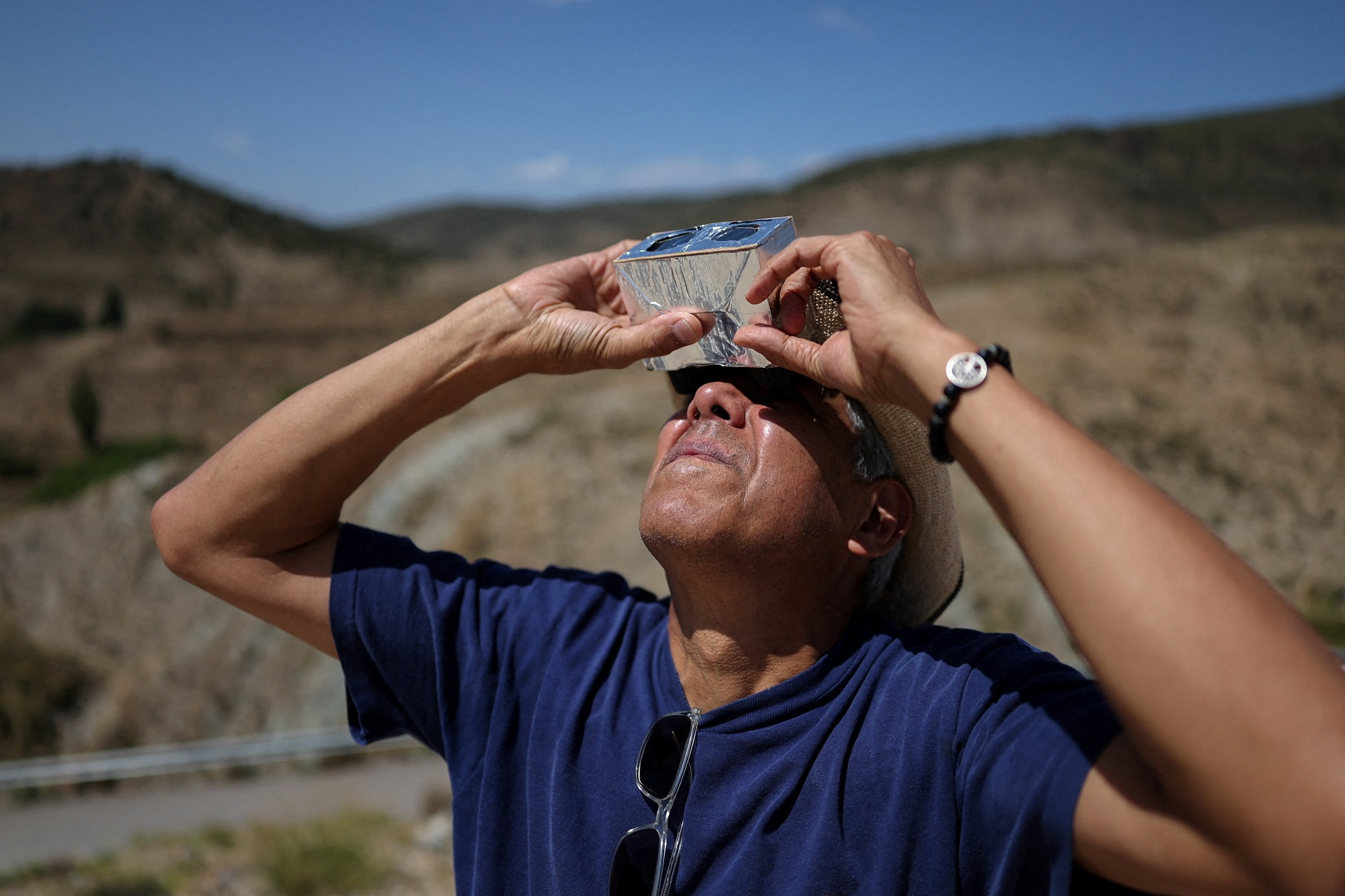
Millions of people will turn their gaze towards the heavens on Wednesday to witness one of nature's greatest spectacles -- a rare total solar eclipse -- as it sweeps over mainland Europe to briefly turn day into night.
The Moon is first expected to blot out the Sun, leaving only the shimmering glow of its outer corona, in Russia's remote Arctic north, before parts of Greenland and Iceland are enveloped in the arc of its eerie shadow.
Excitement was highest in Spain, where tourists thronged the streets of normally quiet villages to experience the dramatic natural phenomenon as the eclipse's narrow path cuts across the Iberian Peninsula from the northern Atlantic coast to the Mediterranean Sea in the south.
Mainland Europe has not experienced a total solar eclipse for 20 years while Spain has not witnessed one in more than a century.
Iceland's capital, Reykjavik, however, has not seen a total solar eclipse since 1433.
"It's the first time and it's the last time, the only time I'm going to see an eclipse," Yenny Guevera, a 50-year-old Peruvian living in France, told AFP excitedly in Burgos, northwest Spain.
Supplies of special viewing glasses were in high demand as a partial eclipse will be visible for millions more in most of Europe, Canada, the northern United States and northwest Africa.
But the phenomenon is fleeting: in parts of Russia and Greenland, the total eclipse will last under two-and-a-half minutes.
For observers in Spain, it will last less than two minutes just before sunset.
The partial eclipse -- which occurs as the Moon starts and finishes crossing the Sun's path, dimming its light -- will last around one hour and 45 minutes.
The event, to be livestreamed by both NASA and the European Space Agency, presents scientists with a rare opportunity to study the Sun's atmosphere and its outermost layer, as they seek to uncover secrets about solar winds and our star's magnetic field.
Another total eclipse will cross southern Spain and northern Africa in August 2027, while an annular eclipse -- when the Moon is not big enough to completely blot out the Sun, creating a so-called "ring of fire" -- is due to visit the Iberian Peninsula in 2028.
Edited by Raymond Yeung
Total solar eclipse to cast its shadow over Europe
2026-08-12 HKT 22:44
Share this story


