


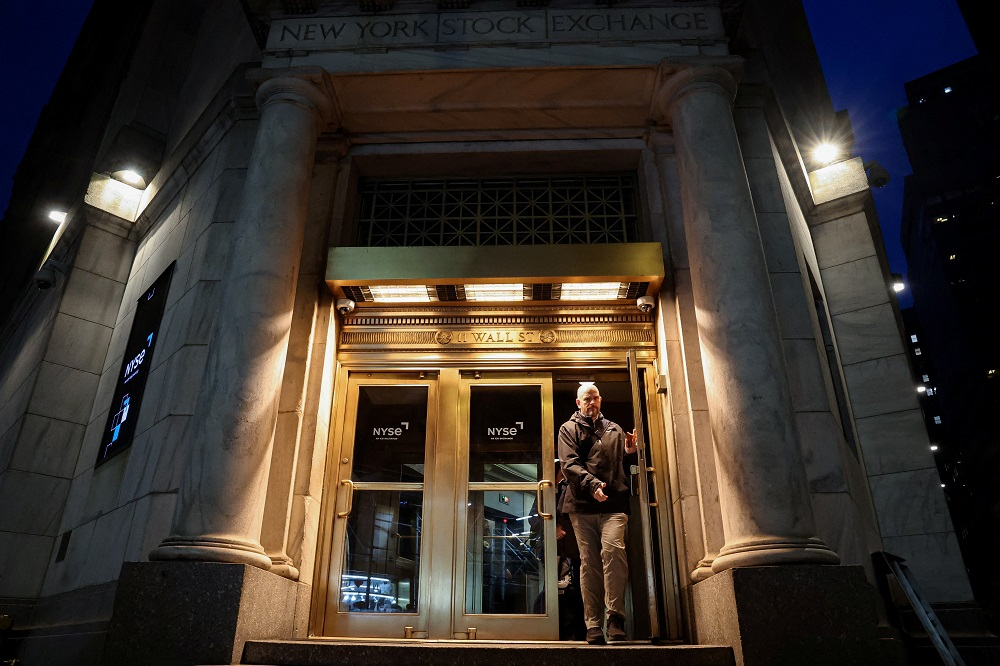
Wall Street stocks retreated on Monday as oil prices advanced on the lack of progress on opening the Strait of Hormuz and a jump in US Treasury yields discouraged equity purchases.
Oil prices added to their recent gains as the United States and Iran showed no signs of reaching a deal to reopen the Strait of Hormuz after nearly six months of war, even though Monday was in theory the day a US-Iran ceasefire expires.
On Monday, US President Donald Trump threatened to bomb Oman if it got in the way of a US-Iran deal.
"The ongoing diplomatic gridlock between Washington and Tehran over transit through the Strait of Hormuz has kept crude prices elevated," said David Morrison, an analyst at Trade Nation.
While oil prices jumped more than two percent, the yield on the 30-year US Treasury bond climbed to 5.31 percent, its highest level since June 2007.
Analysts see spiking Treasury yields as suggesting markets believe inflation will stay high, and recognition that a flood of US bonds reaching the market will keep the US deficit high and demand elevated yields.
"When you get a move like that in oil and interest rates, it just kind of tends to serve as a headwind. This means a little bit less risk-taking than you might have otherwise," said Briefing.com analyst Patrick O'Hare.
"There's just not a lot of buying interest in today's session," said O'Hare, adding that the market move can be accentuated by low trading volumes due to summer vacations.
All three major US indices finished lower, with the S&P 500 down 0.5 percent.
Earlier, London, Paris and Frankfurt all closed lower.
A paper from the European Central Bank highlighted growing anxiety about the spillover effects of a dot.com-type bubble from artificial intelligence on European markets.
"We argue that economic research on past technological revolutions points to a worrisome conclusion: a correction of current stock market valuations is likely," said the ECB paper, which described a US pull-back in AI equities as a worry for the EU.
"The effects of a US correction could extend beyond financial markets to euro area sentiment, financing conditions and hiring," the ECB said. "A US AI fallout would not remain a US problem."
On the corporate front, attention now turns to the release of earnings this week from retail titans Walmart, Home Depot and Target, which could give a clearer view of sentiment among American consumers.
Recent statistics have pointed to a weakening US labour market and slower US consumer spending, but even poor results from the top retailers could help the US stock market, said Ipek Ozkardeskaya, analyst at Swissquote.
"Results pointing to weaker domestic consumption could further tame inflation worries, help ease Fed hike bets and hence put downward pressure on US yields. That would be a positive development for the major US indices, heavy in technology," she said.
The S&P 500 fell 0.5 percent, to 7,745, the Dow also fell 0.5 percent, to 53,459, while the Nasdaq fell 0.3 percent, to 26,644. (AFP)
Edited by Cecil Wong
US stocks fall as bond yields jump, oil prices rise
2026-08-18 HKT 06:27
Share this story


