


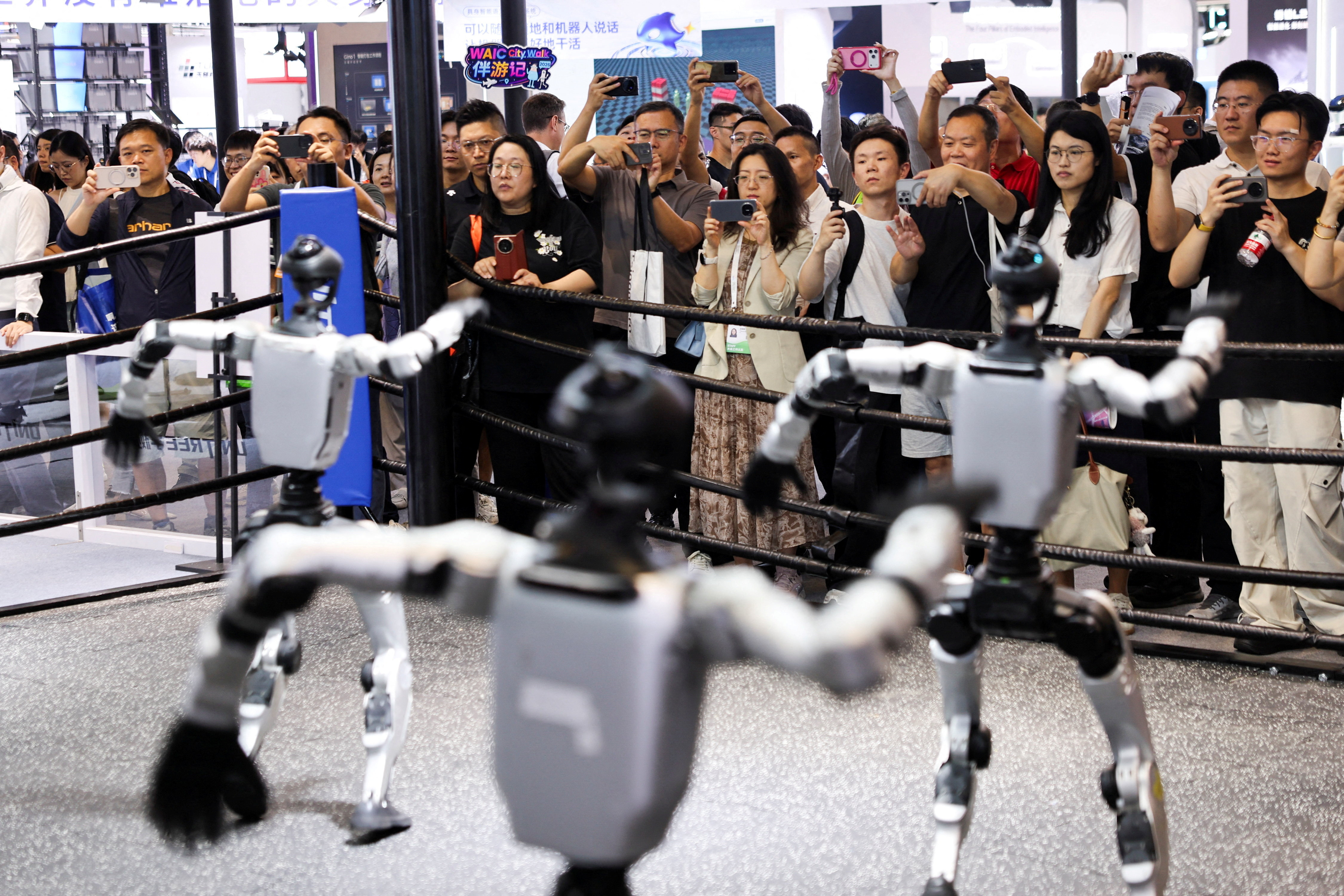
Mainland startup Lumos Robotics is considering a further fundraising round and aims to begin preparing for a possible stock-market listing next year, its founder said, betting that factory cost savings rather than flashy humanoid demonstrations will determine which companies survive China's robot boom.
Lumos has raised about one billion yuan across seven funding rounds, the company said.
Founder and chief executive Yu Chao said the fresh capital would be used mainly for industrial deployments, hardware development, and AI models, including computing infrastructure.
Japanese industrial group Mitsubishi Electric is Lumos' largest outside shareholder and is working with the Chinese firm on robotics solutions for manufacturing.
Lumos develops bipedal robots, but is focusing commercially on MOS 2, a wheeled, dual-arm machine designed for factory work including quality inspection and material handling.
Lumos is one of a growing number of companies in the nation's nascent embodied AI and humanoid robot sector looking to gain an edge by proving that its machines, while not necessarily the most human-like, can deliver the best results on the factory floor.
"The stage of running and jumping has basically passed," Yu said, speaking ahead of the World Robot Conference opening in Beijing on Wednesday.
"The most important thing now is improving reliability in actual industrial deployment."
Yu said Lumos, founded in 2024 – later than several companies already pursuing initial public offerings – would seek to begin moving towards a listing next year.
The company has deployed around 30 MOS robots in inspection and material-handling applications, with roughly five more deployments due shortly, Yu said.
More than 10 other customers are at various stages of deployment or proof-of-concept testing.
Lumos has shipped dozens of MOS robots domestically and expects to deliver about 50 more over the next month or so, targeting around 300 deliveries this year, Yu said.
Yu said the test of a genuine deployment was whether a robot could operate for sustained periods without failure, raise productivity, and generate an acceptable return on investment.
In one inspection project with Mitsubishi Electric, Lumos reduced the cost of a solution to below 350,000 yuan from roughly 500,000 yuan to one million yuan previously, while achieving a cycle time comparable with a human worker, Yu said.
MOS robots deployed commercially generally perform one task at a time, although Lumos has demonstrated multi-task operation internally, Yu said.
He expects robots capable of reliably handling multiple industrial tasks at scale within roughly two to three years.
Lumos has accumulated about 700,000 hours of robotics data, Yu said, using information from deployed machines to train new skills and shorten development cycles.
His goal for this year's 300 targeted deliveries is for data from those robots to feed back into that system.
The Shenzhen-based company plans to make a larger overseas push next year, initially looking at the Middle East and Europe, with Japan and South Korea also under consideration. (Reuters)
Edited by Tony Sabine
Lumos goes through more than motions in funds race
2026-08-18 HKT 16:12
Share this story


