


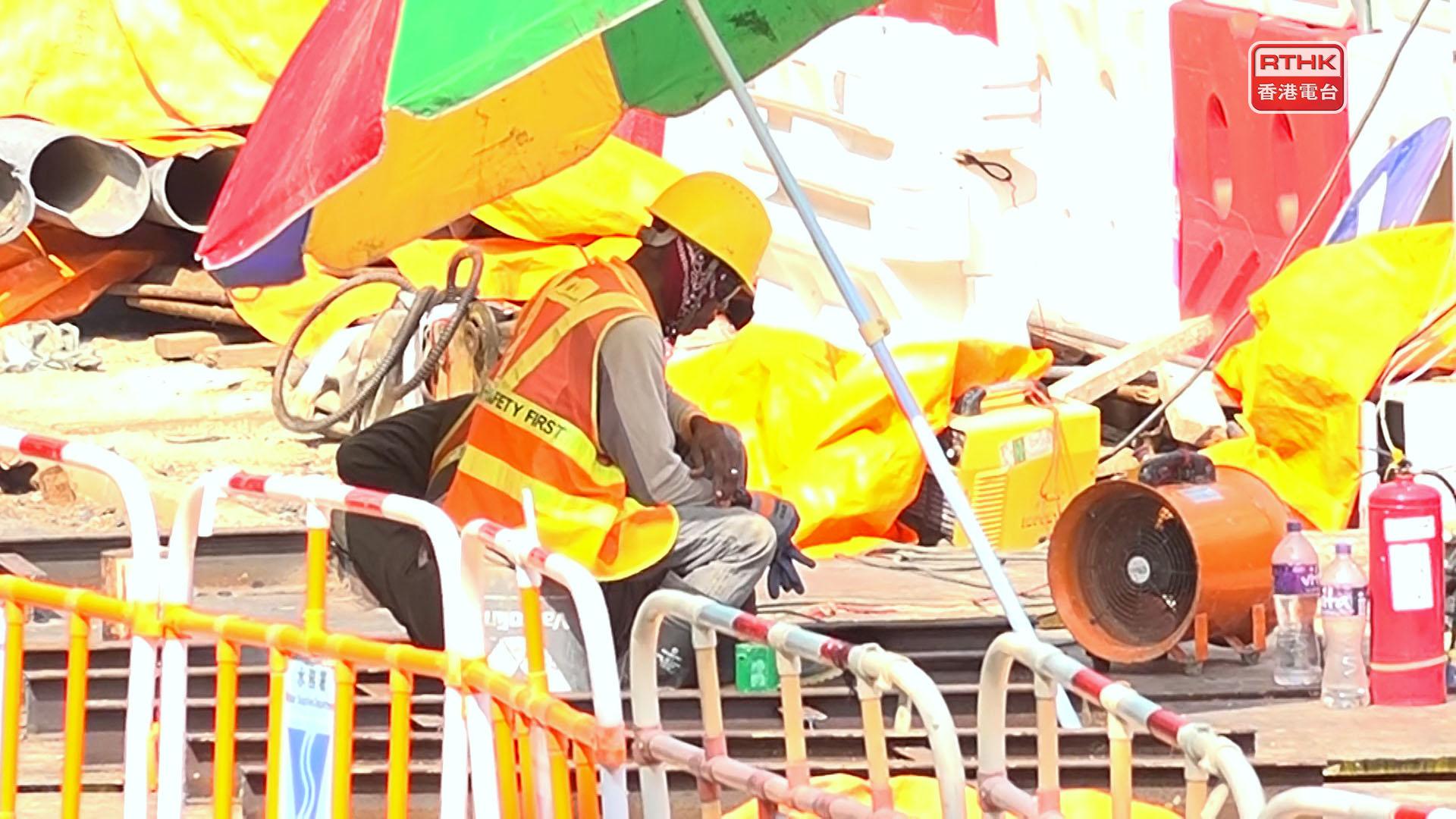
The Labour Department said a refined heat stress at work warning system will be more sensitive towards extreme hot weather.
Two new conditions were added to the system starting on Friday to raise its sensitivity in triggering a warning, meaning there could be more red and black heat stress at work warnings going forward.
When the Observatory issues an extreme heat alert, the amber warning will be issued immediately, and the threshold for raising the warning level will be lowered to allow for an earlier activation.
In addition, if temperatures reach 35 degrees Celsius or above at 40 percent of the weather forecaster’s 39 monitoring stations, the warning will be automatically raised by one level.
Speaking on an RTHK radio programme, Deputy Commissioner (Occupational Safety and Health) Ivanhoe Chang noted there was a need to adjust the system after record-high temperatures were recorded earlier this month.
He said the city will see more days of higher warning levels under the enhanced system.
“We hope that through adjustments to the warning levels, the warnings will more effectively reflect relevant heat stress risks under abnormally high temperatures in particular,” he said.
“We think that overall, if the weather conditions in the future are similar to the trend in the past three years, there could be four to seven days of red warnings, while there would be one to two days of a black warning.”
With the refinements, the system will continue to rely on the Hong Kong Heat Index that takes into consideration the temperature, humidity, wind speed and solar radiation.
When asked why the department did not opt for the Wet Bulb Global Temperature measurement system, Chang said that both the index and WBGT have its own advantages.
As Hong Kong’s summer is relatively humid, the index that sees a higher proportion in humidity can better reflect the city’s subtropical conditions, he said.
But Chang added that the department is open to the usage of other evaluation tools.
It will also keep monitoring the operations of the refined system to see if further adjustments are needed, he added.
Edited by Aaron Tam
'HK to see more red and black heat stress warnings'
2026-08-28 HKT 11:18
Share this story


