


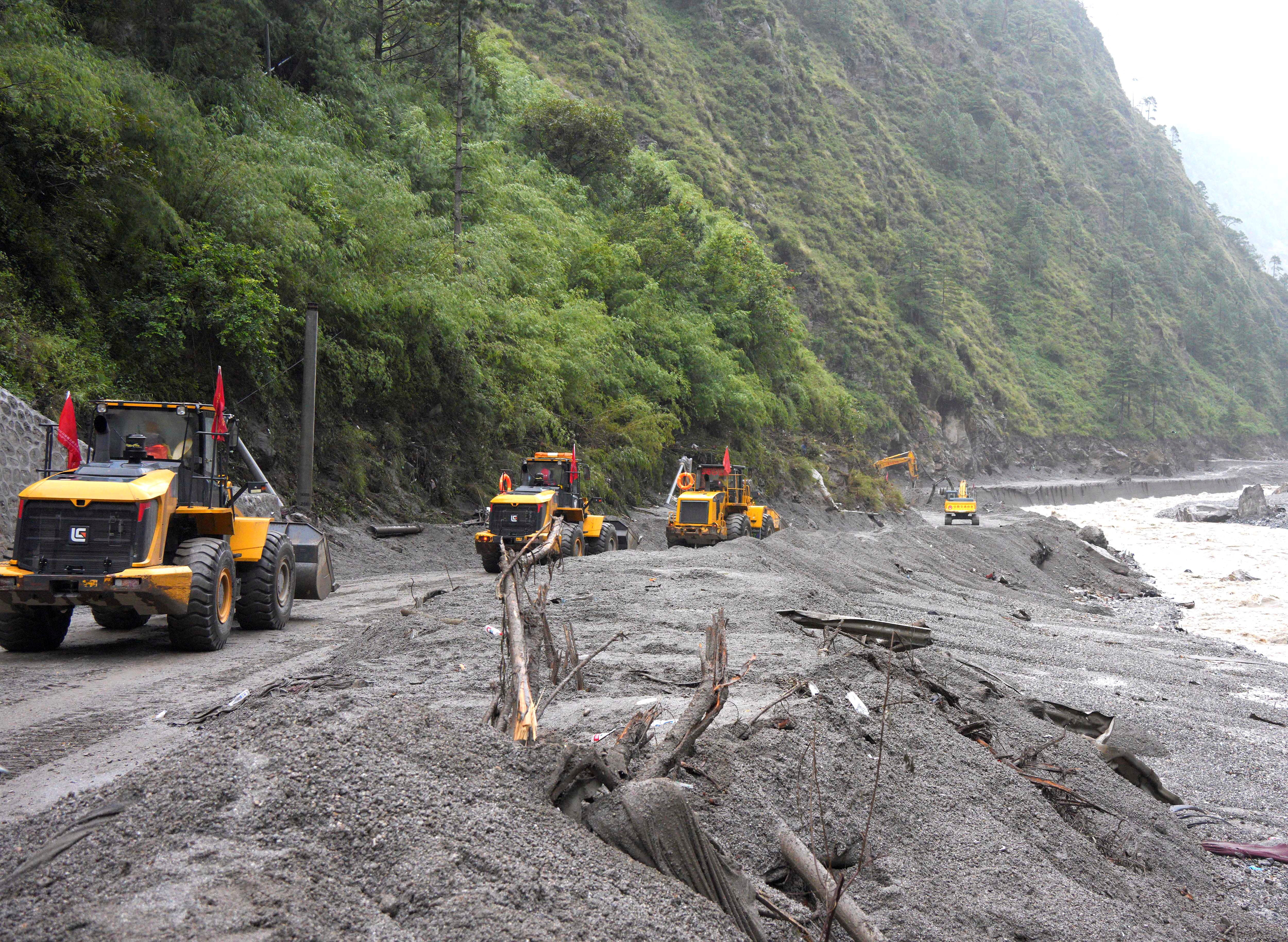
China paused a rescue operation on Friday due to the high risk of renewed flooding in Xizang Autonomous Region where hundreds remain missing after a deadly mudslide hit the border region with Nepal.
Broadcaster CCTV reported that a lake formed by immense piles of debris has begun overflowing towards the area that rescue teams were headed.
"So all rescue teams have been ordered to stand by in place and wait for further instructions," it said, adding that emergency teams which had earlier accessed the area "have been ordered to withdraw one kilometre".
CCTV reported earlier that the lake faces a "high risk of breaching and sending floodwaters downstream", state media reported, citing water authorities.
Water levels are expected to rise over the next three days, peaking around September 1, CCTV reported.
The lake formed after a wall of mud and debris hit the border hub of Gyirong in Xizang on Wednesday, with hundreds reported missing.
"According to forecasts, inflows into the lake could reach about three million cubic metres over the next three days amid continued rainfall, increasing the risk of a breach that could send floodwaters downstream and potentially cause further damage in areas including Gyirong Port and elsewhere downstream," Xinhua News Agency reported late on Thursday.
Rain is forecast in the area over the next three days.
Kathmandu's Flood Forecasting Division has also issued a "special notice", warning of a growing lake behind debris left by the landslide and urging extreme caution.
The latest development complicates rescuers' search on Friday for more than 1,400 people missing after a deadly deluge and landslides swept away entire villages along their remote Himalayan border.
The warnings came as rescuers evacuated 555 stranded tourists from the Chinese side of the border with Nepal in the wake of the devastating mudslide, CCTV reported.
Besides the 555, 499 locals had also been transported out of the disaster zone as of Friday morning. CCTV did not specify the tourists' nationalities.
Police in Nepal said the death toll has so far hit 469.
Emergency teams were racing to pluck survivors from affected zones, with China deploying satellites and drones to aid in the rescue efforts.
The China National Space Administration said on Thursday that immediately after the disaster, it coordinated and deployed satellite resources to conduct emergency imaging of the mudslide-hit area and retrieve historical imagery of the area.
And a large unmanned aerial vehicle, Wing Loong, equipped with high-definition cameras and mobile base stations from China's three major telecommunications operators and a satellite communication system to support emergency communications work, has arrived from Sichuan.
On the other side of the border, Nepali soldiers used sniffer dogs to search for bodies buried under the suffocating dirt.
Rescue personnel also used small UAVs in rescue operations and thermal imaging equipment to capture human heat-source signals.
Lila Pieters Yahia, the UN resident coordinator in Nepal, said Kathmandu had mobilised over 30,000 security personnel for search and rescue and that over 35 bridges have been destroyed and about 40 kilometres of road have been damaged.
“The government has established a relief fund and already the World Bank, India, China and the US have committed to pledge US$229 million to support,” she added.
The US Geological Survey said the disaster was caused by a glacial collapse that triggered a vast flow of icy debris. (Agencies)
_____________________________
Last updated: 2026-08-28 HKT 12:56
Edited by Aaron Tam
Rescue work stops amid fears mudslide lake may burst
2026-08-28 HKT 11:53
Share this story


