


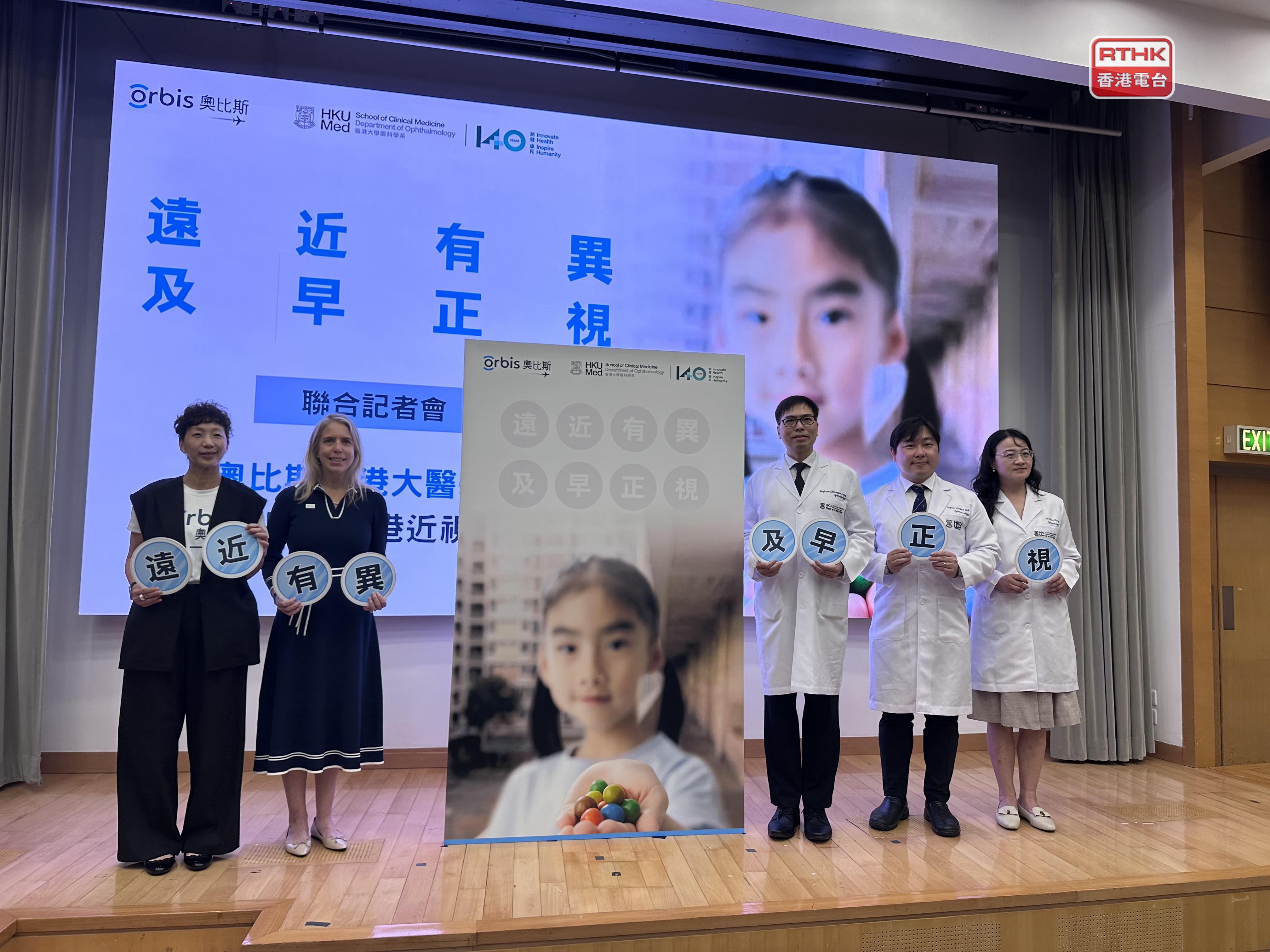
The non-profit organisation, Orbis International, and the University of Hong Kong’s Faculty of Medicine (HKUMed) have launched a joint initiative to combat the city's myopia crisis.
The partnership will offer 1,000 free paediatric eye exams and 1,000 adult myopia screenings, alongside a three-year clinical trial for advanced therapies.
Medical experts describe short-sightedness as a lifelong threat — a condition that takes root in primary school but, if left unmanaged, drastically raises the risk of irreversible blindness in adulthood.
A 2025 HKUMed study conducted at the HKU Eye Centre examined 501 children aged five to 12 and found that nearly eight in 20 children, or 39.7 percent, suffered from myopia.
Professor Christopher Leung, from the Department of Ophthalmology at HKUMed, said myopia development and progression actively happens during this age range.
“The length of the eyeball keeps growing during childhood. We are talking about when we were young, two or three years of age, typically we see hyperopia, but after three four years of age, the eyeball continues to grow and this is the time when myopia kicks in,” he said.
“In some cases, we even see a relatively high degree of myopia developing at the age of five or six years old. It's by the time when we reach about 15 or 16 years of age, the growth begins to retard and that's the time when the length of the eyeball becomes stabilised.”
To evaluate the long‑term impact, HKUMed researchers also analysed 4,217 adults aged 50 and older, revealing that 44.5 percent of older adults suffered from myopia, with 6.7 percent suffering from high myopia.
Experts caution that while glasses correct blurred distance vision, they do not reverse the excessive elongation of the eyeball or eliminate the risks of high myopia, including retinal disease, cataracts, and permanent sight loss.
In direct response, the organisations are rolling out these free services targeting 1,000 children and 1,000 high-risk older adults.
Alongside these immediate community services, the organisations are planning the Children Myopia Control Study in 2027, a three-year clinical trial that will evaluate 0.05 percent atropine eye drops, optical defocus spectacle lenses, and a combination of both therapies for children aged five to 12.
Ophthalmologists are calling on parents to prioritise annual professional eye examinations.
If myopia is detected, they urge families to seek professional advice and discuss evidence-based control options beyond standard prescriptions.
They also recommend that children get regular outdoor time, take regular breaks from close work, and maintain a comfortable reading distance.
Registration for the children's screenings is now open, with adult screening details to be announced soon.
Edited by Tony Sabine
Free screenings to tackle myopia crisis
2026-09-08 HKT 13:06
Share this story


HKU's Professor Christopher Leung speaks to Hailey Yip

