


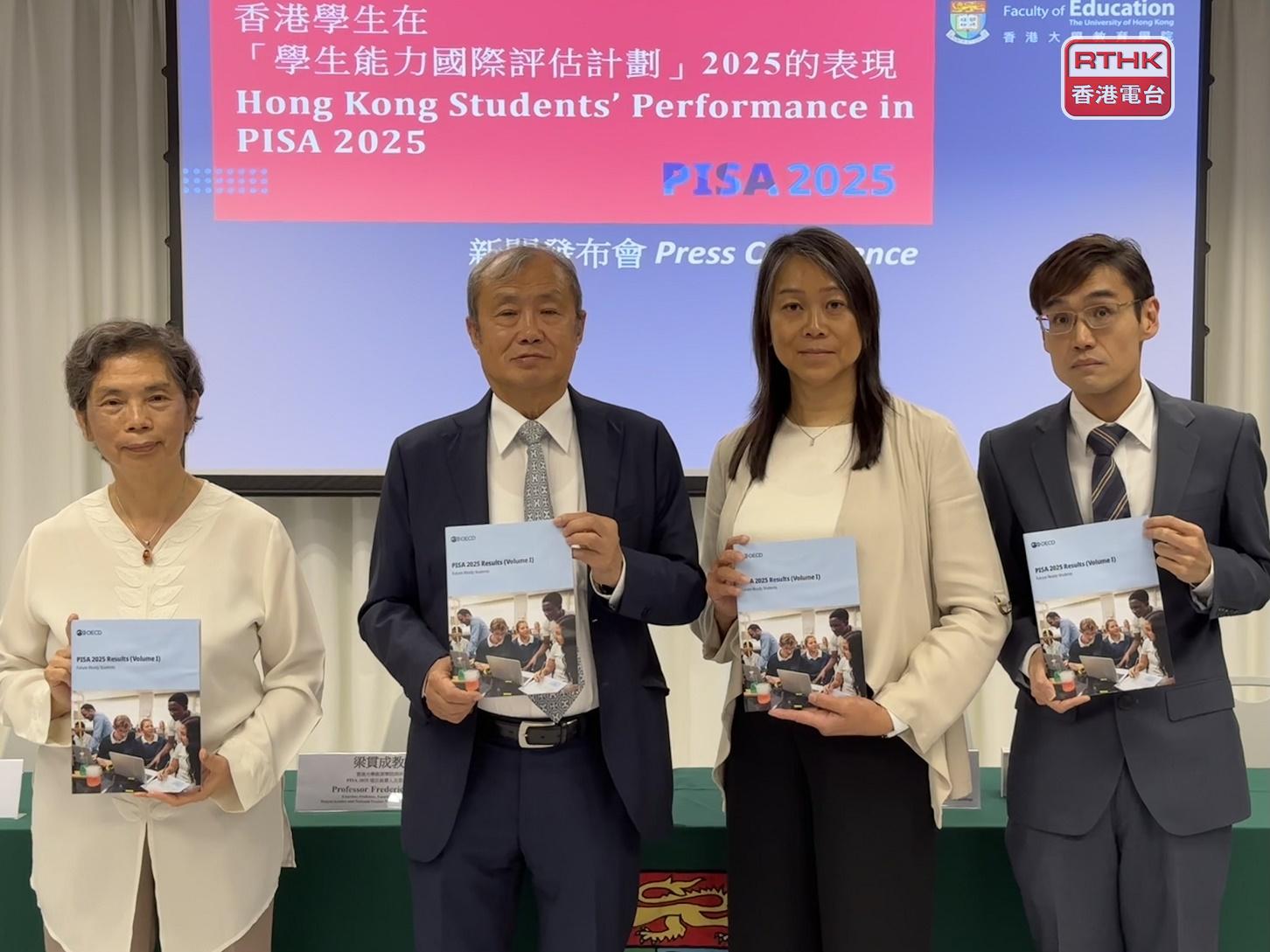
Hong Kong students performed very well when it comes to digital learning, according to a University of Hong Kong-led analysis of an international assessment results.
The assessment, Programme for International Student Assessment (PISA) 2025, was organised by the Organisation for Economic Co-operation and Development (OECD). It measured how well 15-year-olds around the world apply knowledge to real-world and unfamiliar situations.
A total of 6,445 students from 230 schools in Hong Kong were surveyed randomly.
The report showed that there is a higher proportion of top performers and lower proportion of low performers in Hong Kong compared with international average.
For PISA 2025, the innovative domain was "Learning in the Digital World" in which students in the SAR achieved a score of 545, higher than the international average of 500.
Researchers found that in the three core domains of mathematical, scientific and mother-tongue reading literacy, local students also performed better than their counterparts elsewhere.
Hong Kong students scored 522 in mathematical literacy compared with an international average of 463; they posted a score of 496 in scientific literacy, higher than 482 internationally; and mother-tongue reading literacy came in at 480 compared with a 461 international average.
But the scores posted by local students were lower than in the previous assessment in 2022.
"According to the OECD's report, the impact of Covid-19 on the learning stage of students participating in PISA 2025 during their critical developmental period is one of the factors contributing to the general decline in the overall performance of participating countries or economies," a spokesperson from the Education Bureau said.
"This phenomenon may be attributable to multiple factors and warrant our in-depth investigation.
"Among these are Hong Kong's positioning of PISA as an academic research project (distinct from systematic school-based learning assessments or public examinations), Hong Kong students' psychological state and concentration during the test, the test administration arrangements, and students' habits and attitudes towards using digital devices after school, all of which may also have affected their performance in PISA."
Frederick Leung, Emeritus Professor from the Faculty of Education of the University of Hong Kong and the project leader and national project manager of PISA 2025, said the decline is not happening only in Hong Kong but internationally, and that AI was not a leading factor.
He also said PISA will strengthen its emphasis on AI-related literacy moving forward, adding that students will need to incorporate digital and AI tools into their learning.
Edited by Edmond Fong
'HK students very strong in digital learning'
2026-09-08 HKT 20:11
Share this story


HKU's Frederick Leung speaks to Henry Siu

